Replica collection · Planet Ocean · Dive chronograph with date
Omega Seamaster Planet Ocean 600M chronograph ref. 215.20.46.51.03.001, blue dial, 45.5 mm steel and gold
Model reference: 215.20.46.51.03.001
Price by inquiryconfirmed in the chat, with shipping and lead time
Model size45.5 mm
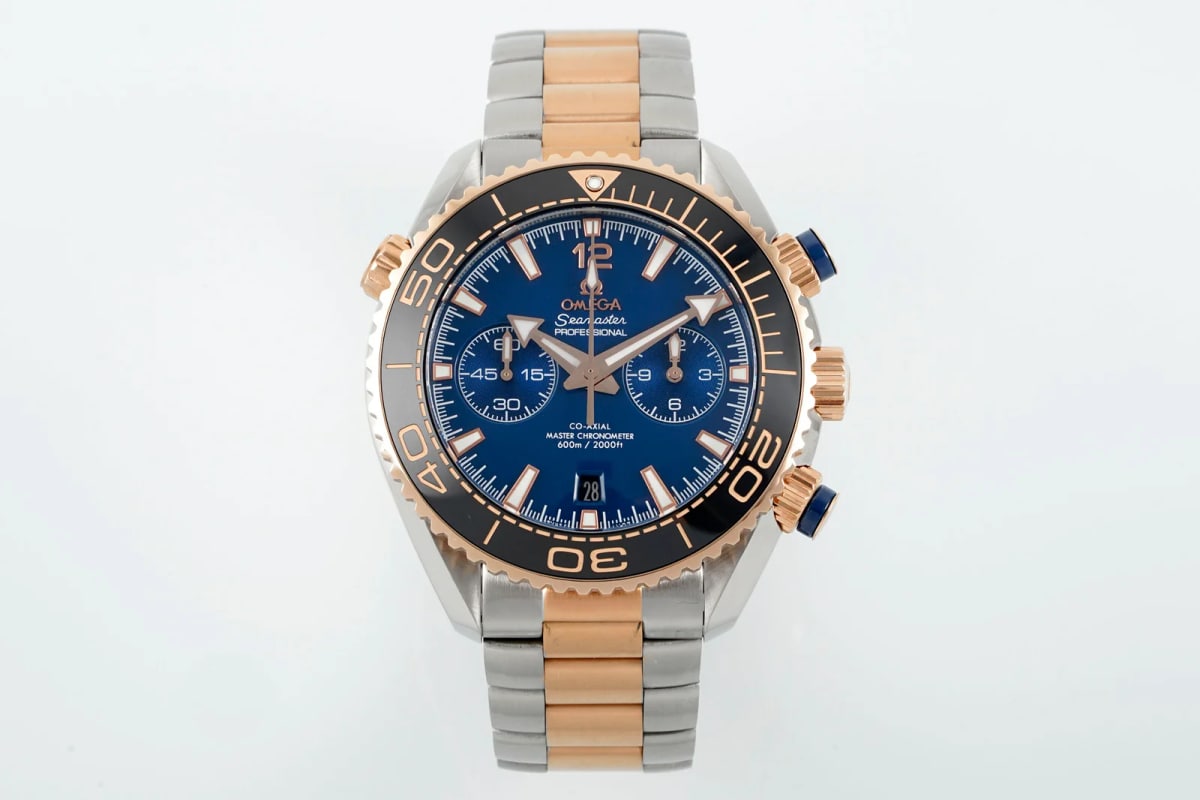
DialBlue ceramic, reading with a fan of lighter blue where the light crosses it
Dial printBrand and Seamaster Professional above the centre; CO-AXIAL, MASTER CHRONOMETER and 600m / 2000ft printed below it
Hour-marker layoutOne marker at each hour, trapezoid in shape with two flanking the date at six, and the numeral 12 standing alone at the top
Omega Seamaster Planet Ocean 600M chronograph 215.20.46.51.03.001, a 45.5 mm two-tone dive chronograph with a blue ceramic dial, the date pressed down to six and a gold-toned diving scale on the bezel.
Opens a WhatsApp chat with the model, the reference and this page already written into the message.
Nothing is sent until you press send. Prefer to write it yourself? Use the inquiry box further down.
About this watch
Design and details
Reference 215.20.46.51.03.001 is the Seamaster Planet Ocean 600M chronograph in 45.5 mm, published by Omega as a steel and 18-carat Sedna gold dive watch with a blue ceramic dial and a blue ceramic bezel insert carrying a gold-toned diving scale. The same published data gives 18.87 mm of thickness, 52.30 mm from lug to lug, 22 mm between the lugs, a weight of about 267 g on the bracelet, 60 bar of depth rating with a helium escape valve, an alveol screw-in case back and a Master Chronometer calibre 9900 with 60 hours of power reserve behind a transparent back.
The four frames below are shown as they arrived. They settle the colour and the print of the dial, where the date sits, what the two counters carry around them, how the bezel scale reads, which parts of the case and bracelet read gold-toned against the steel, and what is visible through the case back.
They cannot settle which movement is fitted to the watch you would be offered, what each part is actually made of, which bracelet and clasp would come with it, how much it weighs as put on a scale, or the state of its water resistance. Those belong in the message rather than in the copy.
How big is the 45.5 mm Planet Ocean chronograph on the wrist?
The case measures 45.5 mm across, and the published data for the reference puts it at 18.87 mm thick and 52.30 mm from lug to lug, with 22 mm between the lugs and roughly 267 g on the bracelet. Diameter is the headline figure, but on a watch this tall the two numbers you actually feel are the lug-to-lug span and the thickness, because they decide whether the case sits flat on the wrist or stands proud of it.
The height comes from the chronograph works, the depth-rated case and the movement, so there is nothing padded about it. Measure your wrist flat and compare that against 52.30 mm rather than against 45.5 mm, and if you are close to the limit ask for the offered watch to be photographed on a wrist with a ruler in the same frame. The published figures describe the design; the individual piece should still be measured for you.
Where is the date on this reference, and what do the two counters carry?
The date sits at six o'clock in a small square aperture low on the dial, and the two counters stand either side of it above the centre. The left counter carries the numerals 15, 30 and 45 around a slim hand; the right counter carries 3, 6, 9 and 12 around a short recorder hand. The published description of the reference lists a small seconds sub-dial alongside the 60-minute and 12-hour chronograph recorders, which is why the printed scales inside the counters are the part of this dial worth reading closely.
Pressing the date down to six is what frees the space at nine and three for the recorders: on a chronograph with two counters and printed scales, a window at three would have had to sit in the middle of one of them. Ask for the counters to be photographed once with the chronograph stopped and again with it running, so you can see where each hand rests at zero and whether it returns to the same place when it is reset.
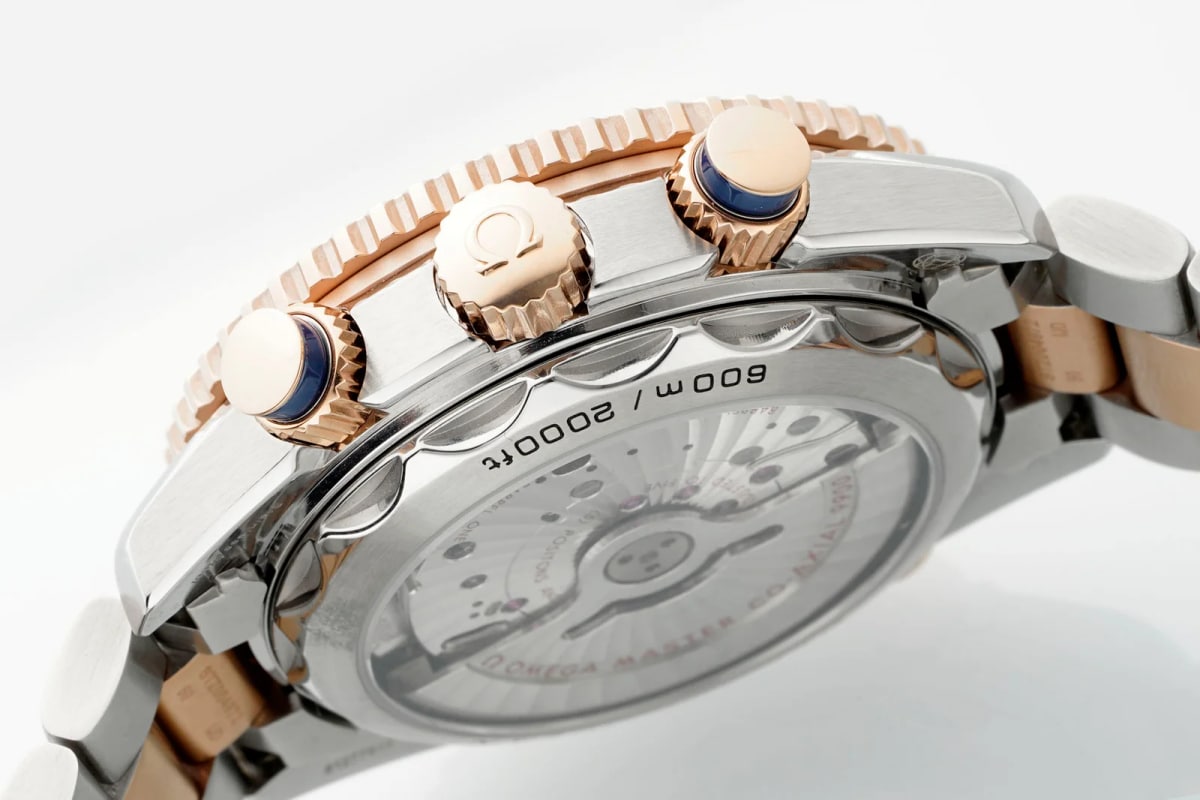
Case back detail with the transparent window showing a round gold-toned element across the centre, engraved lettering around the rim, the scalloped edge and the bracelet folded out to the right
Which parts of this watch are gold-toned, and which are steel?
The published configuration for 215.20.46.51.03.001 is a 45.5 mm case in steel with 18-carat Sedna gold, so the case body and the outer links of the bracelet are steel while the gold is carried by the bezel rim, the crown, the pushers and the centre links of the bracelet. In other words the gold sits on the parts the hand touches and on the rim around the dial, rather than on the body of the watch.
That is how the frames read when the watch is turned. Straight on, the case flank and the outer links come out pale while a band of gold runs down the middle of the bracelet; in the three-quarter view the same tone shows on the bezel edge, the crown and both pushers. What no photograph can settle is the composition of the metal on the piece being offered, or how much gold sits in each element, so ask for the materials to be confirmed part by part for the specific watch.
What does the bezel scale on this Planet Ocean show?
The bezel is a unidirectional rotating dive scale with a blue ceramic insert, and the gold-toned scale within it is named as Ceragold in the published data. The numerals 20, 30, 40 and 50 are the ones legible in the frames, set on a scale built from numerals and fine divisions, with a single luminous pip at the top of the insert to line the scale up with the minutes hand.
A dive scale is set once at the start of a dive and then has to hold its position, so the action of the bezel matters as much as the print on it: how it clicks round, how much play there is before it moves, and where it stops. A still frame shows none of that, and it also says nothing about how the joint between insert and case is sealing on this particular watch. Ask for the bezel to be turned a full circle on video and for the pip to be shown lined up with the marker at the crown.
What does the printing on the dial below the hands say?
Below the centre the dial carries three printed lines in white: the first names the escapement as CO-AXIAL, the second names the MASTER CHRONOMETER standard, and the third gives the depth rating as 600m / 2000ft. Above the centre the dial carries the brand and Seamaster Professional, and the numeral 12 stands alone at the top with markers at every other hour.
The depth figure in that print belongs to the reference: 60 bar, or 600 m, with a helium escape valve, according to the published data for this configuration. It describes what the design is built to withstand and not what has been done to the watch in front of you. If the piece is going to be worn in water, the condition of the seals and the history of the case back are questions to put to the seller rather than lines to read off the dial.
What does the case back show, and what can it not tell you?
The last frame turns the watch over. The back is transparent, so the movement is visible through the glazing with the winding weight lying across the centre and a gold-toned element set into that weight, and the ring around the glazing carries engraved lettering that includes the 600m / 2000ft marking. The published data describes an alveol screw-in case back, and the scalloped notch pattern along the edge in that frame is the feature the term refers to.
A display back shows shapes rather than state. You can see that a winding weight sits over the movement, but not which calibre is fitted to the watch you would receive, how it is running, or when the case was last opened. Ask for the movement to be shown running with the chronograph started, and for the case back to be photographed square on so the engraving around the rim can be read from edge to edge.
Specification
Specifications and configuration
Model details and design
Detail
Description
Model reference
215.20.46.51.03.001
Model size
45.5 mm
Dial
Blue ceramic, reading with a fan of lighter blue where the light crosses it
Dial print
Brand and Seamaster Professional above the centre; CO-AXIAL, MASTER CHRONOMETER and 600m / 2000ft printed below it
Hour-marker layout
One marker at each hour, trapezoid in shape with two flanking the date at six, and the numeral 12 standing alone at the top
Hour markers
Applied markers with gold-toned frames around pale filled centres
Hand arrangement
Broad hour and minute hands with arrow tips and pale fill, a slim centre seconds hand, and a short hand in each counter
Date display
Square aperture at six o'clock showing two digits, below the CO-AXIAL print
Subdial layout
Two counters either side of the centre: the left printed 15, 30 and 45, the right printed 3, 6, 9 and 12; the published description lists a small seconds sub-dial with the 60-minute and 12-hour recorders
Bezel design
Unidirectional rotating dive bezel with a blue ceramic insert, the gold-toned scale named as Ceragold in the published data
Bezel graduations
Gold-toned numerals with fine divisions between them and a luminous pip at the top of the insert; 20, 30, 40 and 50 are legible in the frames
Colour combination
Blue dial, dark blue bezel insert with a gold-toned scale, steel-toned case with gold-toned rim, crown and pushers
Bracelet shown
Three-part bracelet with gold-toned centre links and pale outer links, running from the lugs in the frames
Bracelet (reference supply)
Steel and Sedna gold bracelet per the published configuration for this reference
Clasp (reference supply)
Extendable foldover clasp per the published configuration; not visible in the frames
Crown and pushers
Gold-toned crown between two gold-toned pushers on the right flank, each with a dark blue band, shown in the case back frame
Case thickness
18.87 mm per the published data for this reference
Lug to lug
52.30 mm per the published data for this reference
Lug width
22 mm between the lugs per the published data for this reference
Weight (reference data)
About 267 g on the bracelet per the published data for this reference
Water resistance (reference data)
60 bar, or 600 m, with a helium escape valve per the published data for this reference
Movement (reference design)
Master Chronometer calibre 9900, self-winding, 60-hour power reserve, Co-Axial escapement, column wheel and a time-zone function
Case back
Transparent back over the movement with engraved 600m / 2000ft lettering around the rim, and the scalloped alveol notch pattern along the edge in the frames
Questions
Frequently asked about this reference
How does the 45.5 mm Planet Ocean chronograph compare with a smaller dive watch on the wrist?
At 45.5 mm across, 18.87 mm thick and 52.30 mm from lug to lug, it is a large watch by any measure, and the published weight of about 267 g on the bracelet puts most of that mass on top of the wrist. The figure to hold up against your own wrist is the lug-to-lug span, because that is what decides whether the lugs finish inside the wrist or hang past its edge. Ask for the offered watch to be measured again and photographed on a wrist with a ruler in frame.
Which movement does this reference use, and what does it offer?
The published configuration lists the Master Chronometer calibre 9900, a self-winding chronograph with 60 hours of power reserve and a Co-Axial escapement, and the movement description names a column wheel and a time-zone function. The time-zone function is what the extra crown position is there for. Which movement is fitted to the watch you are offered, and how it is running, has to come from the seller with evidence rather than from the reference data.
What does the 600 m depth rating cover on this watch?
The reference data gives 60 bar, or 600 m, with a helium escape valve, and the dial itself carries the 600m / 2000ft marking. That figure describes what the design is built to withstand rather than the state of the particular watch: seals and gaskets are only as good as their last service, and nothing in a photograph shows when that was. If you plan to wear it in water, ask what the water-resistance position of this piece is and whether anything accompanies it.
What bracelet and clasp does this reference come on?
The published configuration is a steel and Sedna gold bracelet with an extendable foldover clasp, and the frames show a three-part bracelet in which the centre links read gold-toned and the outer links pale. Two things follow from that. Ask which bracelet and which clasp come with the offered watch, and ask how many links are fitted and whether spare links are included, because an extendable foldover clasp is a specific part rather than a general description.
Why is the date at six o'clock on this chronograph?
Two counters take the space at nine and at three, so the date is pressed down to six instead of being cut in at the usual position. That keeps the dial symmetrical either side of the vertical line through the centre and leaves both counters free for the printed scales that identify the chronograph recorders. On a chronograph, ask how the date steps and whether it changes cleanly when the hands are moved forward quickly, since that is a common place for a problem to show itself.
What should I ask to see before deciding on this watch?
Ask for a short video of the chronograph running, with the centre seconds sweeping and the counters advancing, then a clear close-up of the dial in daylight, the case back square on, and the bracelet laid out flat with the clasp open and again closed. Those answer the questions a still frame cannot: whether the hands return to zero, whether the date steps over, and how the links and clasp look on the inside. Then ask for the movement fitted, the materials of each part and everything supplied, all confirmed for the specific watch being offered.
Inquiry message
The message below is pre-written with the model, the reference and this page. The button opens a WhatsApp draft for you to review before sending.
Which bracelet and clasp come with this piece, how many links are fitted, and whether it is the extendable foldover clasp.
What each part of the watch is made of: the case body, the bezel rim and insert, the crown, the pushers and the centre links of the bracelet.
The movement actually fitted to the offered watch, and what evidence of its rate and running accompanies it.
Current price for one watch, the shipping cost to my country, the countries you ship to and the lead time.
Photographs or a short video of the chronograph running with the counters advancing, plus a daylight dial shot and the case back square on.