Explore the collection · Ask about your preferred configuration Inquiries: WhatsApp +86 199 7086 3830 · How ordering works

Series

Black Bay Chrono

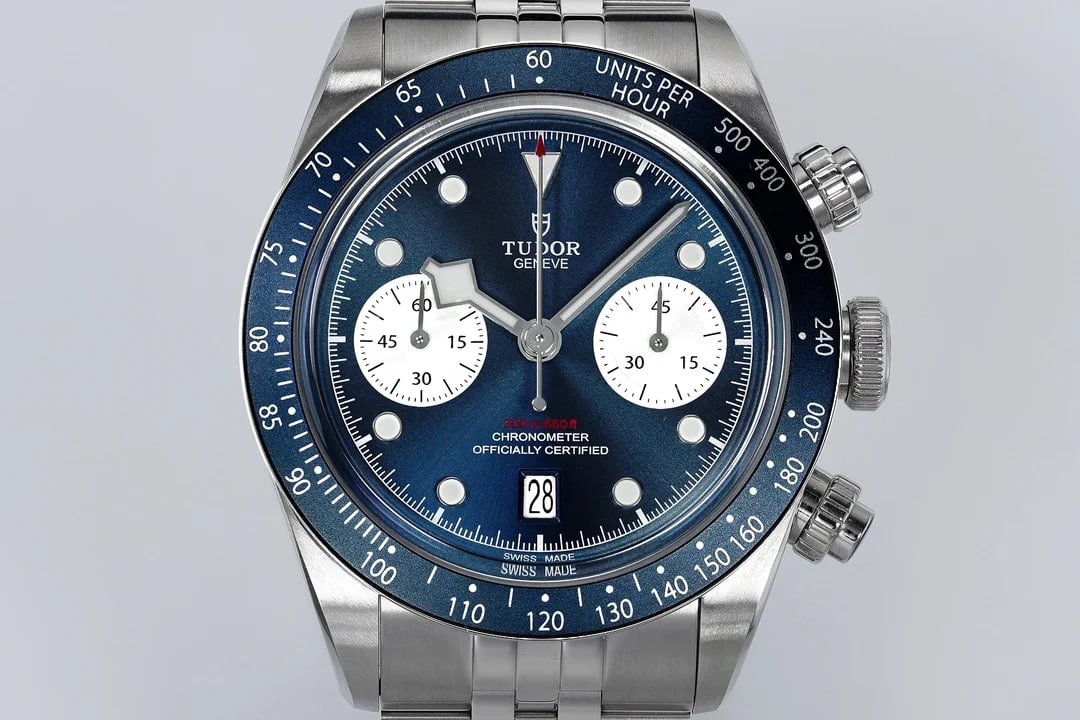
The Black Bay Chrono keeps the Black Bay case and turns it into a chronograph: a crown with a pusher above and below it, two counters sunk into the dial, and a tachymetric scale printed around a bezel that does not turn. The reference in this collection is the blue-dial steel version on the five-row bracelet, with silver counters reading pale against the darker blue dial and the date in a window at six o’clock. The frames on the watch page show the layout straight on, the bezel markings at an angle, the printed block below the centre, and the back of the case.

Blue sunburst dial straight on with two silver counters either side of the centre, applied round markers, the date window at six, a blue tachymetric bezel and the five-row steel bracelet below
  • Bezel Fixed, with an anodised insert carrying a tachymetric scale in pale markings, so elapsed time is read against a printed scale rather than a turning rim.
  • Dial Blue with a sunburst finish and two silver counters, one on each side of the centre, with a date window at six o’clock.
  • Counters The left counter is calibrated for a full hour and the right one runs on into hours, with the centre hand started and stopped by the upper pusher.
  • Bracelet shown Five-row steel bracelet in the frames; the reference is published with a three-link or a five-row alternative, each with its own adjustment clasp.

In this collection

One Black Bay Chrono configuration

The Tudor brand page

This collection lists a small number of configurations. Series not shown here can still be discussed — send the model and reference and availability is checked for you.

Design notes

What defines the Black Bay Chrono

Colour does the work on this dial

A chronograph dial has to keep three things apart: the time, the elapsed seconds and the elapsed minutes or hours. On the blue version of this reference that separation is carried by colour rather than by position — the counters are silver discs on a blue field, so the eye finds them first and the hands read against them. On the black-dial version of the same watch the relationship reverses, which is why the two are worth looking at side by side before choosing.

The date sits where nothing else does

The window at six o’clock is the one position on this layout that no counter occupies, which is why the date ended up there rather than at three. It also means the symmetry of the two counters survives: nothing is cut into the silver discs, and the small block of print that carries the model information sits above or below the centre where it interferes with nothing. Whether that is the arrangement you want is a question about how you read a chronograph, not about which is more correct.

These notes describe the design as it appears in the photographs on this site. Movement, water resistance, weight and material composition are not stated here, because those belong to the specific unit being offered and are confirmed in the conversation before anything is paid.

Compare

Other series and guides

Other Tudor series here

Guides that cover this choice