Price by inquiryconfirmed in the chat, with shipping and lead time
Model size40 mm
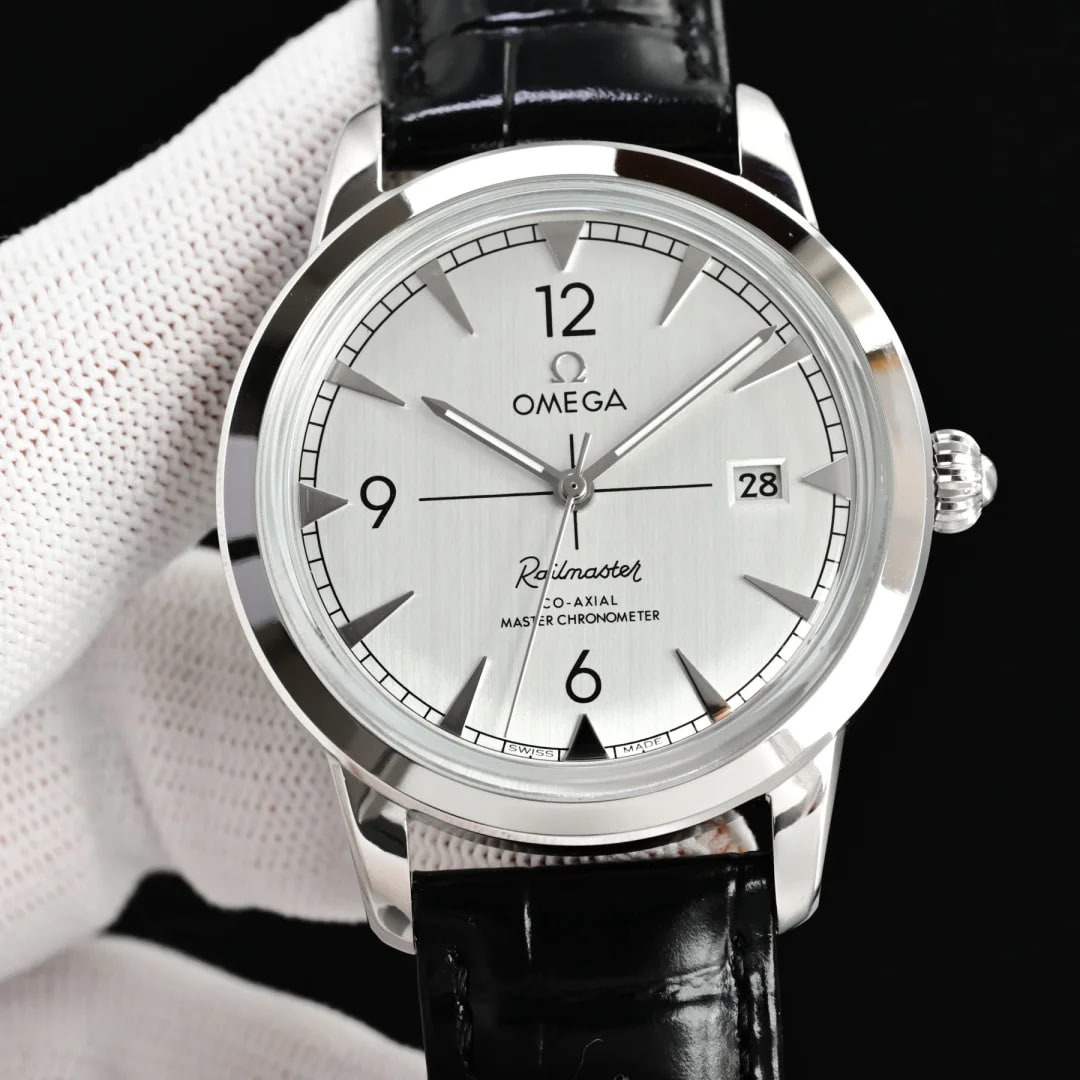
DialVertically brushed grey; it reads pale in the frames where the light falls on it
Dial printBrand name and script Railmaster line name above the centre with the two-line Master Chronometer wording beneath; Omega publishes the Railmaster indication as transferred beige
Bezel designNone: a fixed polished rim, with no rotating bezel and no tachymeter scale
Reference 220.10.40.20.06.001: the Railmaster, a 40 mm field watch with a vertically brushed grey dial, a date at three, printed crossings behind the hands and no rotating bezel, shown in the frames on a black leather strap.
Opens a WhatsApp chat with the model, the reference and this page already written into the message.
Nothing is sent until you press send. Prefer to write it yourself? Use the inquiry box further down.
About this watch
Design and details
The Railmaster is the field watch in Omega’s Seamaster line, and reference 220.10.40.20.06.001 is the 40 mm steel version with a vertically brushed grey dial and a date at three. Omega’s own data for the reference gives a symmetrical 40 mm case, 12.65 mm of thickness, 47.00 mm from lug to lug and 20 mm between the lugs, a case back with a wave-edged design, a dial with brushed hands and recessed hour-markers filled with vintage-toned luminous material, a transferred beige Railmaster indication, the Co-Axial Master Chronometer calibre 8806 with 55 hours of power reserve, a published 15 bar for water, and resistance to magnetic fields reaching 15,000 gauss.
The four frames on this page are shown as they arrived, and together they cover the dial straight on, the case and strap from an angle, the dial close up and the case back. One thing is worth settling before they are read: the dial is a vertically brushed grey surface, and it reads pale in these frames where the light falls on it, so it can look close to silver in a photograph without being silver. What the frames cannot settle — the movement fitted, the metal of each part, the strap or bracelet supplied, the weight, and the water-resistance state of this particular watch — is asked for in the WhatsApp conversation, and the list at the end of the page sets it out.
Is the Railmaster a dive watch or a field watch?
It is a field watch wearing a Seamaster case: the Railmaster has no rotating bezel, no tachymeter scale and no crown guards, and the crossing lines printed behind the hands refer to railway-track markings rather than to a timing scale. Take the bezel away and the dial stops being a tool — nothing on it is there to be turned, timed against or aligned with anything.
That is the practical difference between this reference and a Seamaster diver that shares the family name. A diver is organised around a bezel and a depth rating; the Railmaster is organised around a dial that reads at a glance and a case that passes under a cuff, which is why the published 40 mm by 12.65 mm by 47.00 mm shape of the reference matters more to a buyer than the Seamaster badge on it. What those published figures say about the particular watch on offer is a separate question, and the frames on this page are what it should be checked against.
What does 15,000 gauss actually do for the watch?
It is a magnetic-field figure rather than a depth figure, and it is the specification this reference was built around. Omega publishes 15,000 gauss for the calibre in place, a number far beyond anything a home or an office produces, so the point of the design is that the ordinary magnetic objects around a wrist are not expected to disturb it.
In use the question is narrower and more useful than the headline figure. The real test for a Railmaster is not only whether the watch keeps time but whether it still keeps time after sitting beside a phone, a speaker or a magnetic bag clasp, and that is a property of the individual movement fitted rather than of the case around it. Timing figures taken before and after that kind of exposure are the evidence that answers it, which is why they sit on the inquiry list at the end of this page.
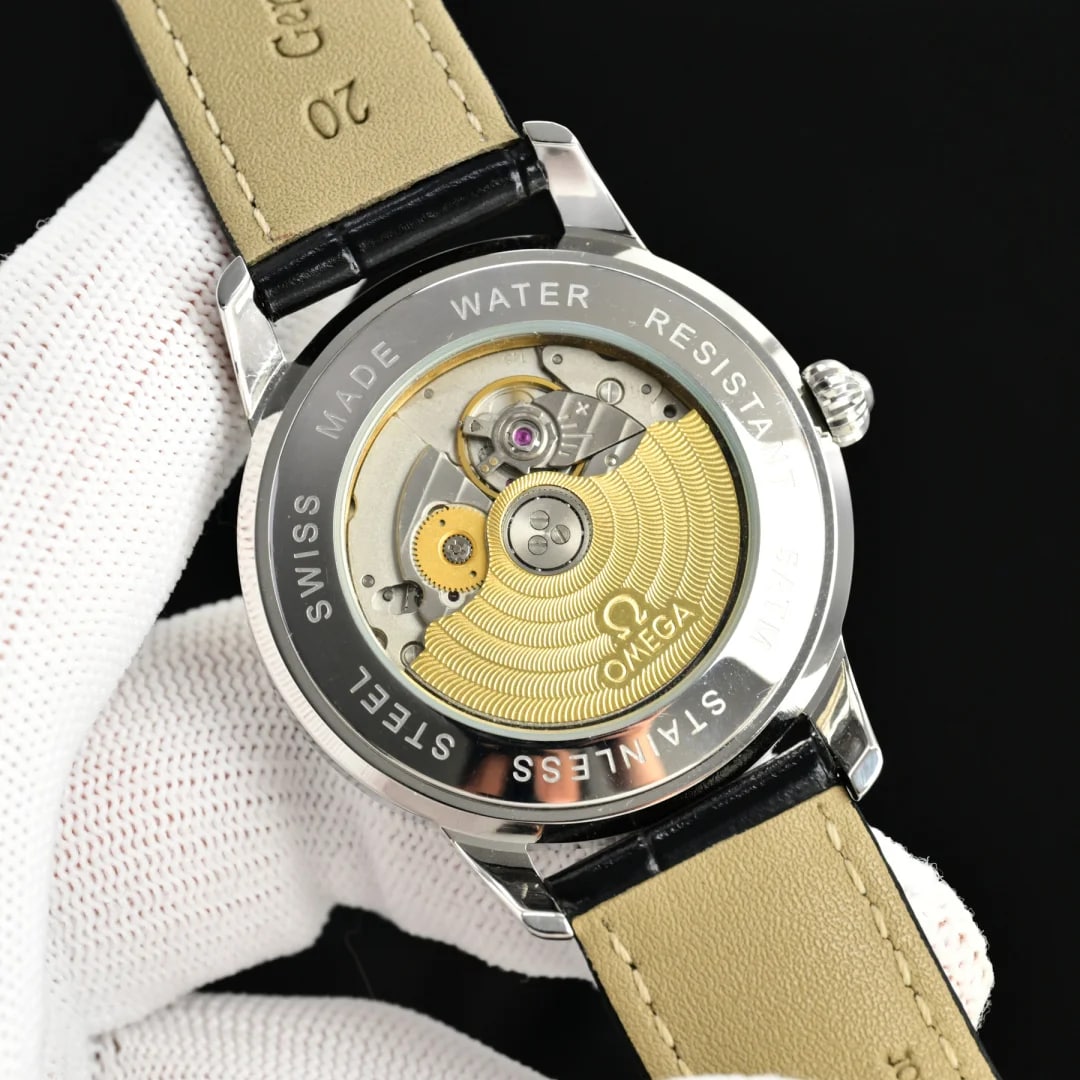
Case back detail with the watch turned over in a gloved hand: the transparent back framed by a ring of engraved lettering, parts visible through it in striped and polished finishes, and the black strap folded behind with its pale tan lining facing the camera
Why does the dial look silver when it is a grey dial?
Because it is a vertically brushed grey surface, and a brushed surface throws light back at whatever stands in front of it. In these frames the dial reads pale where the light lands on it and turns deeper grey as it angles away, which is exactly how a brushed grey panel can look almost colourless in one photograph and plainly grey in the next.
The brush direction is the giveaway worth checking: the strokes run across the dial, they change character at the top and at the bottom under the same light, and the black print sits on top of them. That print does the legibility work here — the brand name and line name above the centre, the two-line Master Chronometer wording beneath them, black numerals at twelve, nine and six, the printed crossings behind the hands, and the date at three.
Which strap or bracelet is supplied with this reference?
Those are two separate facts and this page keeps them apart. In the frames the watch is on a black leather strap of the textured, stitched-edge kind; Omega’s catalogue pairs reference 220.10.40.20.06.001 with a fully brushed integrated steel bracelet and a butterfly clasp.
So the strap in the photographs is evidence of what was photographed rather than of what will be handed over. If the bracelet matters to you — and on an anti-magnetic watch a steel bracelet changes both the weight on the wrist and the way the case carries — ask which of the two comes with the piece and how the clasp or buckle looks from both sides. A pair of photographs of the supplied strap or bracelet settles that faster than any description of it.
How does a 40 mm Railmaster wear on the wrist?
The published figures are 40 mm across, 12.65 mm thick, 47.00 mm from lug to lug and 20 mm between the lugs, with a total weight of about 149 g for the reference. Diameter alone is the least informative of those numbers, because it says nothing about where the case ends relative to the edge of the wrist.
Compare it with a watch you already wear, measured the same way rather than recalled from a spec sheet: two watches can share a 40 mm diameter and sit quite differently, and 47.00 mm from lug to lug is the figure that decides it, while 12.65 mm of thickness is thin enough for a cuff to pass over. Note as well that the weight above is stated for the reference on its bracelet, so the strap shown in the frames will not weigh the same.
What can the four frames on this page not tell you?
A frame records the outside of a watch in one light and stops there. None of these four shows which movement is fitted, what each part is actually made from, the weight of this watch as it would stand on a scale, or whether it still performs to the published 15 bar for water.
Two of those are questions about state rather than specification, and both belong to the individual watch: water resistance after its own history of use, and magnetic behaviour after its own exposure. The magnetic one is the question to press hardest on a Railmaster, since it is the whole reason the reference exists. Everything the frames cannot answer, and the WhatsApp conversation can, is grouped at the end of the page.
Specification
Specifications and configuration
Model details and design
Detail
Description
Model reference
220.10.40.20.06.001
Model size
40 mm
Dial
Vertically brushed grey; it reads pale in the frames where the light falls on it
Dial print
Brand name and script Railmaster line name above the centre with the two-line Master Chronometer wording beneath; Omega publishes the Railmaster indication as transferred beige
Bezel design
None: a fixed polished rim, with no rotating bezel and no tachymeter scale
Bezel graduations
None; every scale on this watch is printed on the dial rather than set into a bezel
Hour-marker layout
Numerals at twelve, nine and six, with arrow-shaped markers between them
Hour markers
Applied arrow-shaped markers with a recessed fill, plus printed numerals at twelve, nine and six
Hand arrangement
Three centre hands: hour and minute hands with a pale fill, and a slim centre seconds hand
Date display
Aperture at three o’clock showing two digits, with no magnifier over it
Subdial layout
None; the dial carries printed crossing lines instead of any subdial or scale
Colour combination
Pale brushed grey dial, black print and black numerals, steel hands and markers, and a black strap in the frames
Strap shown
Black leather strap with a textured surface and stitched edges, as shown in the frames
Strap (reference supply)
Omega catalogues a fully brushed integrated steel bracelet with a butterfly clasp for this reference
Movement (reference design)
Co-Axial Master Chronometer calibre 8806 with 55 hours of power reserve, published for the reference
Case back
Naiad Lock oriented back with a wave-edged design; an opening in the back is visible in the frames
Case thickness
12.65 mm, published for the reference
Lug to lug
47.00 mm, published for the reference
Lug width
20 mm between the lugs, published for the reference
Magnetic-field figure
15,000 gauss, published for the calibre
Water resistance (published)
15 bar (150 m) for the reference; what the individual watch still tolerates is a separate question
Questions
Frequently asked about this reference
Is the Railmaster the same as a Seamaster dive watch?
No. It carries the Seamaster name and a Seamaster case, but it has no rotating bezel, no tachymeter scale and no crown guards, and the crossings printed on the dial are railway-track markings rather than a timing scale. It is a field watch by layout in a diver’s case by construction.
What does the 15,000 gauss figure mean day to day?
It means the ordinary magnetic objects around a wrist are not expected to disturb the watch, since Omega publishes 15,000 gauss for the calibre in place. Because that is a design figure, the useful question about a particular watch is whether it still keeps time after sitting beside a phone, a speaker or a magnetic clasp.
Why does the dial look nearly silver in some frames?
It is a vertically brushed grey dial, and a brushed surface reflects light unevenly, so it reads pale where the light hits it and grey where the surface turns away. The brush strokes and the black print are the steady features to study rather than the overall tone of one photograph.
Which strap comes with the watch?
The frames show a black leather strap, while Omega’s catalogue pairs this reference with a fully brushed integrated steel bracelet and a butterfly clasp. Which of the two is supplied with the piece being offered has to be confirmed in the conversation rather than read off a picture.
Is 47 mm from lug to lug too long for a 16 cm wrist?
That cannot be answered from the diameter or the wrist measurement alone, because how a watch sits depends on how flat the wrist is and where the lugs finish. At 47.00 mm from lug to lug and 12.65 mm thick on the published figures, a photograph of the watch on a measured wrist is the comparison worth asking for.
What should be in writing before paying?
The reference number, the movement fitted, the metal of the case, the strap or bracelet supplied and photographs of that specific watch. Then the commercial terms: the price for one watch, the shipping cost to your country, the countries shipped to and the lead time.
Inquiry message
The message below is pre-written with the model, the reference and this page. The button opens a WhatsApp draft for you to review before sending.
Whether the watch is supplied on the black leather strap shown in the frames or on the catalogued bracelet, what the clasp or buckle is made from, and what the case of the offered watch is actually made from.
Which movement is fitted in the piece you are offering, and what the back of its case is marked with.
Photographs of the dial straight on in daylight, the case flank at a raking angle, and the supplied strap or bracelet from both sides.
How the movement in the offered watch has behaved after sitting beside a phone, a speaker or a magnetic clasp, and any timing figures taken before and after that exposure.
Current price for one watch, the shipping cost to my country, the countries you ship to and the lead time.