Replica collection · Santos Galbée · Dress watch with a date aperture (published reference design)
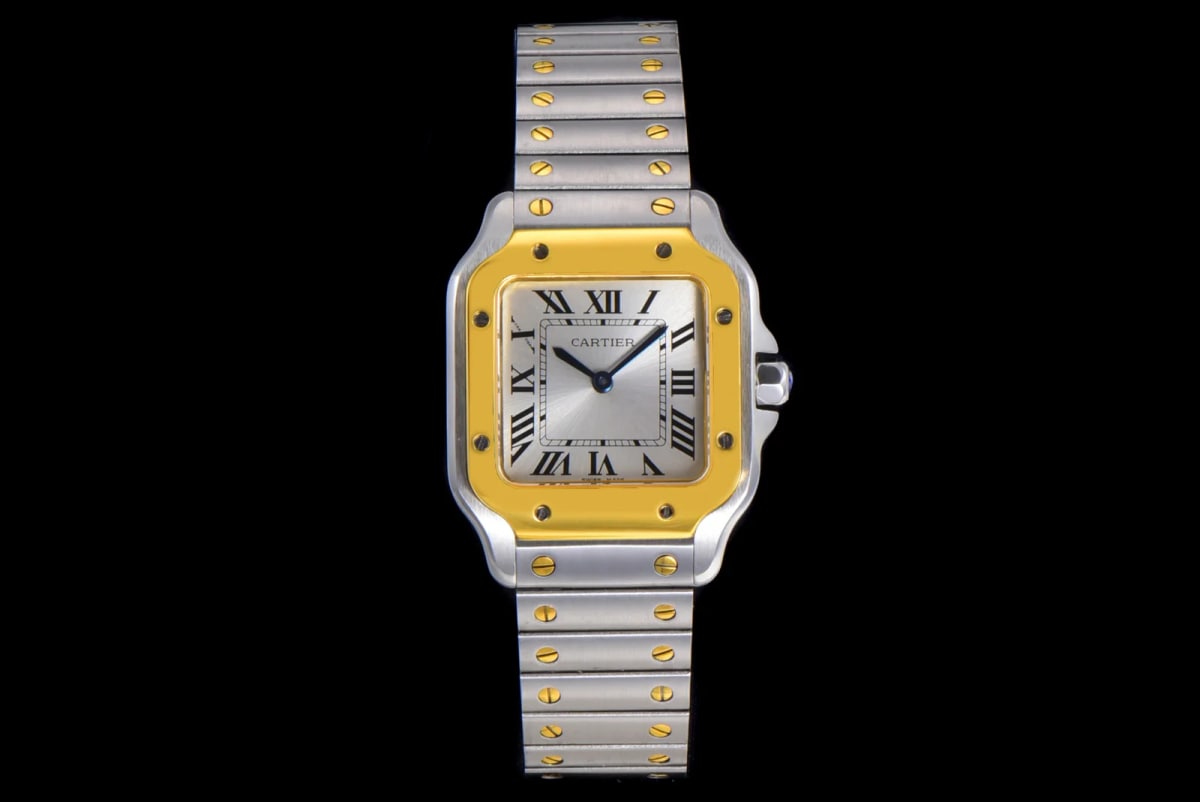
Cartier Santos Galbée ref. 1566, the square 29 mm case with a gold-toned bezel and eight screws, shown on a pale silvered Roman-numeral dial
Model reference: 1566
Price by inquiryconfirmed in the chat, with shipping and lead time
Model size29 mm across the case
DialPale silvered, with a fine spun grain running from the centre; black Roman numerals and blue hands
Dial printCARTIER above the centre, with small printed lettering along the bottom edge of the dial
Bezel designGold-toned band standing slightly proud of the case, held by eight screws set into the bezel
Cartier's Santos Galbée ref. 1566 as the frames show it: a bowed square case with a gold-toned bezel held by eight screws, a pale silvered Roman-numeral dial and a bracelet whose rows carry gold-toned screw heads.
Opens a WhatsApp chat with the model, the reference and this page already written into the message.
Nothing is sent until you press send. Prefer to write it yourself? Use the inquiry box further down.
About this watch
Design and details
Four frames of the same watch are below. Straight on, the whole piece is in view: a square case whose sides bow outward, a gold-toned bezel standing slightly proud of it with eight screws set into the bezel, a pale silvered dial carrying black Roman numerals, a printed minute track and two blue hands, and a bracelet of pale links whose rows each carry gold-toned screw heads. The second frame takes the case from below at an angle, showing the crown with its blue cabochon at the right and the bracelet turning away out of the shot; the third closes on the dial and its lettering; the fourth lays the folding clasp open, flat against the background.
The four frames are shown as they arrived, and they are the only record of this watch that the page relies on. Where the reference has a published description — reference tables for the 1566 give a square case of 29 mm by 41 mm at 6.7 mm thick, a two-tone build of stainless steel with an 18-carat yellow gold bezel, eight screws holding the bezel, a sapphire crystal and a quartz calibre (Cartier 87 / 687) — that description is stated as the manufacturer's catalogue configuration for the reference, not as a finding about the piece the photographs show.
Everything a photograph cannot settle is put to the seller instead. Which calibre is fitted, what each part of this particular watch is made of, which bracelet or strap comes with it, what it weighs, and what its water resistance has been tested to are all questions rather than claims, and they are listed at the foot of the page.
Why is the Santos Galbée case called curved, and where can you see it?
The curve sits in the flanks of the case, not in the dial. The case stays square in plan, but between the lugs its sides bow outward, and that bulge is what the name refers to — in the second frame the flank swells away from the bezel and then tapers back towards the bracelet, which is the quickest way to tell this case from a flat-sided square one.
The case is not the only thing that curves away from the bezel: the bracelet leaves the case in a continuous line, and its screw-and-pin rows carry the same screw heads that the bezel does. The published tables for reference 1566 give the case as 29 mm by 41 mm at 6.7 mm thick, and you can see the proportions in the straight-on frame — a small square head with the bracelet running straight out of it top and bottom. Because the case is square rather than round, the figure across it says less about the fit than the length from lug to lug.
Where does the gold sit on this watch, and where does it not?
In the frames the warm colour is concentrated rather than spread. The gold reading appears in the bezel band around the dial, in the screw heads set into the bracelet rows, and in the thin band of colour at the joint between case and bracelet; the flanks of the case, the lugs and the bodies of the links stay pale. That is why the bracelet reads as a pale strip with a line of warm dots running down it rather than as a band of solid colour.
Separately from what the frames show, the published reference tables describe the 1566 as a two-tone build — a stainless-steel case with an 18-carat yellow gold bezel — and that is the manufacturer's catalogue configuration for the reference as a whole, not a statement about the metals used on this piece. The metal of each part of the offered watch, including any plating or wrap on the gold-coloured surfaces, is one of the questions put to the seller.
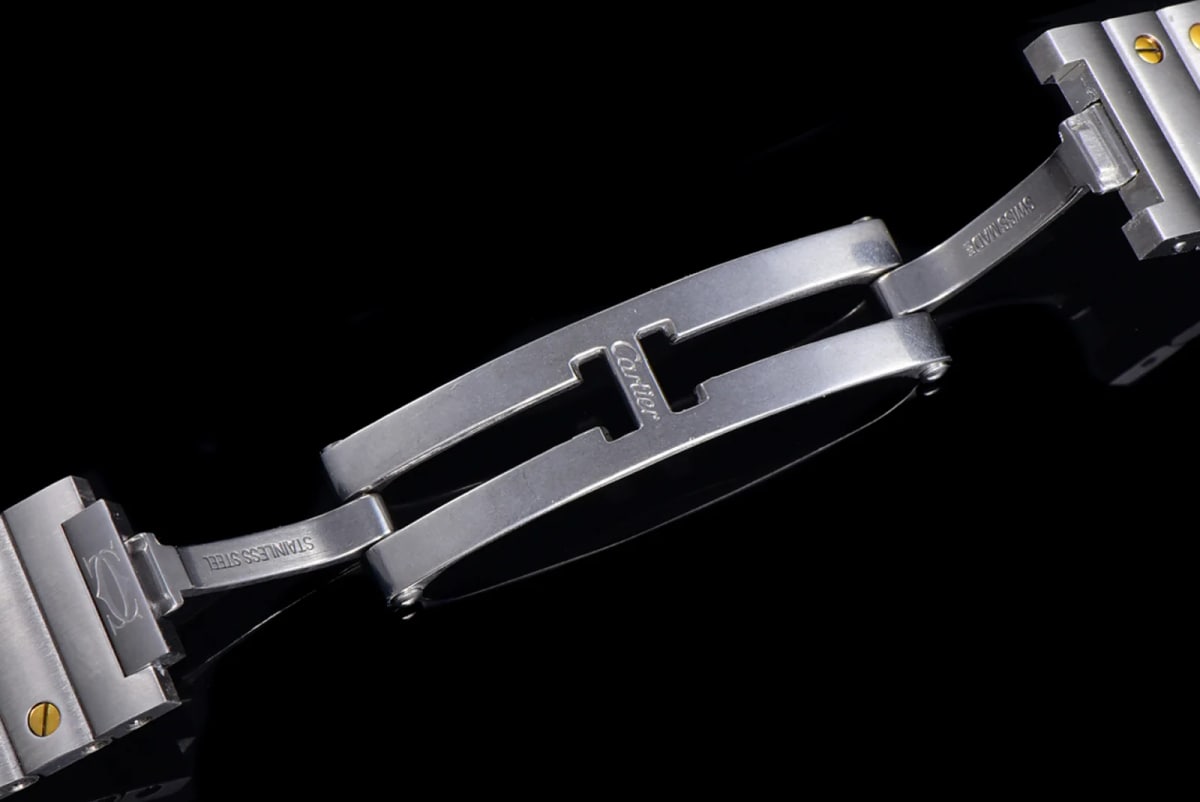
Clasp detail with the folding clasp opened flat against the dark background, engraved lettering running along its blades, and the bracelet links with their gold-toned screw heads laid out beside it
What does the pale silvered dial look like up close?
The dial is pale and silvered, and it is not a flat surface: it carries a fine spun grain that runs from the centre outwards, so the same dial looks bright at one angle and almost plain at another. Over that surface the Roman numerals, the square minute track that frames them, the thin inner rectangle and the CARTIER lettering are all printed in black, and the two hands are blue. Small printed lettering sits along the bottom edge of the dial.
Dial finish is a per-piece question on this model, because the published tables list the 1566 as having been offered in more than one dial colour across the production run. Colour is therefore not part of the reference name, and the dial on this page is described only as the third frame shows it. If you are comparing two 1566 watches, ask for each dial photographed straight on in daylight, with the light the same, before deciding that they differ.
What do these four frames leave unsettled about the watch?
They settle shapes and nothing else. Between them the frames show the bowed square case, the gold-toned bezel with its eight screws, the pale silvered dial with black Roman numerals and blue hands, the bracelet rows with their gold-toned screw heads and the open folding clasp. No frame shows the back of the case or anything inside it, so the movement cannot be identified from these shots.
What the photographs cannot establish is the list that goes to the seller: which calibre is fitted in the offered watch, what each part — case, bezel, bracelet links, screws — is actually made of, what thickness any plating or wrap has, which bracelet or strap is supplied, the measured weight, and the state of the water resistance. Each of those is written into the inquiry list rather than assumed from a picture.
What should you ask about the bracelet and its clasp?
The bracelet is the part of this watch that carries the most visible detail. Its rows are pale, each row holding gold-toned screw heads, and the construction behind those heads is the screw-and-pin arrangement that the bezel screws echo. The clasp in the fourth frame is a folding type, shown opened flat against the background with engraved lettering running along the blades.
Ask how many links are fitted, how many spare links come with the watch, and what wrist size the bracelet is currently set for, because missing links change the fit more than the case size does and they are easy to overlook in a photograph. Ask for the bracelet laid out flat and closed, plus the clasp open and shut, and ask whether the bracelet supplied with the watch is the one in these frames.
How do you identify a 1566 against other Santos Galbée references?
Start with the reference number, then use the case. Published tables for the 1566 give a square case of 29 mm by 41 mm with a 6.7 mm thickness, a bezel held by eight visible screws, a sapphire crystal and a quartz calibre (Cartier 87 / 687). Two watches of this reference can still look unalike, because the dial was offered in several finishes over the run, so the case and the reference number are the steadier ground than the dial colour.
The details that hold across the frames here are the bowed flank between the lugs, the eight screws in the bezel whose line continues down into the bracelet's own screws, and the printed square minute track that frames the Roman numerals. Bring the reference 1566 into the conversation along with the case size you want, and ask which other Santos Galbée references are on offer at the same time so the differences can be compared directly instead of from memory.
Specification
Specifications and configuration
Model details and design
Detail
Description
Model reference
1566
Model size
29 mm across the case
Dial
Pale silvered, with a fine spun grain running from the centre; black Roman numerals and blue hands
Dial print
CARTIER above the centre, with small printed lettering along the bottom edge of the dial
Bezel design
Gold-toned band standing slightly proud of the case, held by eight screws set into the bezel
Hour-marker layout
Roman numerals around the dial, framed by a printed square minute track
Hour markers
Printed in black on the dial surface, with no raised edges visible in the close-up frame
Hand arrangement
Two blue hands from the centre, with no visible third hand in the frames
Date display
Published tables for reference 1566 list a date aperture in the dial; these frames do not show one
Colour combination
Pale silvered dial with a gold-toned bezel and warm screw heads over pale bracelet links
Case shape
Square in plan, with the flanks bowing outward between the lugs
Crown
Fluted crown at the right of the case, set with a blue cabochon
Bracelet shown
Rows of pale links, each row holding gold-toned screw heads, on a screw-and-pin construction
Clasp shown
Folding clasp, opened flat in the fourth frame, with engraved lettering along its blades
Strap shown
None — the watch in the frames is on its bracelet
Strap (reference supply)
Not settled by these frames; the bracelet or strap supplied with the offered watch is a question for the seller
Case size (published design data)
29 mm by 41 mm, 6.7 mm thick, as given in the reference tables for the 1566
Movement (reference design)
Quartz calibre, Cartier 87 / 687, as published for reference 1566
Crystal (reference design)
Sapphire, as published for reference 1566
Dial variants (reference design)
Published tables list the dial as offered in several finishes across the 1566 production run, which is why dial colour is a per-piece detail
Questions
Frequently asked about this reference
Is the Santos Galbée 1566 a quartz watch?
The published reference tables list the 1566 on a quartz calibre, Cartier 87 / 687. Nothing in the frames here shows the back of the case or the movement, so which calibre is fitted in the offered watch is a question rather than a fact. Ask it together with the metal questions, in the same message.
What size is the 1566, and how does a square case that size wear?
The published design data gives a square case of 29 mm by 41 mm with a 6.7 mm thickness. Because the case is square and its flanks bow outward, the measurement across it describes the dial end of the watch rather than the fit. Ask for the lug-to-lug figure and the wrist size the bracelet is set for before deciding whether it will suit you.
Why do two Santos Galbée 1566 watches turn up with different dial colours?
The reference tables list the dial as having been offered in more than one finish across the production run, so dial colour is a per-piece detail on this model rather than part of the name. The frames on this page show one such dial: pale and silvered, printed in black. Ask which finish the offered watch has and for it to be photographed straight on in daylight.
What is visible on the bezel of this reference?
Eight screws sit in the bezel, and in the straight-on frame they read darker than the gold-toned band around them. The bezel itself stands slightly proud of the case, which you can see clearly in the angled frame where the flank drops away beneath it. The line of those bezel screws continues down into the bracelet, whose rows carry their own screw heads.
What should I check on the bracelet and clasp before buying?
Ask how many links are fitted, how many spare links come with the watch, and what wrist size the bracelet suits, since missing links are the usual reason a bracelet of this kind no longer fits. Ask for the bracelet laid out flat and closed as well as the clasp open and shut, so the fold and the engraved lettering can both be seen. Confirm whether the bracelet supplied is the one in these frames.
Can the metal of the case be read from a photograph?
No. Gold-toned and pale describe how surfaces look under one set of lights, not what they are made of, and a warm colour on a bezel says nothing about how that colour was produced. The reference tables describe the 1566 as a two-tone build of stainless steel with an 18-carat yellow gold bezel, and that is the catalogue configuration for the reference. The metal of each part on the offered watch has to come from the seller.
Inquiry message
The message below is pre-written with the model, the reference and this page. The button opens a WhatsApp draft for you to review before sending.
Current price for one watch, the shipping cost to my country, the countries you ship to and the lead time.
Which calibre is fitted in the offered watch, and whether it is the quartz movement published for reference 1566.
What each part of the offered piece is made of — case, bezel, bracelet links and screws — with the thickness stated for any plating or wrap.
The bracelet or strap supplied with the watch, the clasp, the number of links fitted, any spare links, and the wrist size the bracelet is currently set for.
The measured weight, lug-to-lug and case thickness of the piece on offer, and whatever you can show about its water-resistance state.