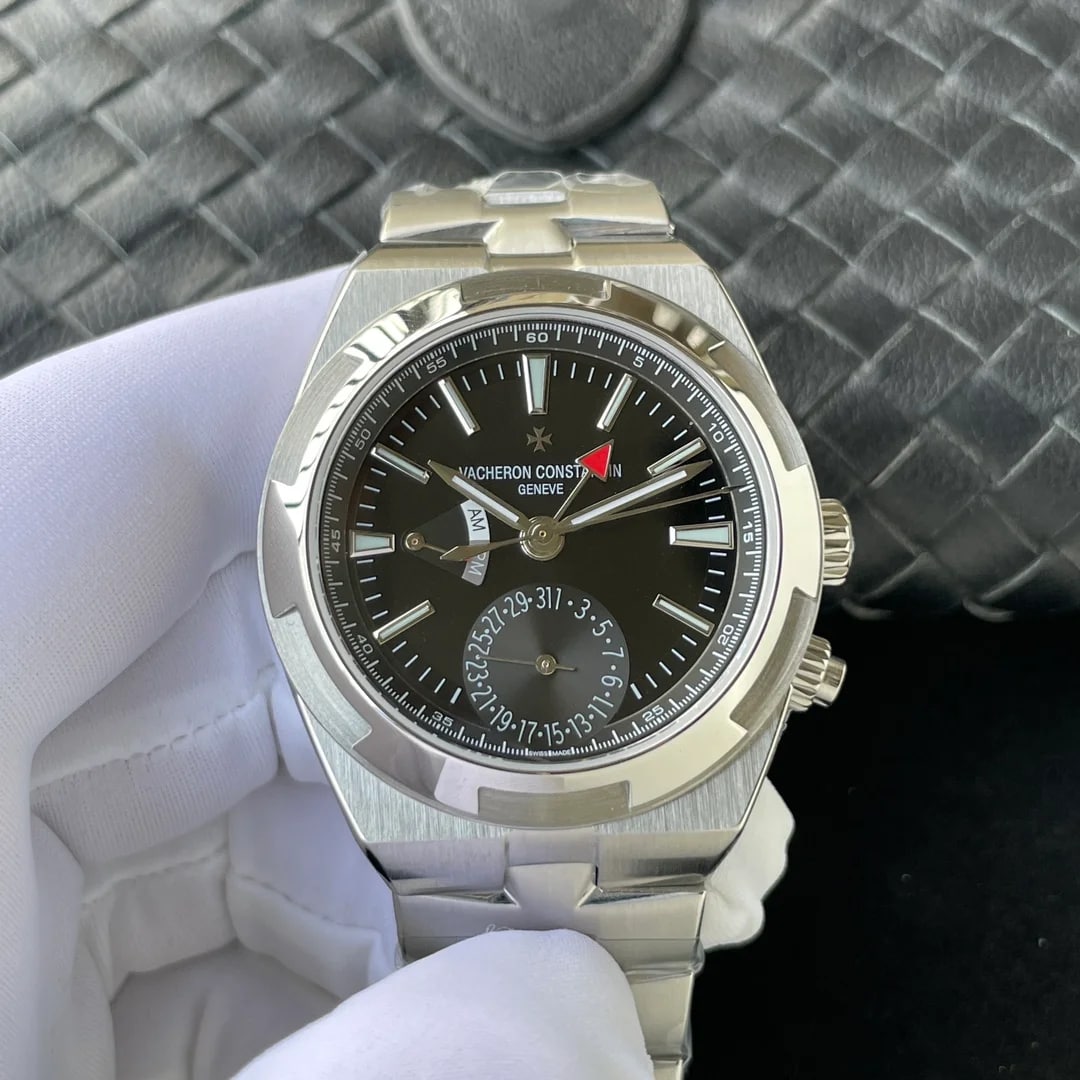
Vacheron Constantin Overseas Dual Time, stainless steel with a black lacquered dial, 41 mm
Model reference: 7920V/210A-B546
Price by inquiryconfirmed in the chat, with shipping and lead time
Model size41 mm
DialBlack lacquer over a sunburst base
Dial printMaltese cross with Vacheron Constantin and Genève above the centre
Hour-marker layoutOne tapered baton per hour, filled centre with a polished surround
Vacheron Constantin Overseas Dual Time 7920V/210A-B546, a 41 mm steel Overseas with a black lacquered dial, a red-tipped second-zone hand and a day-night scale.
Opens a WhatsApp chat with the model, the reference and this page already written into the message.
Nothing is sent until you press send. Prefer to write it yourself? Use the inquiry box further down.
About this watch
Design and details
This is the Overseas Dual Time in 41 mm, reference 7920V/210A-B546, shown with a black lacquered dial built over a sunburst base. Vacheron Constantin’s own page for that reference describes a stainless-steel Overseas 12 mm thick, water-resistant to 150 m and antimagnetic, with a transparent sapphire case back, a steel bracelet on a triple folding clasp, and the self-winding calibre 5110 DT/2 inside it: 234 parts, 60 hours of power reserve, central seconds, hours, minutes, a second time zone with day/night indication and the date.
On the dial in these frames, the second time zone is the hand with the red tip, and the small printed scale near nine o’clock reads AM and PM for its day and night. The date sits in a counter above six rather than in a window at three. The gallery runs from the dial straight on, through the dial and bracelet at an angle, to the case flank and finally the sapphire back. Those frames settle the dial, its print, the markers and the bracelet; they cannot say which movement is fitted to the offered watch, what its case and bracelet are actually made from, which strap and clasp come with it, or what state its seals are in, so those questions belong in the message rather than in the copy.
Why is the date shown in a counter above six o’clock on this reference?
The date on this dial is not an aperture cut into the surface but a small counter of its own above six o’clock, with the days printed in an arc and a slim pointer hand stepping across them. Putting it there clears the area around three o’clock for a baton marker and keeps the dial balanced on either side of the vertical line through the centre.
A counter also changes what you look at when the watch is set. Instead of glancing sideways at a window, you read a pointer against a printed scale, which takes a moment longer but holds up better against a dark dial. Whether that pointer steps cleanly from one day to the next, and how it behaves when the time is moved forward quickly, are things to ask about on the actual piece rather than assume from a photograph.
What makes the hands and markers stand out against the black dial?
The hour markers are single tapered batons with pale filled centres and bright surrounds, and the hour and minute hands carry the same fill inside polished edges. Against the black lacquered surface, the contrast comes from that fill and from the way the polished outline catches light, not from a change of colour anywhere on the dial.
Two details complicate the reading. The red tip on the second-zone hand is the brightest thing on the dial and pulls the eye before either of the time hands, and the printed AM and PM scale shares the nine o’clock region with a baton marker, so the two sit close together in a photograph. Ask for the dial in daylight, straight on and again at an angle, to check that the fill reads evenly across every marker.
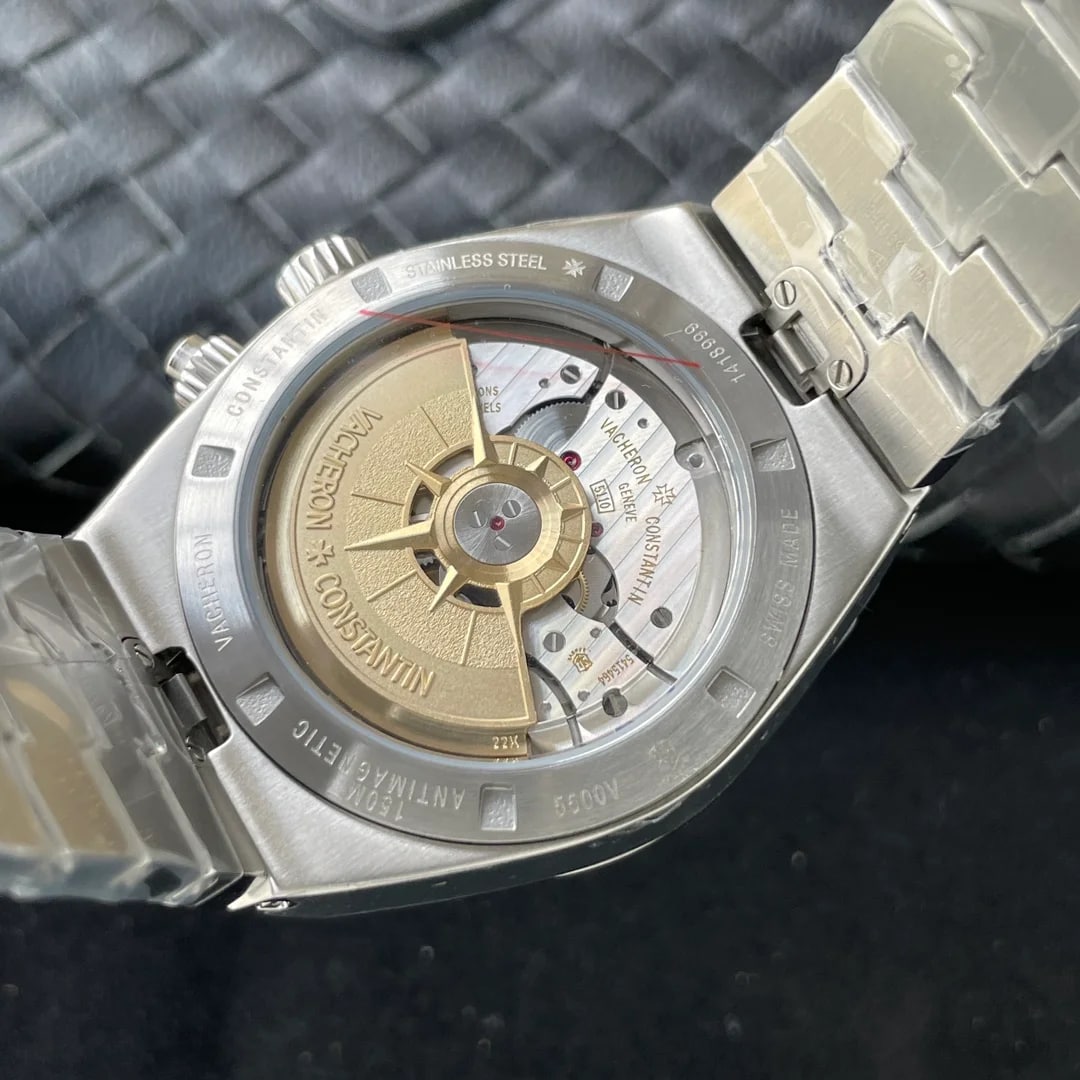
Case back detail with the sapphire window over the winding weight, engraved lettering around the rim and the bracelet links meeting the lugs on either side
What sits on the case flank beside the crown?
The frames show the crown on the flank between its guards, with a round element beside it carrying the Maltese cross, and the bracelet links meeting the case a short distance away. The flank is finished along the case rather than across it, so it reads differently from the flat surfaces above and below.
Which element moves the second time zone, which one steps the date, and whether the crown has more than one pulled position are all outside what a still photograph can show. On a dual-time watch that matters, because setting the other zone without disturbing the local time is the reason the extra element is there at all. Ask for the setting sequence to be demonstrated on video, on the watch being offered.
What does the sapphire case back show, and what does it leave open?
The last frame looks into the back of the watch: a sapphire window over the movement, the winding weight lying across it, and the case ring around the outside carrying engraved lettering, including the antimagnetic and 150 m markings. The bracelet is attached at the lugs on both sides in that same frame.
A display back shows shapes, not condition. You can see that there is a weight over the movement and a balance moving, but not how the watch keeps time, whether it has seen a service, or which movement is fitted to the piece you would actually receive. If those answers matter to you, they have to come from the seller for this watch, because a reference sheet describes the design rather than the object.
What does the 150 m and antimagnetic line on the specification actually cover?
The 150 m figure and the antimagnetic wording belong to the published description of reference 7920V/210A-B546: a 41 mm stainless-steel Overseas, 12 mm thick with a sapphire back, rated to that depth and described as antimagnetic in the manufacturer’s own data. That is what the design is built for.
It is not a statement about the watch in these photographs. Seals, crowns and case backs are only ever as good as their last service, and nothing in a still frame tells you whether the gaskets are sound or when they were last checked. If you intend to wear the watch near water, ask what the water-resistance position of this particular piece is and whether any test supports it.
How does the bracelet meet the case, and what does that mean for changing it?
In the frames the bracelet leaves the lugs as a run of flat links, brushed on the faces with brighter bevels along the edges, and meets a case flank finished in a different direction from the case top. The join is close enough that no spring-bar end shows from the outside at any of the angles photographed.
This reference is designed around a bracelet that can be swapped without tools, and a second strap with its own folding clasp is normally part of how such a watch is supplied — but what accompanies the individual watch is a supply question rather than a design one. Ask what is included with the offer, whether the release mechanism has been used, and whether the bracelet and any spare strap are the ones intended for this case.
Specification
Specifications and configuration
Model details and design
Detail
Description
Model reference
7920V/210A-B546
Model size
41 mm
Dial
Black lacquer over a sunburst base
Dial print
Maltese cross with Vacheron Constantin and Genève above the centre
Hour-marker layout
One tapered baton per hour, filled centre with a polished surround
Hand arrangement
Filled hour and minute hands, slim centre seconds, red-tipped second-zone hand
Date display
Counter above six with printed days and a pointer hand
Subdial layout
Single date counter above six; printed AM/PM day-night scale at nine
Bezel design
Stepped ring, notched at intervals, with brushed faces and polished edges
Colour combination
Black dial, silver-toned case and bracelet, red on the two pointer tips
Bracelet shown
Multi-link bracelet with brushed link faces and polished bevels
Clasp
Triple folding clasp per the reference data; not visible in the frames
Case back
Transparent sapphire back with engraved lettering around the rim
Movement (reference design)
Self-winding calibre 5110 DT/2, 234 parts, 60-hour power reserve
Questions
Frequently asked about this reference
How does the dual-time display work on this Overseas, and how do I read the second zone?
The hand with the red tip is the second-zone indicator. It travels round the same hour ring as the local hour hand, so the other city’s hour is read from where that hand points against the printed track, not from a separate counter. The small scale near nine o’clock, printed AM over PM, is the day and night indication that goes with it, so you can see whether the hour you are reading falls in the other zone’s daytime before you decide whether it is a reasonable time to call. Ask the seller to show the red-tipped hand being set on this watch, and to confirm whether that day and night scale follows the second zone or the local time in the configuration being offered.
How does a 41 mm Overseas wear, and what should I know about the interchangeable bracelet system?
41 mm is the case diameter, and on this reference the case is 12 mm thick. Diameter alone never settles a fit: the case thickness, the lug-to-lug length and the first links of the bracelet decide how the watch sits and how much of the wrist it covers. The bracelet on this reference is made to be changed without tools, which is why the join at the lugs is worth a photograph of its own. Whether the spare strap, the second clasp and any release tool come with the watch being offered is a question for the seller, so ask for the lug-to-lug measurement and for the list of what is included before you compare it with your wrist.
What should I inspect on the bracelet and clasp of this watch?
Start with the bevelled edges of the links and the gaps between them, because that is where a bracelet that has been worn hard shows itself first, then look at the clasp: how the leaves close, whether the closure sits flush with the bracelet and how much adjustment is left in it. Ask how many links are fitted, how many can be removed and whether spare links come with the watch. A close-up set showing the bracelet laid out flat and the clasp both open and closed will answer most of this faster than any description, and it shows the condition of the polished surfaces rather than hiding them.
What can these photographs not prove about the watch?
They show the dial, its print, the markers, the case flank and the case back, and nothing beyond that. Which movement is fitted to the offered watch, what its case and bracelet are actually made of, which strap and clasp are supplied with it, its measured weight and the state of its water resistance all sit outside what a frame can tell you. The frames also cannot show the seconds running or the date stepping over, so what you want at that point is not another still image but a short video of the watch in your seller’s hands.
What should I confirm with the seller before paying?
Confirm that the reference 7920V/210A-B546 on the paperwork matches the watch in the photographs, then pin down the configuration and everything supplied with it, and the measurements you would otherwise be guessing at: case thickness, lug-to-lug length and weight in grams. Ask which movement is fitted and what evidence accompanies it, and ask about the bracelet, the clasp and the case back on this specific piece. Only once the watch you are being shown is the watch you would receive is it worth talking about commercial terms.
What is specific to the black lacquered dial on this reference?
Vacheron Constantin describes this dial as black lacquer over a sunburst satin-finished base, with a velvet-finished minutes track around the outside and snailed counters. In practice that means the dial is not one flat black: the centre lightens in a fan when the light comes from the side, while the outer track stays matte, which is the quickest way to tell the two finishes apart in a photograph. Ask for a daylight shot taken at an angle so the sunburst shows, plus one straight on in the same light, so you can judge the dial rather than the lamp.
Inquiry message
The message below is pre-written with the model, the reference and this page. The button opens a WhatsApp draft for you to review before sending.
Which movement is fitted in the offered watch, and what evidence of its running comes with it.
What the case, bezel and bracelet of this individual watch are actually made from, and how many links are fitted.
Current price for one watch, the shipping cost to my country, the countries you ship to and the lead time.
Whether the spare strap and the second folding clasp come with this piece, and whether the bracelet release mechanism has been used.
A short video of the red-tipped second-zone hand and the date counter being set, plus close-ups of the case back, the crown flank and the clasp.