Opens a WhatsApp chat with the model, the reference and this page already written into the message.
Nothing is sent until you press send. Prefer to write it yourself? Use the inquiry box further down.
About this watch
Design and details
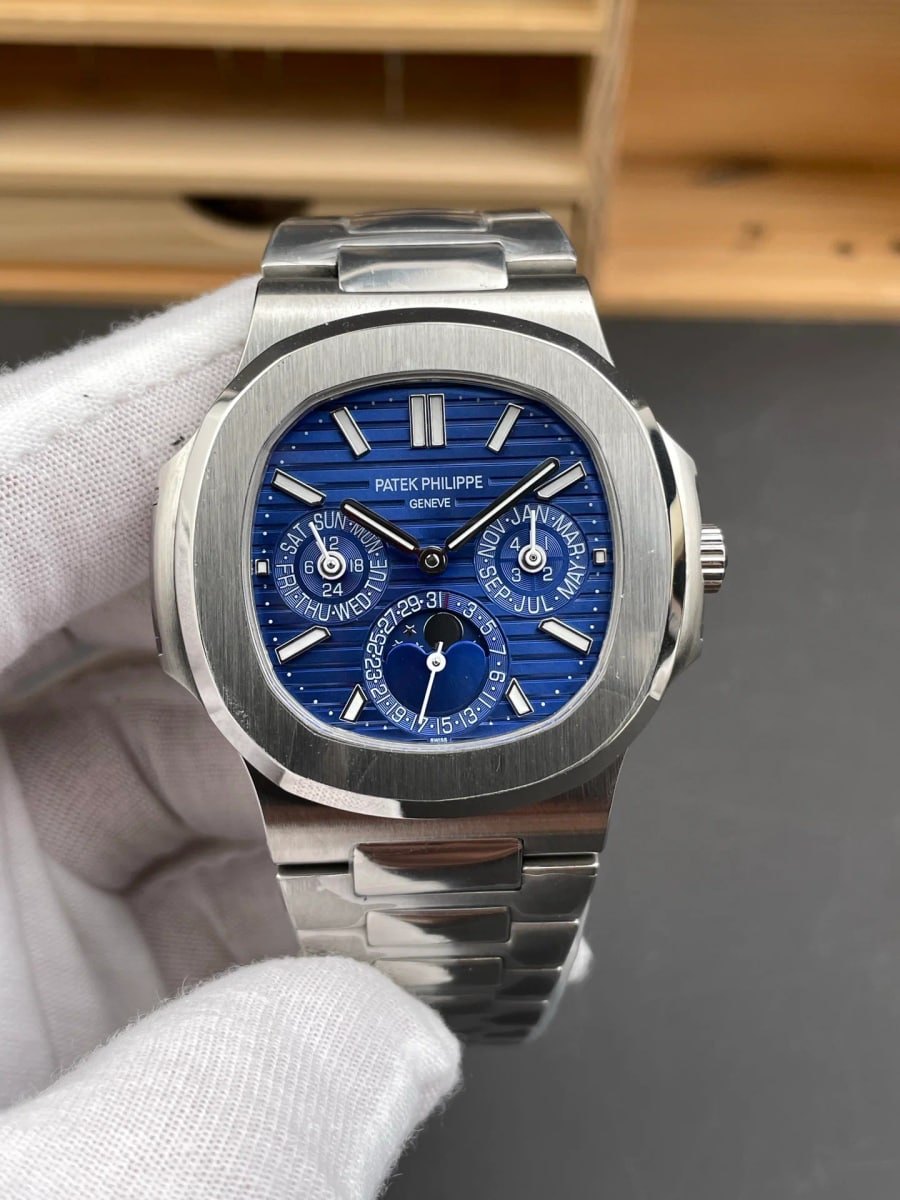
This is the Nautilus perpetual calendar, reference 5740/1G-001, in white gold with a blue dial. The photographs show a 40 mm case with a rounded octagonal bezel, an integrated bracelet, and a dial whose centre is given over to calendar information rather than a single date window. The surface is sunburst blue with horizontal embossing, and the brand lettering sits above the middle of the dial.
The four frames on this page answer four different questions. The straight-on frame settles the dial layout and where each register sits; the angled frame shows how shallow the case is and how the bracelet folds away from it; the case-back frame shows the movement through the crystal; the clasp frame shows the bracelet fastened. What none of them settles is the piece itself — which movement is fitted, what metal the offered watch is made from, which bracelet and clasp come with it, and whether it still keeps water out. Those are questions for the conversation, not claims for a photograph.
How do the three registers split the calendar information?
Each register carries two readings rather than one. At nine o’clock the days of the week are printed around the outside with the 24-hour numerals inside them; at three the months run around the edge with the four-year cycle numbered inside; at six the dates sit around the rim with the moon phase shown inside the register.
Read together, the dial carries five separate indications without a line of text printed across it. That is why the register positions are worth noticing when you look at the watch: the day and 24-hour pair sits opposite the month and leap-year pair, and the date and moon phase sit below the centre, so the middle of the dial stays balanced instead of being filled with a list.
What is the 24-hour track inside the day register for?
The inner track of the nine o’clock register runs 6, 12, 18, 24 rather than 1 to 12. It reads a whole day in one sweep, so the dial tells you whether the time shown is morning or evening — something a 12-hour dial alone cannot do.
On a perpetual calendar that distinction has a purpose. A correction should only be made when the mechanism is clear of the change window, and knowing where the watch sits in the 24-hour cycle is how that is judged. Patek Philippe’s published data for this reference notes that the calendar needs a date correction only once a year; how and when to make that correction on the watch in front of you is something to have walked through directly.
Close-up of the closed folding clasp on the bracelet, held in a gloved hand, showing how the links fold back toward the case
What does 40 mm across and 8.42 mm high mean for the fit?
The diameter is a mid-size figure; the height is the unusual one. Patek Philippe’s published data for this reference gives 8.42 mm, which is very little for a watch carrying a full perpetual calendar mechanism, and it is why the case reads flat rather than tall in the angled frame. The reference design also specifies a white gold case and bracelet, a screw-down crown, a sapphire crystal case back and water resistance to 30 m.
Whether that suits your wrist depends on measurements a photograph cannot give you. Ask for the lug-to-lug length and the case height measured on the actual watch, and for the number of links fitted, since the bracelet decides where the case finally sits. A watch this thin on an integrated bracelet can wear either larger or smaller than its diameter suggests, and only those figures will tell you which.
What does each of the four photographs show?
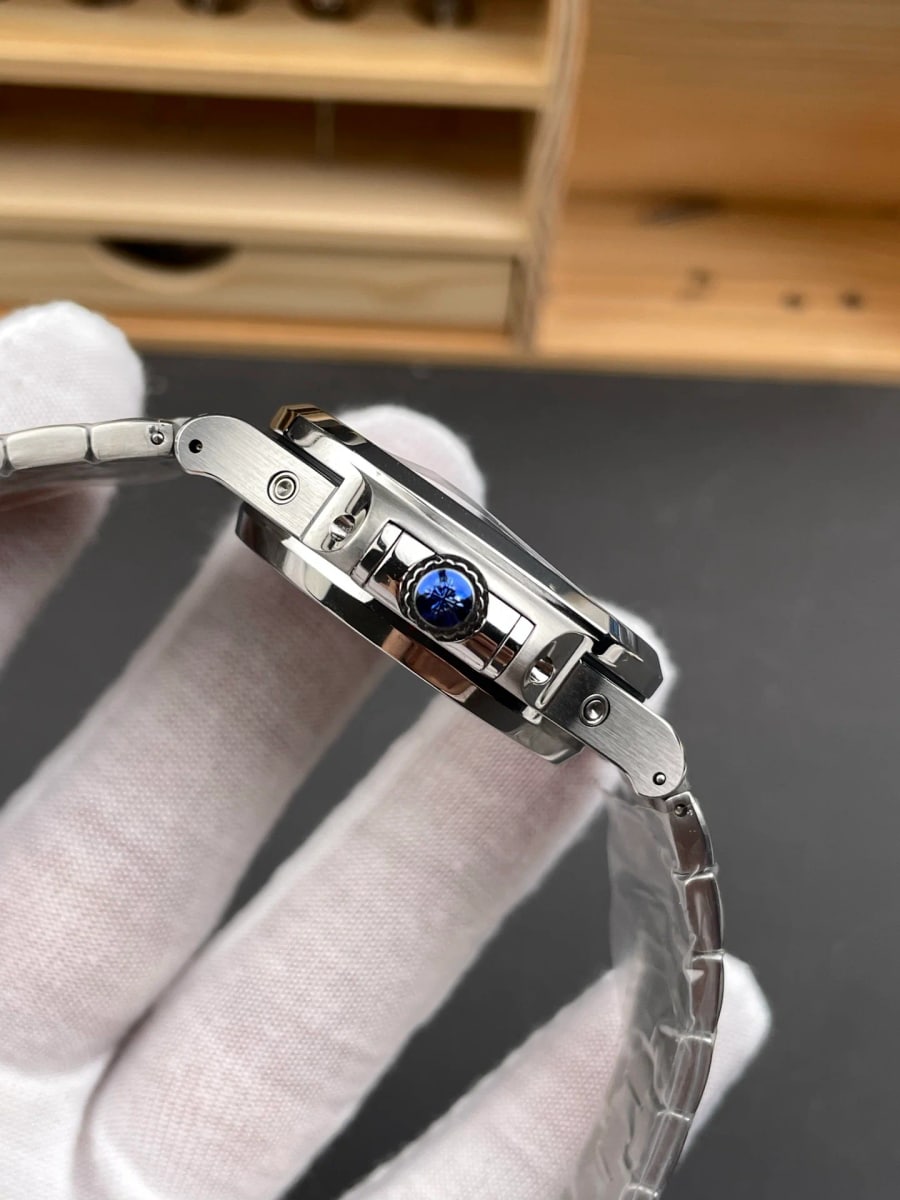
The first frame is the dial straight on: the blue embossed surface, the lettering above the centre, the three registers and the moon phase inside the lower one, with the bracelet visible at both sides of the case. The second is the case seen from the side and slightly behind, which is where the shallow profile, the crown and the folded bracelet are easiest to judge.
The third frame looks through the case back. The movement is visible under the crystal with the winding segment sitting off centre above the plates, and the engraving around the outer ring is legible with the bracelet attached at the lugs. The fourth shows the bracelet closed with the clasp folded. Between them the frames cover the dial, the profile, the back and the fastening — the four places most people look at first.
How does this differ from a Nautilus that shows a date only?
A date-only Nautilus gives you one aperture at three o’clock. This reference gives you the day of the week, the date, the month, the leap-year position and the moon phase, with the 24-hour reading folded into the day register. The dial is busier for it, and the centre of the dial is where the difference is most obvious in a photograph.
The mechanism is the other separation. A perpetual calendar has to allow for unequal month lengths and for February in a leap year, and it is presented here inside a case whose height is barely different from far simpler watches in the same family. If the calendar display is what you are after rather than the plain three-hand look, this is the reference in the collection that carries it.
What should I confirm about the offered watch before deciding?
Four things on this reference cannot be answered from its photographs. Which movement is fitted. What the offered piece is actually made from, case and bracelet together. Which bracelet and clasp variant comes with it. And the water-resistance state of this particular watch rather than of the reference design.
Patek Philippe’s published data for 5740/1G-001 describes the reference, not the individual watch: that is what a specification sheet can ever tell you. So ask for the case back photographed straight on, the clasp photographed open, a clear statement against each of the four points above, and a straight answer on how the watch has been kept — all of it in writing, before any money moves.
Specification
Specifications and configuration
Model details and design
Detail
Description
Model reference
5740/1G-001
Model size
40 mm across, 8.42 mm high
Dial
Blue sunburst with horizontal embossing
Dial print
Brand and city lettering above the centre; the word SWISS at the bottom
Hour-marker layout
Applied white-gold baton markers around the dial
Hand arrangement
Rounded baton hour and minute hands with white luminescent coating; thin centre seconds
Subdial layout
Day and 24-hour at nine; month and leap-year cycle at three; date and moon phase at six
Bezel design
Rounded octagonal bezel with polished bevels and a brushed flat face
Colour combination
Blue dial against a white-gold case and bracelet
Bracelet shown
Integrated white-gold-tone bracelet with polished centre links
Clasp
Folding clasp, shown closed in the photographs
Case back
Sapphire crystal, with the movement visible through it
Movement (reference design)
Self-winding calibre 240 Q, 3.88 mm high, 38 to 48 hours of power reserve
Questions
Frequently asked about this reference
How does 5740/1G-001 differ from the other Nautilus references in this collection?
The dial is the first difference: three calendar registers occupy the centre instead of a single date aperture at three o’clock, so the whole face is organised around the calendar rather than around the time. If you are comparing two Nautilus offers, compare the register layout first — that is where this reference parts company with the simpler ones.
How does the case wear given how thin it is?
The diameter is mid-size and the height is unusually small for a perpetual calendar, at 8.42 mm in Patek Philippe’s published data for the reference. On paper that should sit flat and slide under a cuff. Lug-to-lug length, the taper of the first bracelet links and your own wrist measurement settle the rest, so ask for those figures for the actual watch.
What should I look for in the photographs on this page?
Four things. The straight-on frame tells you whether the register positions and the moon-phase display match the layout described here. The angled frame shows the case depth and the crown. The case-back frame shows the movement and the engraved outer ring. The clasp frame shows the fastening closed. Then ask for the same four views of the watch being offered.
What can these frames not prove?
They cannot show which movement is inside, what the offered case and bracelet are actually made from, whether the crown still seals, or whether the watch still keeps water out. A photograph of a closed case back proves only that a case back is fitted. Those points belong in the questions you send, not in what you assume from an image.
What should be confirmed before I pay?
Get the reference 5740/1G-001 in writing, the case height and lug-to-lug measured on the actual watch, the number of links fitted and any spare links, a photograph of the clasp open, and direct answers on the movement and the metal. Confirm the destination and cost of shipping in advance as well, so nothing is left to the last message.
Does this watch need setting like an ordinary calendar watch?
The calendar is perpetual, so it tracks uneven month lengths and the leap-year cycle on its own, and Patek Philippe’s data for the reference notes that the only manual correction is a date correction once a year. That correction should only be made when the mechanism is clear, which is what the 24-hour track helps you judge. Ask for that adjustment to be demonstrated on the delivered watch.
Inquiry message
The message below is pre-written with the model, the reference and this page. The button opens a WhatsApp draft for you to review before sending.
Current price for one watch, the shipping cost to my country, the countries you ship to and the lead time.
Which movement is fitted in the offered watch, and what its case and bracelet are actually made from.
The bracelet and clasp that come with this watch, how many links are fitted, and whether spare links are included.
The case height and lug-to-lug length measured on this watch, its water-resistance state as it stands, and a walkthrough of the once-a-year date correction on the perpetual calendar.
Photographs of the actual watch: the dial straight on, the case from the side, the case back and the clasp open.