Patek Philippe Nautilus 5712/1R-001, rose gold with a brown sunburst dial, 40 mm
Model reference: 5712/1R-001
Price by inquiryconfirmed in the chat, with shipping and lead time
Model size40 mm, measured from 10 to 4 o’clock
DialBrown sunburst with a black-gradient rim, horizontally ribbed
Dial printBrand and city lettering above the centre
Hour-marker layoutApplied baton-style markers, with white luminescent coating
A 40 mm Nautilus in rose gold with a brown sunburst dial and a black-gradient rim, carrying the date by hand, moon phases, a power-reserve sector and small seconds.
Opens a WhatsApp chat with the model, the reference and this page already written into the message.
Nothing is sent until you press send. Prefer to write it yourself? Use the inquiry box further down.
About this watch
Design and details
This is the Nautilus 5712/1R-001, a 40 mm travel-time calendar whose dial is deliberately out of balance: the date is read by a small hand, the moon phase and small seconds share the lower part of the dial, and the power reserve sits in the upper-left corner. The reference data records a case 8.52 mm thick, measured 40 mm across from 10 to 4 o’clock, with a screw-down crown and a sapphire display back.
The four frames below work through the design in order — the dial straight on, the case and dial at an angle, the movement through the case back, and the clasp and strap edge-on. What only the individual watch can answer — the movement fitted in it, the metal of the piece offered, the band supplied with it and its water-resistance state — is raised in the WhatsApp conversation rather than stated here.
How are the four dial reads arranged on the 5712/1R-001?
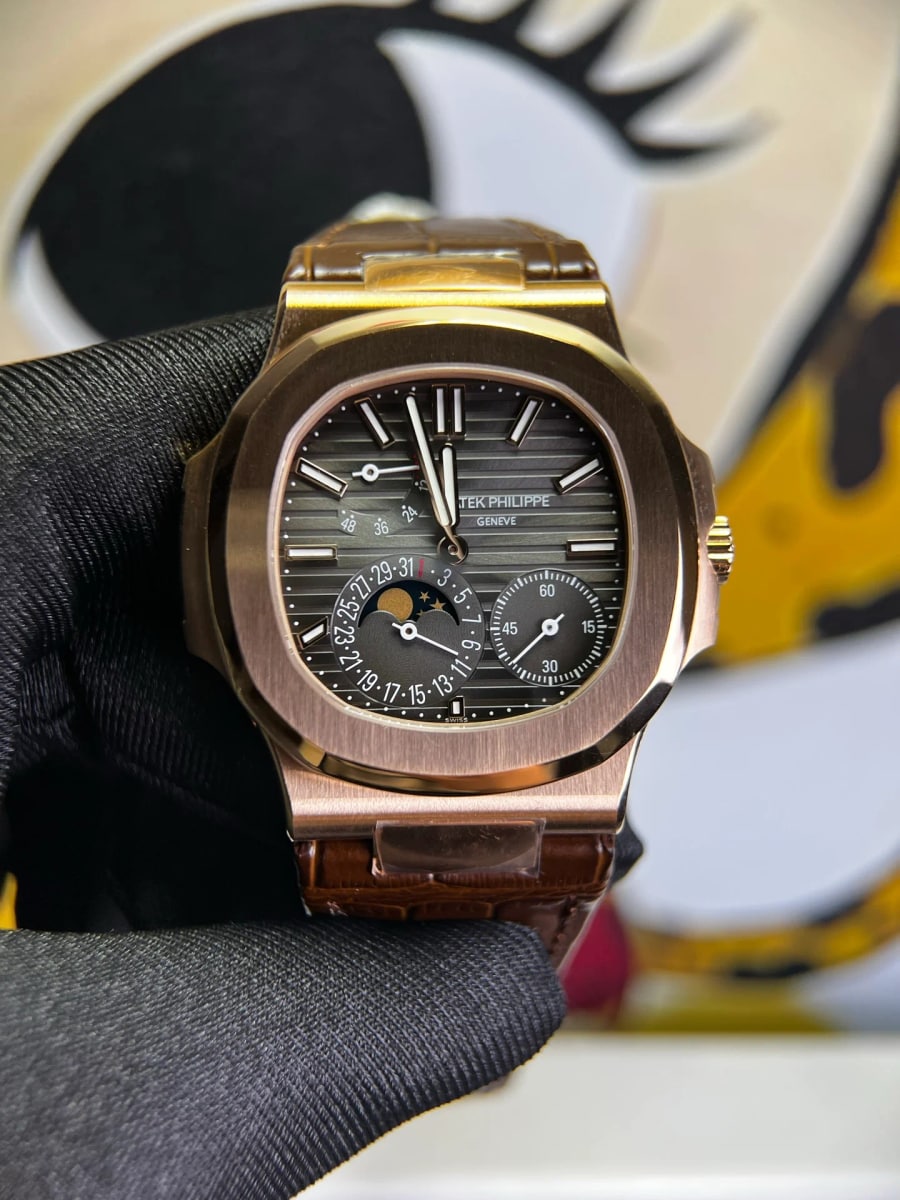
The dial is deliberately off-centre. In the upper-left corner a sector tracks the remaining power reserve, scaled 48 down to 24 in the photographs. The lower half of the dial carries the moon-phase aperture with the date numerals printed around it and read by a small hand, while small seconds sit in their own register to the right. There is no date window at three.
Reading it takes a moment at first: the hour and minute hands pass over the reserve sector in the upper left, and the date hand is the shortest of the three. Whether the reserve sector falls as the watch runs, whether the moon phase advances and whether the date steps cleanly are all observable in a short video of the actual watch, and that video is the thing to request.
Is the dial brown, and what does the black-gradient rim do?
The dial is documented as brown with a sunburst finish under a black-gradient rim, and the frames behave that way: the brown reads lightest where the light strikes the centre of the ribbed surface and darkens toward the edge until the rim looks near-black. The straight-on frame shows the grooves and the darker border together; the angled frame shows the same surface with more light across it.
That is also why the colour is easy to misjudge in a single photograph, since the same dial reads differently in daylight and under a lamp. The finish sits on the metal beneath the print, so the light decides which part of the dial you are looking at. Ask for a daylight photograph of the dial straight on and at an angle, plus a short video, before you compare it with another watch.
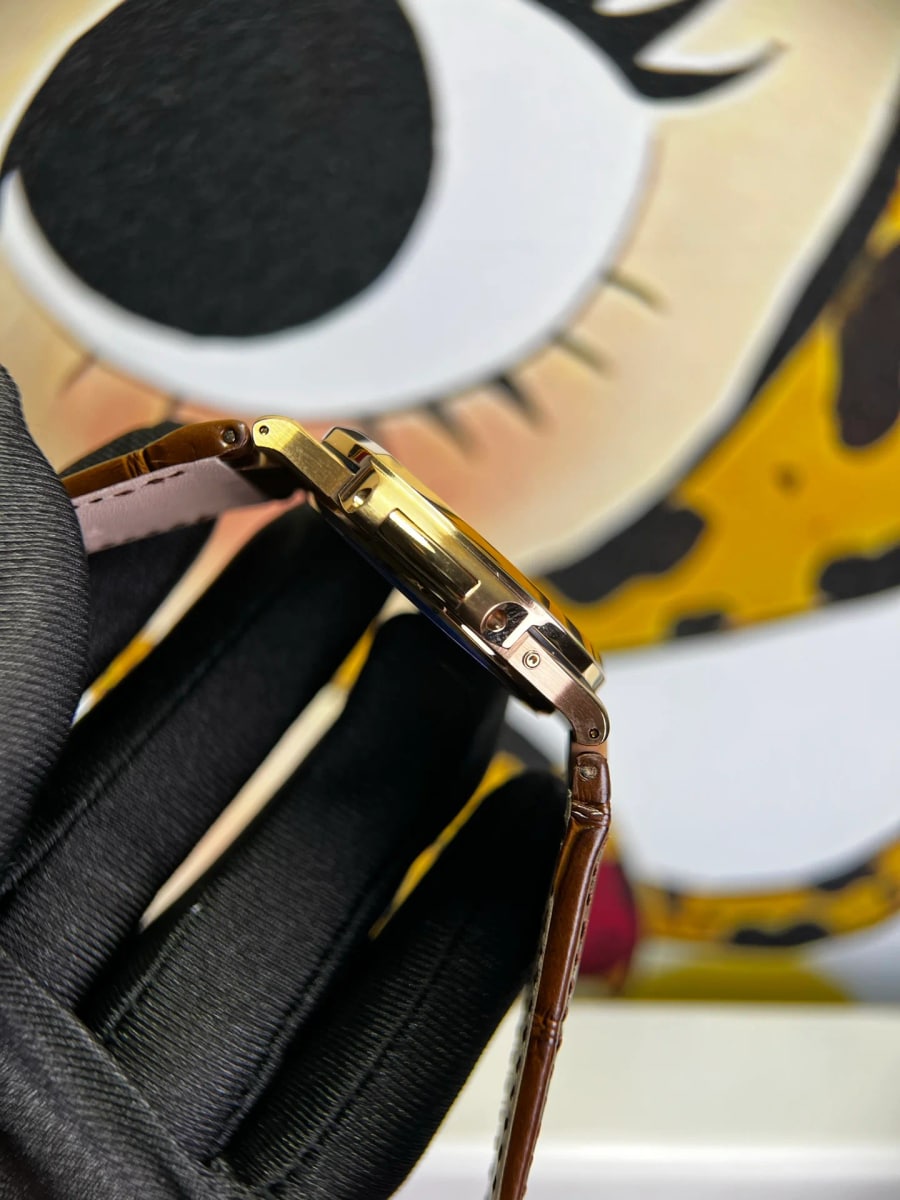
Clasp detail in profile: the thin gold-toned case edge, the crown on the flank, the folding clasp closed under a clear protective film and the brown strap with visible stitching
What has to be set by hand on this reference?
The calendar side of this reference is hand-set rather than quick-set: the date is read by a hand against printed numerals and the moon phase sits in its own aperture, so moving the date past a short month and setting the moon phase are both done by hand. Whether a correction tool comes with the offered watch, and what the seller’s setting procedure is, are the first two things to establish.
Sequence also matters when it is done by hand: the usual practice is to move the hands clear of the changeover before touching the date, and never to force a jumper if it resists. The reference data records a 3.99 mm movement inside a case 8.52 mm thick, which is where the thinness of the watch comes from. Ask to see the date stepping and the moon phase advancing on video.
How does a 40 mm case at 8.52 mm thick wear?
The 40 mm figure is the case measured across from 10 to 4 o’clock rather than straight across, which is how this case shape is quoted, and the same reference is 8.52 mm thick. A thin case under a wide, flat bezel spreads the watch across the wrist instead of standing up on it, so it wears wider than the diameter alone suggests.
Diameter will not answer the fit by itself. Lug-to-lug length decides whether the case reaches past the wrist, and the weight of the piece decides how it carries through a day — neither is published for the offered watch, so ask for both measured on it. Your wrist circumference in centimetres, taken with a tape, is the number worth sending with the question.
What do the four frames show, and what do they leave open?
The straight-on frame settles the dial colour and where the four reads sit. The angled frame shows the case profile and the crown on the right. The case-back frame shows the movement through the sapphire back with the winding weight lying over the plates. The last frame shows the clasp closed and the strap edge-on, with the thin case and the crown on the flank.
None of them identify the movement fitted, the metal of the offered piece, the band that will be supplied, or the water-resistance state as delivered. Note also that the watch in the frames is on a brown strap rather than the bracelet the reference is catalogued with, and a clear protective film is still over the clasp. Those points are questions for the seller, not conclusions to draw from a picture.
How does this reference differ from the simpler Nautilus models?
Where a time-and-date Nautilus carries three hands and a date window at three, this dial carries four separate reads and no window at all: power reserve, moon phase, date by hand and small seconds. That is the visible difference between the references, and it is the one that changes how the dial looks from every angle.
Case material and the band are the other axis. This reference is documented in rose gold with a matching bracelet, whereas the frames here show a gold-toned case worn on a brown strap. If you are comparing versions, compare the actual pieces: ask which Nautilus references are on hand, what each is fitted with, and what the case and band of each one are made from.
Specification
Specifications and configuration
Model details and design
Detail
Description
Model reference
5712/1R-001
Model size
40 mm, measured from 10 to 4 o’clock
Dial
Brown sunburst with a black-gradient rim, horizontally ribbed
Dial print
Brand and city lettering above the centre
Hour-marker layout
Applied baton-style markers, with white luminescent coating
Hand arrangement
Rounded baton hour and minute hands, both lumed
Subdial layout
Power-reserve sector upper left, small seconds to the right
Bezel design
Wide flat bezel, softly rounded octagonal outline
Colour combination
Brown dial with a black-gradient rim, in a gold-toned case on a brown strap
Bracelet shown
Brown strap in the photographs, not the reference’s bracelet
Clasp
Folding clasp, with a clear protective film over it
Case back
Sapphire display back, movement visible through it
Crown
Screw-down crown on the case flank (reference design)
Case thickness (reference design)
8.52 mm
Movement (reference design)
Self-winding calibre 240 PS IRM C LU, 3.99 mm high
Questions
Frequently asked about this reference
Which Nautilus reference is closest to this one, and what changes?
This page covers the 5712/1R-001 only. The nearest comparison in practice is another Nautilus carrying the same four dial reads in a different case material, so ask which of them the seller can show side by side. Compare the two on measured thickness, weight in grams and the band each one is fitted with, rather than on the reference numbers alone.
Do the published 40 mm and 8.52 mm figures tell me how it will fit?
They describe the case, not the fit. The 40 mm is measured across the case from 10 to 4 o’clock and the 8.52 mm is the thickness; neither includes the lugs or the band. Ask for the lug-to-lug length and a measured weight on the offered watch, and send your wrist circumference with the question.
What should I look at in the photographs before inquiring?
Start with the straight-on frame: it is where the dial colour, the reserve sector, the moon-phase aperture and the small-seconds register can be checked together. Use the angled frame for the case profile and the crown, and the last frame for the clasp and the strap. Ask for the same three views in daylight on the actual watch.
What can these photographs not prove about the watch?
They cannot show which movement is fitted, what the case and band are made from, what the water-resistance state is now, or which strap or bracelet would be supplied. The band in the frames is not the bracelet the reference is catalogued with, so the band is a supply question rather than something the pictures answer.
What should be confirmed before I pay?
Get written answers to four things: which movement is fitted, the material of the case and band of the offered piece, whether the bracelet of the reference comes with it alongside the brown strap, and the water-resistance state after any work. Ask about the setting and correction tool if one is included, and for a video showing the date, moon phase and reserve checks.
The dial has no date window — how is the date read?
By a hand against numerals printed around the moon-phase aperture in the lower part of the dial, set by hand rather than from a quick-set crown position. That is why the date hand is the shortest on the dial and why month-end corrections take a moment of care.
Inquiry message
The message below is pre-written with the model, the reference and this page. The button opens a WhatsApp draft for you to review before sending.
Which movement is fitted in the offered watch, and whether the reserve sector, moon phase and hand-set date all advance correctly.
What the offered watch is supplied on: the reference’s own bracelet, the brown strap shown in the photographs, or both.
Current price for one watch, the shipping cost to my country, the countries you ship to and the lead time.
Measured thickness, lug-to-lug length and weight in grams of the piece you would send, and what its case and band are made from.
Photographs of the actual watch: the dial straight on and at an angle, the case back, and the clasp closed and open.