Replica collection · Calatrava Pilot · Two-time-zone
Patek Philippe Calatrava Pilot Travel Time 5524R-001, rose gold with a brown dial, 42 mm
Model reference: 5524R-001
Price by inquiryconfirmed in the chat, with shipping and lead time
Model size42 mm, round case
DialBrown sunburst over a sandblasted brass base
Dial printMaker and city above the centre; LOCAL and HOME beside it; minute track at the rim
Hour-marker layoutApplied Arabic numerals filled with luminescent coating; a small rectangular index at six o’clock
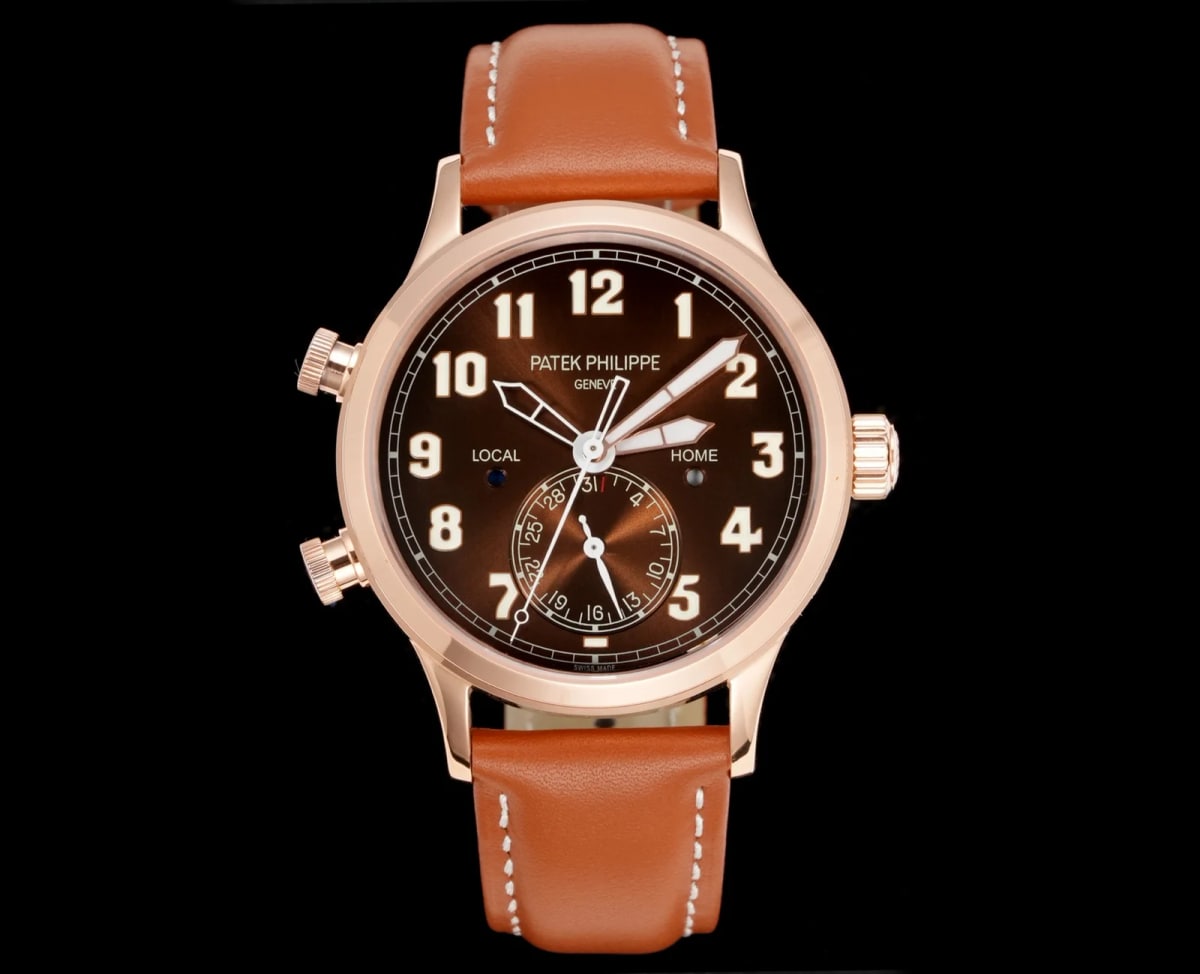
Patek Philippe Calatrava Pilot Travel Time 5524R-001 in rose gold: a 42 mm case, a brown dial with applied Arabic numerals, a date subdial and two time zones.
Opens a WhatsApp chat with the model, the reference and this page already written into the message.
Nothing is sent until you press send. Prefer to write it yourself? Use the inquiry box further down.
About this watch
Design and details
The 5524R-001 is the Calatrava Pilot Travel Time in rose gold: a 42 mm round case, a brown sunburst dial over a sandblasted brass base, applied gold Arabic numerals filled with luminescent coating, and a date subdial above six o’clock. The photographs show that dial straight on, at an angle and close up, and they show the controls on both flanks of the case — the crown at three o’clock and the two push-pieces on the left.
The frames settle the layout: the maker and city lettering above the centre, LOCAL and HOME beside it with a small round indication under each, a printed minute track at the rim, and the date scale printed 1 to 31 with 31 in red. What they cannot settle is what the individual watch is built from or fitted with — the metal of its case, which movement is inside it, which of the reference’s two straps is supplied, and whether it has been tested for water resistance — so those become questions in the inquiry rather than claims on this page.
How do the two time zones work on the 5524R-001?
The dial carries two hour readings rather than two dials. The local-time hour hand is moved forward and back in one-hour steps by the two push-pieces on the left of the case, at eight and ten o’clock, so you can reset the local hour without stopping the watch and without touching the crown.
Home time keeps running on its own throughout, and the reference also shows the day/night state of home time, so you can tell whether the other zone is in daylight or darkness before you call it. The date follows local time, which is what keeps the calendar changing with the day you are actually living rather than the one back home.
What does the date subdial above six o’clock show?
That subdial is the date register. Its scale is printed around the outside of the small disc at its centre and runs from 1 to 31, with the 31 marking picked out in red at the top, and a hand travels the scale as the month advances. It is a date, not a month or a second time zone, read the way you would read a date aperture, only on a longer track.
Because the date follows local time, this is the hand to watch when you cross a time-zone boundary: it moves with the local date rather than the home date. On a dial of this size the register is easy to pick out, but the scale is short, so ask for a straight-on frame of the subdial in daylight if you want to check how the printing and the red 31 sit on the brown surface.
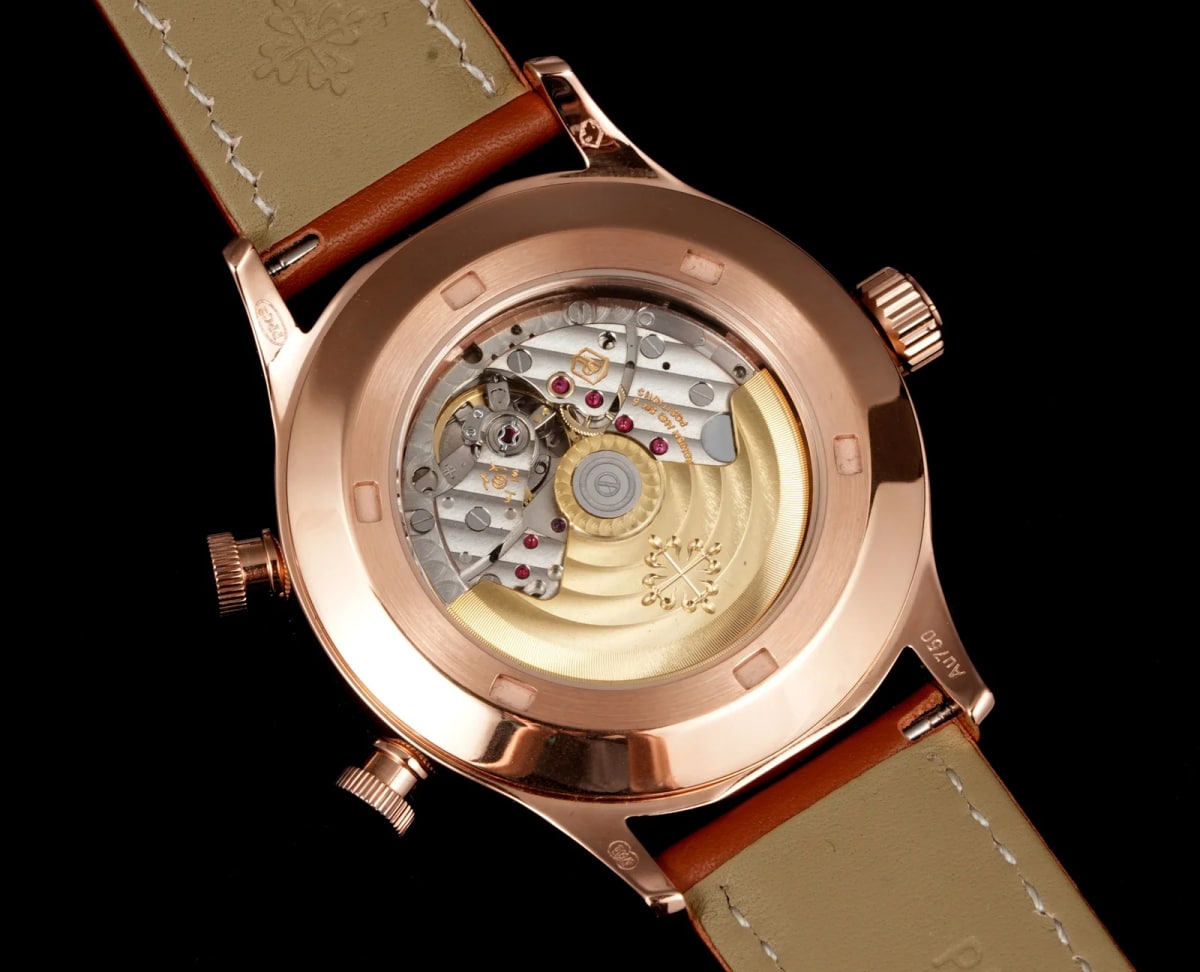
Case back detail with the round back of the gold-tone case catching the light and the brown leather strap turned away below it
How does a 42 mm case wear on the wrist?
Forty-two millimetres is the size of this reference, and the pilot layout gives it visual weight: the numerals are large, the hands are broad, and the case carries four controls with the crown on the right and the two push-pieces on the left.
Diameter on its own never answers a fit question. Lug-to-lug length, case thickness and how the strap leaves the lugs decide where the case sits, and those numbers belong to the individual watch rather than to the reference. Send us your wrist measurement and we can tell you how the dimensions of the actual watch compare with it.
What does the dial look like in the photographs?
The dial is brown over a sandblasted brass base, and the finish shifts with the light: flat and dark in the straight-on frame, warmer where the angled and the close-up frames catch it. The Arabic numerals are applied and filled with luminescent coating, and the minutes are printed at the rim, outside them.
The frames also show how much of the dial is given over to reading points: the maker and city lettering above the centre, LOCAL and HOME on either side with a small round indication beneath each, the date register above six, and the printed minute ring. Ask for a straight-on dial photograph in daylight if you want to judge the brown yourself, because a black background changes how a dark dial reads.
Which strap and clasp does this reference come with?
Patek Philippe lists the 5524R-001 on a leather strap with a prong buckle, and the reference’s second strap is a khaki calfskin. The photographs show one brown leather strap with light stitching; they do not show the khaki one, and they cannot tell you which strap the individual watch will arrive on.
So the strap is a question rather than a given: ask which of the two is supplied, whether the second one comes with the watch, and what the buckle is made from. Strap length and the number of holes matter as much as the material, because a 42 mm case changes where the strap sits on the wrist; a photograph of the strap laid flat with the buckle closed answers both at once.
What should you look at across the four frames?
Each frame answers a different question. The straight-on frame fixes the dial colour, the numeral style and the position of the two push-pieces; the three-quarter frame shows the shape of the case flank and how the lugs meet the strap; the dial close-up shows the printing and the date scale; and the last frame looks at the back of the case, where the opening shows the working parts with the strap turned away.
Work through them in that order and you have most of what a still image can give you. What they leave open is everything behind the dial and inside the case, which is why the last frame matters more for what it prompts you to ask than for what it shows: what the case and the push-pieces are actually made from, which movement is fitted, and whether the watch has been tested for water resistance.
Specification
Specifications and configuration
Model details and design
Detail
Description
Model reference
5524R-001
Model size
42 mm, round case
Dial
Brown sunburst over a sandblasted brass base
Dial print
Maker and city above the centre; LOCAL and HOME beside it; minute track at the rim
Hour-marker layout
Applied Arabic numerals filled with luminescent coating; a small rectangular index at six o’clock
Hand arrangement
Broad baton hour and minute hands over the centre; a small hand serving the date subdial
Date display
Subdial above six o’clock, scale printed 1 to 31 with 31 in red
Bezel design
Smooth round bezel, no scale or graduations
Colour combination
Brown dial and brown leather strap with a warm gold-tone case
Strap shown
Brown leather with light stitching, as photographed
Clasp
Prong buckle
Case back
Round back with a central opening, as photographed
Movement (reference design)
Two-time-zone design: local hour stepped by the two case push-pieces
Questions
Frequently asked about this reference
How does the 5524R-001 differ from the other Calatrava Pilot Travel Time references?
This page covers one configuration: the 5524R-001, the rose-gold reference with the brown dial. What you can compare from the photographs is the dial colour and finish, the applied Arabic numerals, and the tone of the case. Patek Philippe documents this reference on a leather strap with a prong buckle and gives it a khaki calfskin second strap, so the strap is itself a configuration to confirm. If you are weighing it against another Calatrava Pilot Travel Time, name that reference and we will compare the two offers side by side rather than guess at the differences.
Will a 42 mm case be too large for my wrist?
That depends on your wrist and on the actual dimensions of the offered watch, not on the diameter alone. Ask for the lug-to-lug length, the case thickness and the distance between the lugs, then set them against your own wrist measurement. A 42 mm pilot case with two push-pieces on the left also sits differently from a smooth dress case of the same diameter, so the width across the case including the push-pieces is worth having.
What should I check in the photographs before I inquire?
Start with the dial straight on and in daylight, then the numeral ring at an angle, then the date subdial close up, and finish with the case back. In each frame look for the things you would notice on the wrist: how crisp the printing is, whether the applied numerals sit flat, how the case edges and lugs read, and the condition of the strap and its stitching.
What can these photographs not prove about the watch?
They cannot tell you what the case and the push-pieces are actually made from or whether any part of the watch is plated, which movement is fitted, which of the reference’s two straps is supplied, or whether the watch has been tested for water resistance and in what state. A photograph shows one example of the reference. Ask for those details, in writing, about the piece you are being offered.
What should I confirm before paying?
Confirm the reference 5524R-001, the metal of the case and push-pieces, the movement fitted, the strap and buckle supplied, the measured size and weight of the actual watch, and its water-resistance state with any test evidence. Ask for photographs or a short video of that specific watch rather than stock images, so what you agree to is what you have already seen.
Does setting local time on the 5524R-001 disturb the date or the home-time reading?
Stepping the local hour forward or back with the two push-pieces does not stop the watch and does not move home time, which keeps running on its own. The date is tied to local time, so it follows the local hour you have set. Whether the date and the day/night indication change cleanly on the offered watch is something to check in a short video while the hour hand is stepped through midnight and noon.
Inquiry message
The message below is pre-written with the model, the reference and this page. The button opens a WhatsApp draft for you to review before sending.
Which movement is fitted in this watch, and what the case and the two push-pieces are actually made from.
Which of the reference’s two straps is supplied — the brown leather with the prong buckle, or the khaki calfskin — and the strap length and number of holes.
The measured case size, thickness, lug-to-lug length and weight of the actual watch, and whether it has been tested for water resistance.
Photographs or a short video of this specific watch: the dial straight on in daylight, the numerals and printing at an angle, the date subdial close up, and the case back.
Current price for one watch, the shipping cost to my country, the countries you ship to and the lead time.