Omega Speedmaster Silver Snoopy Award 50th Anniversary 310.32.42.50.02.001, 42 mm stainless steel with a silver dial
Model reference: 310.32.42.50.02.001
Price by inquiryconfirmed in the chat, with shipping and lead time
Model size42 mm
DialSilver, with the blue carried by the markers and hands
Dial printBrand and line lettering above the centre, with a small stamp below it
Hour-marker layoutAngle-shaped markers set around the dial, with no numerals
Omega Speedmaster Silver Snoopy Award 50th Anniversary 310.32.42.50.02.001: a 42 mm chronograph with a silver dial, a blue ceramic bezel and two Snoopy figures.
Opens a WhatsApp chat with the model, the reference and this page already written into the message.
Nothing is sent until you press send. Prefer to write it yourself? Use the inquiry box further down.
About this watch
Design and details
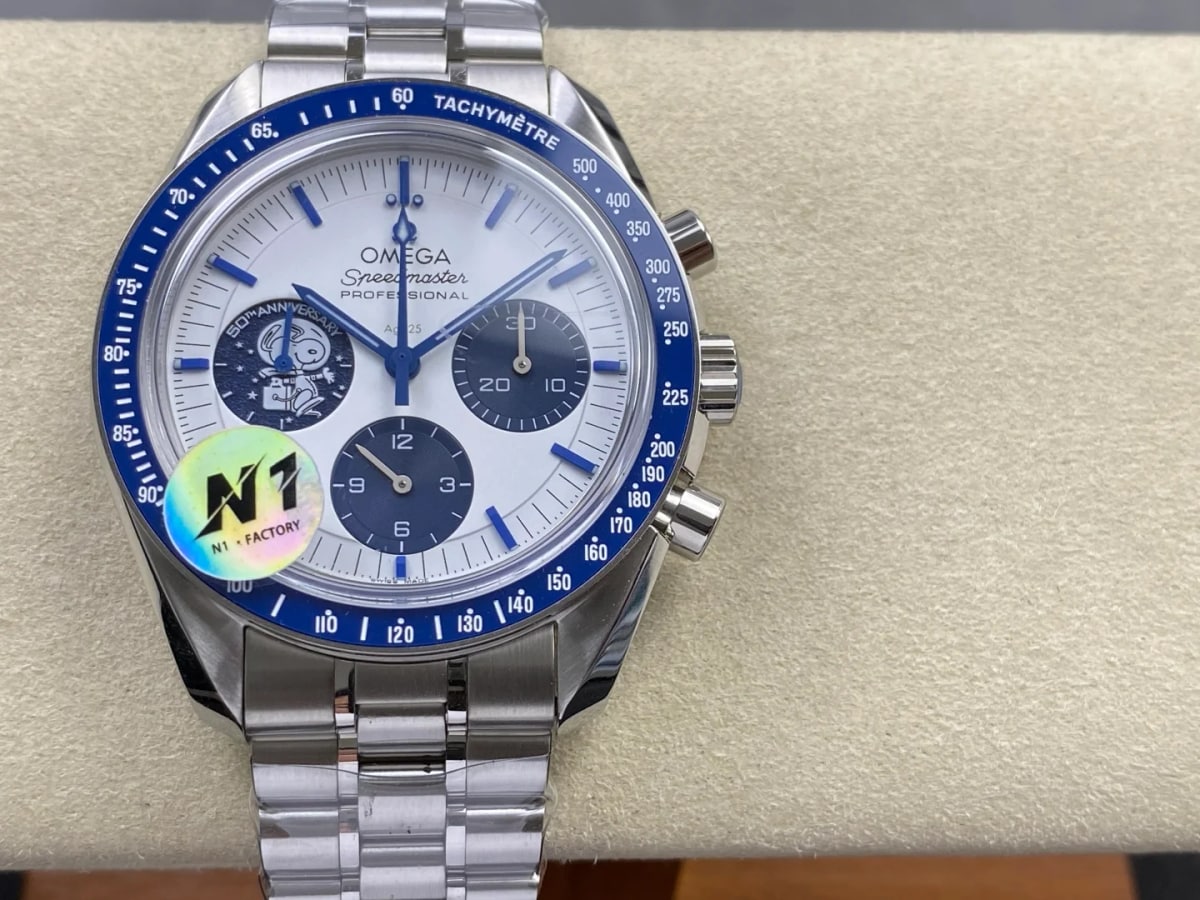
This record covers the Silver Snoopy Award 50th Anniversary Speedmaster, reference 310.32.42.50.02.001, as it appears in the frames supplied with the listing: a 42 mm chronograph with a silver dial, blue markers and hands, three blue registers, a blue tachymeter bezel and a metal link bracelet. The photographs keep the markings they came with, including the round sticker still sitting on the crystal.
The published data for the reference supplies the rest: the blue ceramic bezel ring with its white enamel tachymeter scale, the embossed silver Snoopy medallion in the small-seconds register at nine o’clock, the sapphire display back whose applied elements carry a Snoopy animation driven by the chronograph, and the calibre 3861 of the reference design. Everything that belongs to the individual watch rather than to the reference — which movement is fitted, what the case and bracelet are made of, which strap comes with it, and the state of its water resistance — is put as a question in the inquiry list instead of being stated here.
What do the three registers on this dial count?
Each register does a different job. The one at three o’clock is the minute counter, and its scale is printed in ten-minute steps up to thirty, which is why 30, 20 and 10 are the only numerals inside it. The register at six o’clock is the hour counter, marked 12, 3, 6 and 9, and it takes over once a timing run passes half an hour. The register at nine o’clock is the running seconds, and on this reference the medallion sits inside it, so it is the one register that is never empty.
Read together, they give a complete elapsed time from the centre seconds hand: seconds on the sweep hand, minutes on the three o’clock register and hours on the six o’clock register. In the frames all three register hands are parked where the chronograph was left, so the pictures show the layout rather than the counters at work. Whether each hand starts, stops and returns to zero cleanly is worth confirming on a short video of the actual watch before you commit.
How is the blue tachymeter bezel read?
A tachymeter gives a rate rather than a duration. Start the chronograph as the thing you are timing begins, stop it when that thing ends, and the centre seconds hand will be pointing at a number on the bezel: that number is how many of the same units the moving object would cover in an hour. The scale rises to 500 at the top right and steps down through 400, 350 and the rest as you follow the ring anticlockwise, so short events are read near the start of the scale.
The numerals are white against the blue ring, with the divisions printed between them, and the scale sits on the bezel around the crystal rather than on the dial, which is why the dial itself carries no timing scale at all. One thing the pictures cannot settle is whether the ring is fixed or turns, since a still image looks the same either way. Ask about that on the piece you are considering if a rotating bezel matters to you.
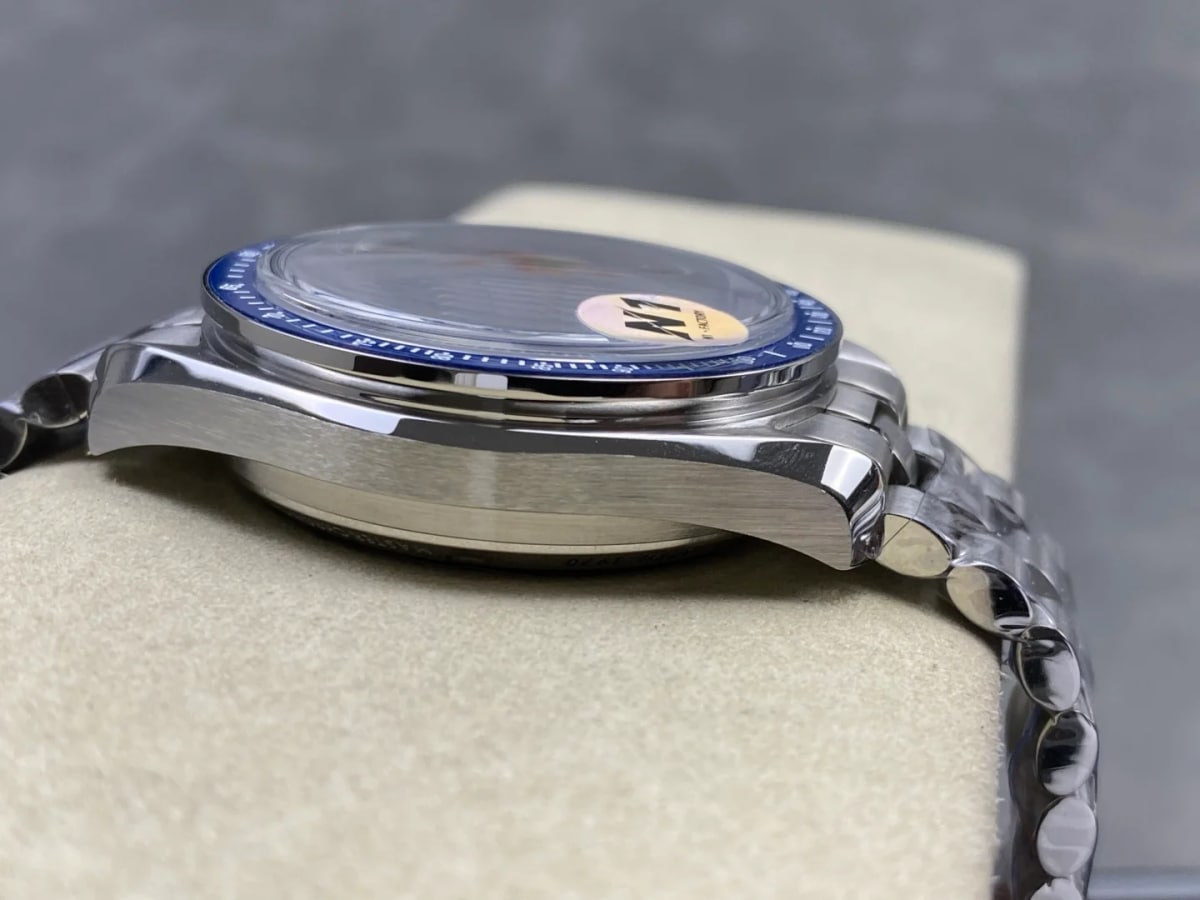
Detail of the case flank with its crown and two pushers, the sticker on the glass, the bezel edge seen from the side and the bracelet folded with its clasp
Why do the markers and hands carry the blue instead of the dial?
The dial keeps its silver-white surface and the colour is applied on top of it: the hour markers are separate angle-shaped pieces set into the dial, and the hands are finished in blue. The medallion marks the anniversary of the award Omega received for its part in bringing Apollo 13 home, which is why a Snoopy figure appears twice on this watch, once inside the dial register and once as applied work on the movement side.
That leaves a dial that reads as one pale surface carrying blue accents rather than a printed pattern, and it shifts with the light: the silver lifts and throws back whatever is in front of it while the blue stays dark, so the markers hold their shape at an angle even when the surface is bright. What the frames cannot show is how the blue on the markers and hands of the offered watch was produced, so ask how it is finished on the piece being offered.
What sits on the far side of the case, and what drives the animation?
The back of this reference is a sapphire display back rather than a solid cover, and its applied elements carry a second Snoopy: the far side of the moon and a rotating Earth disc are worked onto that side of the watch, and Snoopy travels across them. The animation is tied to the chronograph rather than to the running seconds, so it is the chronograph that sets it moving.
Because the back is open, the movement is on show as well, and the fitted calibre is exactly the kind of detail a photograph cannot settle for an individual watch. None of the four frames on this page look at the back at all; they cover the dial, the bezel, the medallion and the case flank. If the animation is what interests you, ask for a video of the back with the chronograph started, stopped and reset.
The bracelet in these frames is steel — which strap should I expect?
Every frame on this page shows the watch on a metal link bracelet, and the clasp is folded over the case in the close-up frame. The reference as published by Omega is supplied on a blue coated nylon fabric strap, whose lining carries the Apollo 13 mission trajectory. Those two do not agree, and the disagreement belongs to the piece being offered rather than to the reference, so this page describes the bracelet the photographs show and says nothing about what would arrive with the watch.
Ask which bracelet or strap is actually fitted to the watch you are being offered, and whether the other one comes with it. The answer changes two things at once: how the watch looks next to the blue bezel, and how it feels on the wrist, because a link bracelet and a fabric strap put the same case on the arm very differently. That question is already one of the five in the inquiry list below.
How does a 42 mm Speedmaster chronograph sit, and what settles it?
Forty-two millimetres is the model size, and on a chronograph that number is only part of the story: the bezel ring, the case flanks with the crown and the two pushers, and the way the lugs drop toward the wrist all decide how much of the arm the watch covers. Case depth matters here too, because the pushers sit proud of the flank and the bracelet has to fold around them.
The measurements that answer a fit question — lug-to-lug length, case thickness, the number of links fitted and your own wrist measurement — are not visible in any photograph, and they change once a bracelet has been sized for someone. Ask for them in millimetres for the specific piece, with a photograph of the bracelet closed on a flat surface, and the answer will be about the watch you would actually receive.
Specification
Specifications and configuration
Model details and design
Detail
Description
Model reference
310.32.42.50.02.001
Model size
42 mm
Dial
Silver, with the blue carried by the markers and hands
Dial print
Brand and line lettering above the centre, with a small stamp below it
Hour-marker layout
Angle-shaped markers set around the dial, with no numerals
Hand arrangement
Blue hour and minute hands, with a centre chronograph seconds hand
Subdial layout
Small seconds with the medallion at 9; 30-minute counter at 3; 12-hour counter at 6
Bezel design
Blue ceramic ring with a white tachymeter scale
Colour combination
Silver-white dial and blue accents inside a blue bezel ring
Bracelet shown
Metal link bracelet in the photographs, with the clasp folded over the case
Clasp
Folding clasp, shown closed against the case side in the close-up frame
Case back
Sapphire display back with applied Snoopy elements
Movement (reference design)
Co-Axial Master Chronometer calibre 3861
Strap (reference supply)
Blue coated nylon fabric, published for this reference
Questions
Frequently asked about this reference
What sets this reference apart from a standard silver-dial Speedmaster?
Three things are visible straight away: the medallion inside the nine o’clock register with its ring of anniversary lettering, the blue ceramic tachymeter bezel with its white scale, and three blue registers sitting in a silver dial. The second Snoopy is on the other side, worked into the applied elements of the sapphire display back so that it moves when the chronograph runs. The medallion and the back animation belong to this anniversary reference rather than to the silver dial as such, so dial colour alone is not what makes the watch the 50th Anniversary piece.
How do I check the medallion and the case-back animation?
For the medallion, ask for a close-up taken straight on rather than at an angle, in daylight rather than with flash, framed on the nine o’clock register; both the ring of lettering and the figure at its centre should be sharp. For the animation, ask for a short video of the case back with the chronograph started, stopped and reset, because the moving parts are driven by the chronograph and a still frame of the back proves nothing. Make both checks on the offered watch, not on a stock picture.
How does the steel bracelet change the look against the blue bezel?
A metal bracelet puts another bright, reflecting surface directly against the case, so the blue bezel reads as a single dark ring held between two pale ones. A fabric strap in the blue this reference is published on carries the colour on down from the bezel to the wrist and tends to make the watch look smaller on the arm. The frames here show the bracelet, so judge that combination from them, and ask for a photograph on the strap if you want to compare the two.
What can these photographs not prove about the watch?
At least four things: which movement is fitted, what metal the case and bracelet actually are, which strap or bracelet would come with the watch, and the state of its water resistance as supplied. The frames also cannot show weight or any measurement in millimetres, because nothing in a photograph is to scale. Each of those is a question about the individual piece, and the inquiry list below is written to get them answered.
What should I confirm before I pay?
Ask for the reference number as it appears on the watch, the movement fitted, the material of the case and bracelet, and the bracelet or strap that is actually supplied. Then ask what evidence comes with it for water resistance, and whether the chronograph starts, stops and resets cleanly on video. Price, availability and delivery belong in the same conversation, so that every answer describes one and the same watch.
How does the silver dial photograph?
A pale, reflective dial takes on the colour of whatever surrounds it and blows out under direct flash, so it can look grey in one frame and white in the next. The useful photograph is a straight-on shot in soft daylight with the watch filling the frame, which keeps the blue of the markers and registers close to how they read in person. Ask for one frame in daylight and one in shade, so the dial’s real tone is not hidden by the lighting.
Inquiry message
The message below is pre-written with the model, the reference and this page. The button opens a WhatsApp draft for you to review before sending.
Which movement is fitted to this watch, and what the case and the bracelet are made of.
The bracelet or strap actually supplied with the piece: the metal link bracelet in the photographs, or the blue coated nylon fabric strap published for this reference, and whether the other is included.
Current price for one watch, the shipping cost to my country, the countries you ship to and the lead time.
Photographs and a short video of this exact watch: the nine o’clock medallion close up, the case back with the chronograph started, stopped and reset, and the clasp closed.
The state of the water resistance as supplied, and any evidence that comes with it.