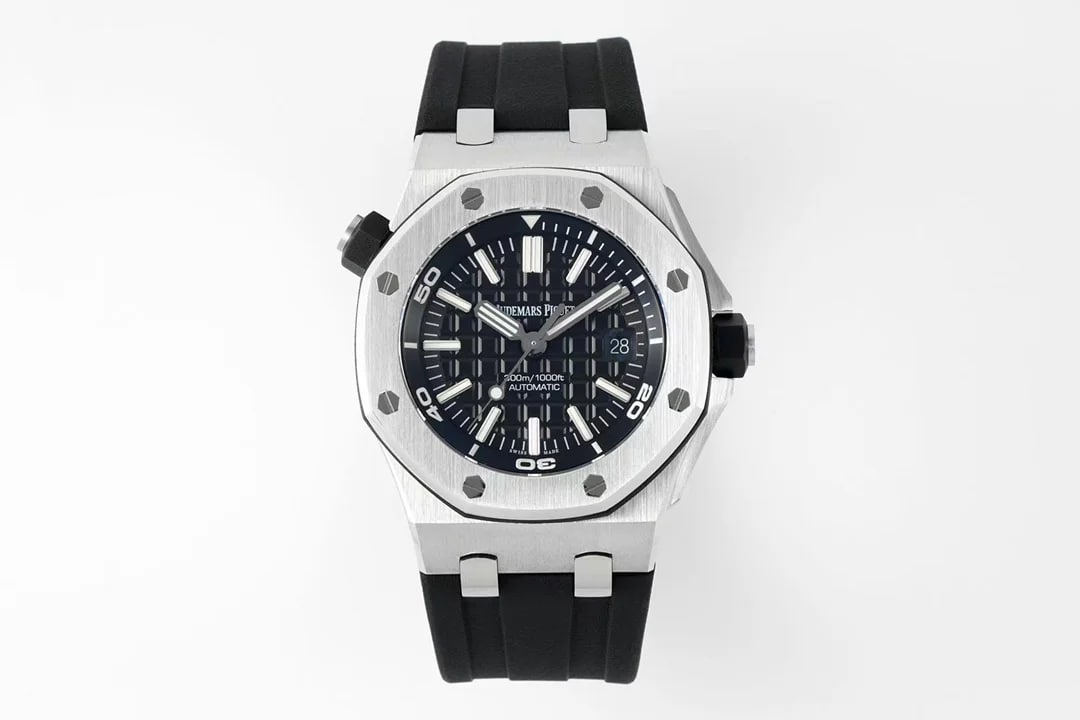
Audemars Piguet Royal Oak Offshore Diver, reference 15710ST.OO.A002CA.01, black Méga Tapisserie dial on a rubber strap, 42 mm
Model reference: 15710ST.OO.A002CA.01
Price by inquiryconfirmed in the chat, with shipping and lead time
Model size42 mm
DialBlack, Méga Tapisserie
Dial printBrand lettering above the centre; depth rating and AUTOMATIC below
Hour-marker layoutApplied baton indices, triangle at twelve o’clock
Reference 15710ST.OO.A002CA.01, the 42 mm Royal Oak Offshore Diver with a black Méga Tapisserie dial, an internal sixty-minute dive scale and a black rubber strap.
Opens a WhatsApp chat with the model, the reference and this page already written into the message.
Nothing is sent until you press send. Prefer to write it yourself? Use the inquiry box further down.
About this watch
Design and details
This is the 42 mm Royal Oak Offshore Diver, reference 15710ST.OO.A002CA.01, shown with a black Méga Tapisserie dial on a black strap. The photographs settle the appearance: the squared dial texture, the applied markers, the printed block under the centre, the date at three o’clock, and a ring of dive numerals inside the crystal rather than on the bezel.
Two details are worth noticing before you read on. The case carries two crowns rather than one, because the timing scale is internal and is driven from the side of the case, and the octagonal bezel therefore stays fixed with its screws on show. Everything else the frames cannot answer — which movement is fitted, what the case and bezel are made from, which strap and buckle come with the piece, and what its water-resistance state is — is asked for in the inquiry list at the foot of this page.
Why is the sixty-minute dive scale inside the crystal instead of on the bezel?
On this reference the elapsed-time scale is printed on a ring that sits inside the crystal, around the outer edge of the dial. That leaves the bezel free to be the fixed octagonal ring with exposed screw heads that identifies the Offshore, rather than a part that turns. The numerals climb in ten-minute steps — 20, 30, 40 and 50 are legible in the frames — and the fine divisions between them are what you read against the minute hand.
The trade-off is where your eye has to go. On a classic diver you rotate a ring and read a marker on the outside of the case; here you look inside the glass, which keeps the scale clear of knocks but puts the numerals close to the dial texture, where they are less obvious at a glance. Whether the scale on the offered watch turns smoothly through its full sixty minutes, and whether it returns exactly to its start, is something to watch on video rather than infer from a still.
What does the Méga Tapisserie dial do as the light moves across it?
Méga Tapisserie is a raised grid of squares cut into the dial surface, larger and deeper than the small tapisserie used on other Royal Oaks. In the straight-on frame the surface reads as flat black and the pattern almost disappears; in the angled frame the walls of each square catch the light and the dial becomes a diagonal weave. That difference between two photographs of one dial is the pattern working, not two different dials.
The flat finish is what keeps the watch legible, because the printed block under the centre and the applied markers have to sit on top of that texture and still read. How crisp the pattern edges are on a particular watch is only visible up close, so ask for a frame at an angle in daylight instead of judging from a lit studio shot.
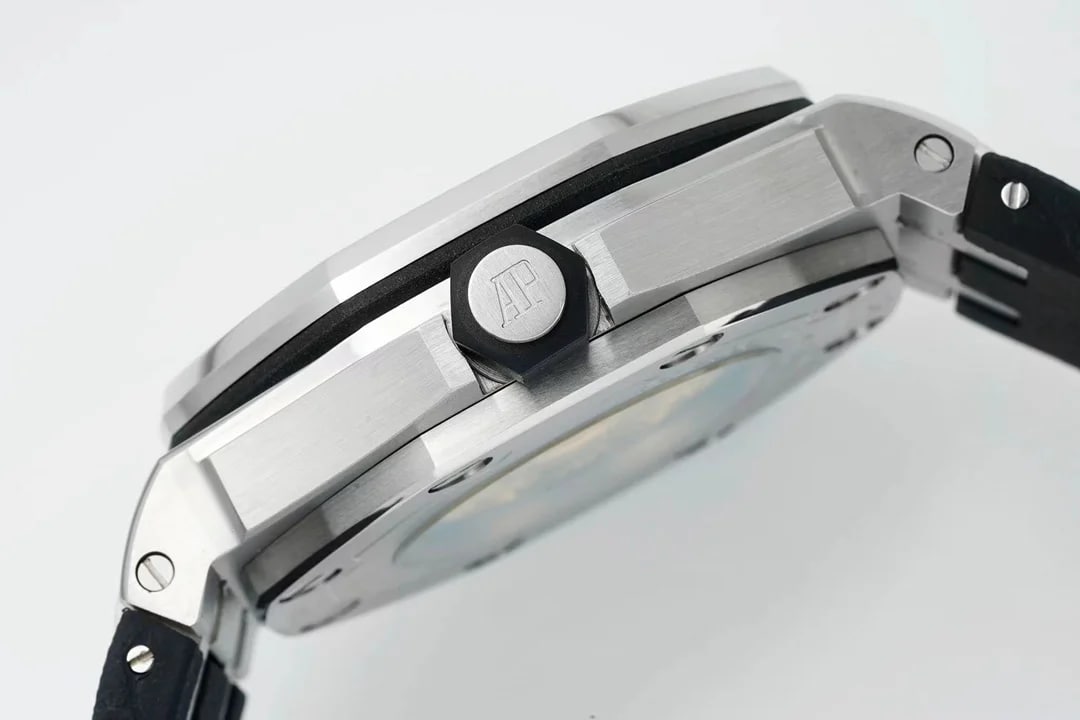
Side detail of the case showing the octagonal crown and its monogram, the brushed and polished flank, a screw head at the strap fitting and the black strap leaving the case
Which parts of the dial are applied, and which are printed?
The hour markers are separate pieces set onto the dial: applied indices in a white-metal tone, on baton shapes, with a triangle at twelve o’clock. The hands belong to the same family — broad hour and minute hands with luminous fills and a slim centre seconds hand. Everything else is printed on the surface: the brand lettering above the centre, the two-line block beneath it, the minute divisions, the dive numerals on the inner ring and the line at the bottom of the dial.
That split is what you inspect first, because printed elements show wear or damage sooner than applied ones, while applied markers can be checked for sitting flat and for even spacing. In these frames the white print is clean and the markers sit level, but a still image cannot tell you whether the luminous material is intact across the whole dial, so ask for one photograph in dim light.
What is the movement in the reference design, and is it visible through the back?
As specified, this reference uses the self-winding calibre 3120, running at 21,600 vibrations per hour with around 60 hours of power reserve, and it is described with a sapphire display back. Those are the published design parameters for the reference, and they are useful context rather than a description of any one watch.
The movement actually fitted to the piece you are offered is a separate matter, and it is where a catalogue page has no authority at all. Ask which movement is inside, ask for a photograph of the back, and confirm whether the back on that watch is a display back. If it is, the back gives you something concrete to judge from a clear photograph, which is worth more than any summary.
How thick is the case, and how does that change the way it wears under a sleeve?
The case is 42 mm across and about 14.1 mm deep, which is substantial for that diameter and is part of what gives an Offshore its presence on the wrist. Depth, not diameter, is what decides whether a watch slides under a shirt cuff or sits on top of it, and on a strap rather than a bracelet the case tends to shift a little more as the wrist moves.
Two measurements answer a fit question better than the diameter on its own: lug-to-lug length and case thickness, taken together with your wrist circumference. None of them can be read off a ruler in a product photograph, so ask for them measured on the watch being offered before you decide whether 42 mm is right for you.
What do the exposed screws on the bezel and the case tell you when you inspect one?
The bezel is held by hexagonal screw heads that sit flush in the octagonal ring, and the frame of the case flank also shows a screw head at the lug where the strap is fitted. They are a design signature, and they are also the parts an inspector checks first, because a screw that has been forced leaves a mark across its slot or sits proud of the surface it should be level with.
In these frames the screw heads read clean and evenly set, and the bezel edge shows the highlight you would expect from an angled shot. A still photograph cannot tell you whether every screw is tight, whether the heads line up the same way when you have the watch in front of you, or how the case flank behaves in daylight. Ask for a short video turning the watch slowly instead.
Specification
Specifications and configuration
Model details and design
Detail
Description
Model reference
15710ST.OO.A002CA.01
Model size
42 mm
Dial
Black, Méga Tapisserie
Dial print
Brand lettering above the centre; depth rating and AUTOMATIC below
Hour-marker layout
Applied baton indices, triangle at twelve o’clock
Hand arrangement
Broad hour and minute hands, slim centre seconds
Date display
Aperture at three o’clock, no magnifier
Bezel design
Fixed octagonal ring with exposed hexagonal screw heads
Colour combination
Black dial, black strap, silver-tone case and bezel
Strap shown
Black rubber strap
Clasp
Steel pin buckle
Case back
Sapphire display back on the named reference
Movement (reference design)
Self-winding calibre 3120, 21,600 vph, about 60 hours
Questions
Frequently asked about this reference
What does the second crown at ten o’clock do?
It drives the internal rotating dive scale. On this reference the timing ring sits inside the crystal, so the crown at ten is what turns it, while the crown at three winds and sets the watch. That is also why the bezel itself is a fixed steel ring with screw heads instead of a ring you rotate by hand. Whether the second crown turns smoothly on the watch being offered, and whether the scale stops where it should, is a question for a video of that piece.
How does a 42 mm Offshore case wear compared with a 40 mm diver?
It wears bigger than the two-millimetre difference suggests, because the case is about 14.1 mm deep and the bezel is a wide octagonal ring rather than a slim turning bezel. The width across the lugs is what decides whether it overhangs your wrist, so ask for lug-to-lug length and case thickness measured on the actual watch, and compare those with a watch you already wear.
What should I check on the rubber strap and on the inner dive scale?
On the strap, look at the ends where it meets the lugs and at the buckle, since that is where a strap creases, splits or pulls away from its fittings, and ask whether the buckle and keepers supplied with the watch are the ones in the photographs. On the scale, ask for the crown at ten to be turned through its full sixty minutes on camera, so you can see the numerals travel all the way round and line up again at the start.
What can these photographs not prove about the watch?
They show the front, the angle, the dial close up and the case flank, and nothing else. They cannot show which movement is fitted, what the case and bezel screws are actually made from, which strap and buckle would be supplied, or what the water-resistance state of the piece is. A photograph also cannot show whether the luminous material on the markers and hands still performs. Each of those has to be answered in words, by the seller, about the specific watch.
What should I confirm before paying?
The total for one watch and the shipping cost to your country, which countries can be shipped to, and how long delivery takes. Then the mechanical and material questions: which movement is inside, what the case and bezel are made from, which strap and buckle are supplied, and any evidence for the water-resistance state of that watch. Ask for each answer in writing, together with the photographs or video that back it, before any money changes hands.
Is the Méga Tapisserie pattern part of the dial or printed onto it?
It is the dial surface itself, cut as a raised grid of squares and finished flat, not a printed image of a pattern. That is why the structure changes with the light while the printed lines on the dial stay constant in every frame. On the watch you are offered, how sharp the square edges are and how evenly the surface reflects is something a close-up at an angle in daylight will show, so ask for that photograph rather than a flat lit one.
Inquiry message
The message below is pre-written with the model, the reference and this page. The button opens a WhatsApp draft for you to review before sending.
Current price for one watch, the shipping cost to my country, the countries you ship to and the lead time.
Whether the second crown at ten turns the internal dive scale smoothly through its full sixty minutes and returns to the start.
Which movement is fitted to the offered watch, and whether the case back on that piece is a display back.
What the case, the bezel and its screw heads are made from, since the photographs do not settle it.
A close-up of the dial at an angle in daylight, plus a short video turning the watch and the strap ends and buckle.