Replica collection · Royal Oak · Self-winding date
Audemars Piguet Royal Oak Selfwinding, steel and 18-carat rose gold with a silver Grande Tapisserie dial, 41 mm
Model reference: 15400SR.OO.1220SR.01
Price by inquiryconfirmed in the chat, with shipping and lead time
Model size41 mm
DialSilver-tone, Grande Tapisserie
Dial printBrand name and Automatic above and below the centre; Swiss Made at the bottom
Hour-marker layoutApplied baton markers at every hour, over the squared pattern
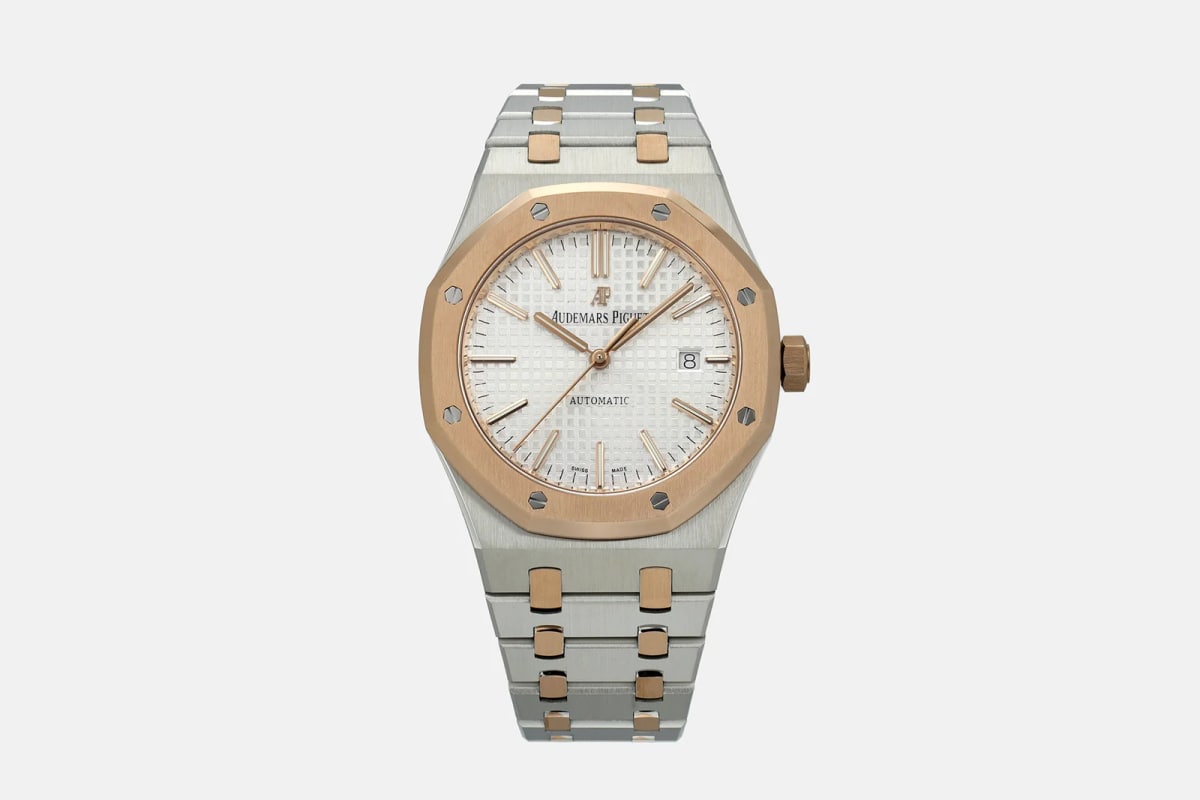
A 41 mm Royal Oak Selfwinding in steel and 18-carat rose gold, shown with its silver Grande Tapisserie dial, a date at three o’clock and the two-tone bracelet.
Opens a WhatsApp chat with the model, the reference and this page already written into the message.
Nothing is sent until you press send. Prefer to write it yourself? Use the inquiry box further down.
About this watch
Design and details
This is the 15400SR, the 41 mm Royal Oak Selfwinding built with a stainless-steel case and a bezel and centre links in 18-carat rose gold. The front frame sets out both colours at once: the octagonal bezel across the top of the dial, and the bands of rose gold running down the middle of the bracelet with steel on either side of them.
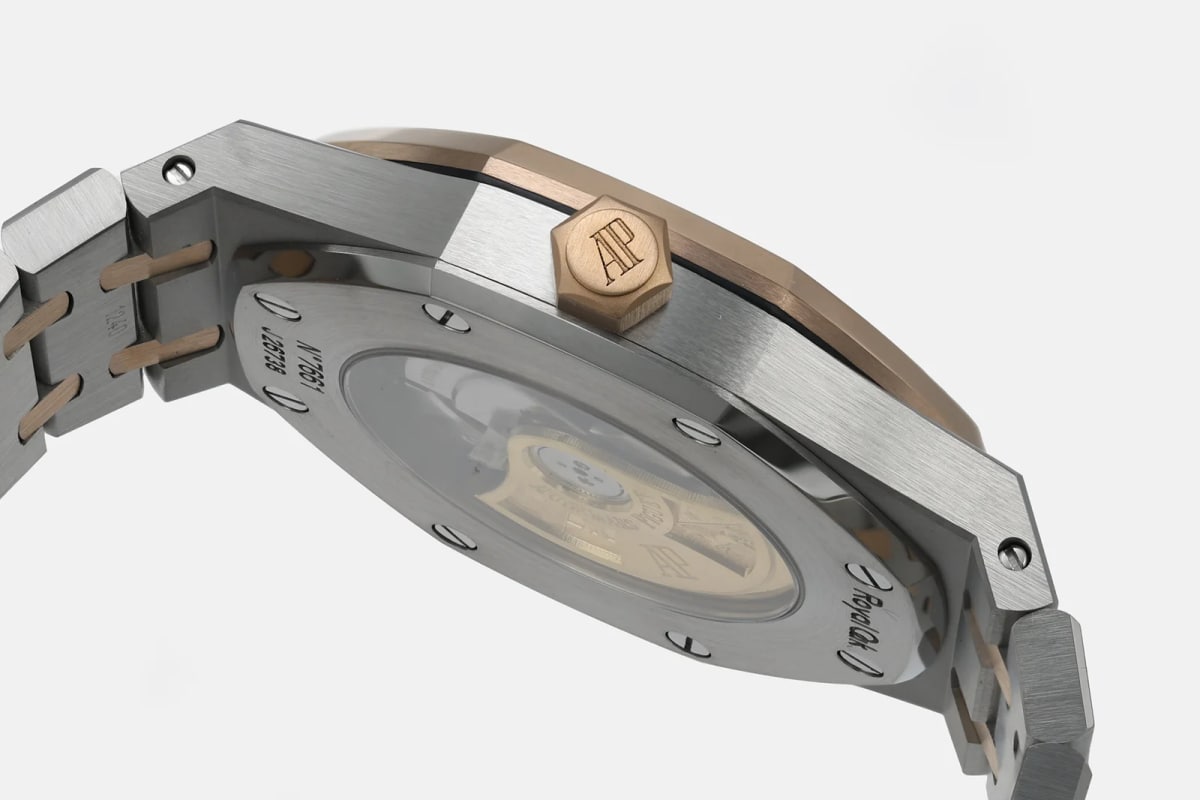
The second and third frames move closer — the case at an angle with the crown on the right, then the dial itself — and the fourth turns the watch over to the sapphire case back, where the winding weight can be seen through the glass. What the photographs cannot settle is raised in the conversation: which movement is fitted in the offered watch, what the metal of that particular piece is, which bracelet and clasp it arrives with, and what its water resistance has actually been tested to.
How does the 41 mm Royal Oak case wear on the wrist?
The Royal Oak case is not a plain round barrel. Its sides taper towards a thin profile on this reference, and the bracelet leaves the case at a fixed angle, so the first links curve around the wrist almost immediately instead of standing out from the lugs.
That is why the size on the card only starts the conversation. What decides the fit is the lug-to-lug measurement, the curvature of the first links and how many links are fitted. Two people with the same wrist circumference can end up with different answers. Ask for the lug-to-lug figure and for the wrist size the bracelet is currently set for.
What does the Grande Tapisserie pattern look like on this dial, and why does the date interrupt it?
Grande Tapisserie is a raised squared pattern laid over the dial surface in a grid, so the dial is never flat: light catches the top of each square and the grooves between them read darker. Across a 41 mm dial there is room for the grid to stay clearly legible, and in the third frame the individual squares are easy to pick out.
The pattern is also what makes the date conspicuous. At three o’clock the grid stops and a window is cut through it, with a fine minute track printed around the outer rim and applied baton markers sitting above the squares. A textured dial shows dust, marks and any polishing far more readily than a plain one, so view the frames at full size before asking questions.
Case back detail through the glass, with the winding weight visible inside and the bracelet links running away from the lugs
Where exactly does the rose gold sit on a two-tone Royal Oak?
On a two-tone Royal Oak the gold is not spread evenly. On this reference the bezel is rose gold, the case and the outer links are steel, and the centre links of the bracelet are rose gold, which produces long bands of colour running lengthwise down the bracelet rather than a solid-metal watch.
That arrangement changes what you see from each side. Straight on, the bezel and the centre bands dominate and the watch reads warm overall. From the side, the steel flank of the case and the outer links are what the eye picks up first. Which tone wins depends on light and angle, so judge the balance from the angled frame as well as the straight-on one.
What do these frames leave open about the individual watch?
The photographs establish shapes: the octagonal bezel with its eight screw heads, the squared dial pattern, the aperture at three o’clock, the alternating link colours. They do not establish what runs inside the case, what the offered piece is made from, or how it has been treated since it was assembled.
So the movement fitted, the metal of the case and of its gold parts, the thickness of any plating or wrap if something is not solid, the bracelet and clasp that ship with the watch and its water-resistance state are all questions rather than findings. Ask them directly, with the reference number, before reading any photograph as a description of the piece you would receive.
What is worth checking on the bezel screws and the bracelet?
The eight screw heads are the most exposed metal on the bezel, because they sit at the corners where a watch collects contact, and the bright edges of the bracelet links mark sooner than the brushed faces beside them.
Ask for close-ups of two or three bezel corners and of the bracelet lying flat, with the clasp both open and closed, and ask how many spare links come with the watch. The clasp itself is not visible in the frames supplied here, so its type and the adjustment it offers come from the seller rather than from the photographs.
Where does the 15400 sit in the Royal Oak Selfwinding line?
The 15400 generation followed the 15300 and it has since been discontinued, which is why this reference turns up as a used watch rather than a current catalogue piece. Its date sits at three o’clock and its dial is the silver Grande Tapisserie.
If you are weighing it against other Royal Oak Selfwinding watches, compare the reference number and the case size rather than the photographs, because dial patterns and apertures can look similar across generations. Bring the reference 15400SR.OO.1220SR.01 and the size you want into the conversation, and ask which related variants are on offer at the same time.
Specification
Specifications and configuration
Model details and design
Detail
Description
Model reference
15400SR.OO.1220SR.01
Model size
41 mm
Dial
Silver-tone, Grande Tapisserie
Dial print
Brand name and Automatic above and below the centre; Swiss Made at the bottom
Hour-marker layout
Applied baton markers at every hour, over the squared pattern
Hand arrangement
Baton hour and minute hands, thin centre seconds
Date display
3 o’clock, plain aperture cut through the pattern
Bezel design
Octagonal, brushed, with eight visible screw heads
Colour combination
Silver-tone dial with rose-gold bezel, hands and centre links, steel elsewhere
Bracelet shown
Integrated multi-link bracelet with rose-gold centre links and steel outer links
Clasp
Not shown in the frames supplied here
Case back
Sapphire back, winding weight visible through the glass
Movement (reference design)
Self-winding calibre 3120, 60 hours of power reserve, 21,600 vibrations per hour
Water resistance (reference design)
50 m
Crystal
Sapphire, front and back
Questions
Frequently asked about this reference
How does the two-tone 15400SR differ from the all-steel and the all-gold Royal Oak versions?
The all-steel version carries one metal across the case, bezel and bracelet, and the all-gold version carries gold across all of it, so the colour stays uniform in both. The two-tone 15400SR splits them: the bezel and the centre links are rose gold while the case and the outer links are steel, which leaves bands of steel separating bands of gold along the bracelet. That is a visual and weight difference rather than a functional one.
How does a 41 mm Royal Oak wear compared with smaller cases?
The diameter is only part of it. On an integrated bracelet the case sits closer to the wrist than a round watch of the same width, and the length from lug to lug — not the 41 mm across the bezel — is what decides whether the case overhangs. Ask for the lug-to-lug measurement and how many links are fitted before assuming the size will suit you.
What should I look at on a two-tone bracelet and bezel before committing?
Start with the eight bezel screw heads, since they sit at the corners where marks appear first, then follow the centre links for the same reason: gold-coloured polished metal shows wear more than steel does. Ask for the clasp open and closed, the bracelet closed flat, a close-up of two bezel corners, and the number of spare links included.
What can these photographs not prove about the watch?
They cannot show which movement is inside, what the offered case and gold parts are actually made from, which bracelet and clasp are supplied, or whether the watch has held its water resistance. They also say nothing about whether the individual watch is new or used. All of that has to come from the seller as a statement about the specific piece.
What should I confirm with the seller before paying?
The reference, the movement fitted, the metals used for the case, bezel and centre links with plating or wrap thickness stated if anything is not solid, the bracelet and clasp supplied, how many links are fitted and removable, the measured weight and lug-to-lug, and whatever the seller can show about water-resistance testing.
What is specific to the Grande Tapisserie dial on this reference?
The raised squared pattern covers the whole dial rather than only a centre panel, and the date window at three o’clock is cut straight through it, so the grid breaks at one point of the surface. Ask for the dial straight on in daylight and at an angle, so the depth of the squares and the edges of the aperture can both be judged.
Inquiry message
The message below is pre-written with the model, the reference and this page. The button opens a WhatsApp draft for you to review before sending.
Current price for one watch, the shipping cost to my country, the countries you ship to and the lead time.
Which movement is fitted in the offered watch, and whether it is the calibre 3120 arrangement.
The metal of the bezel, case and centre links on the offered piece, with the plating or wrap thickness stated if anything is not solid.
Lug-to-lug length, case thickness, the number of bracelet links fitted, and the wrist size the bracelet currently suits.
Photographs of the actual watch: the dial straight on and at an angle, two bezel corners close up, and the bracelet with the clasp open and closed.