Opens a WhatsApp chat with the model, the reference and this page already written into the message.
Nothing is sent until you press send. Prefer to write it yourself? Use the inquiry box further down.
About this watch
Design and details
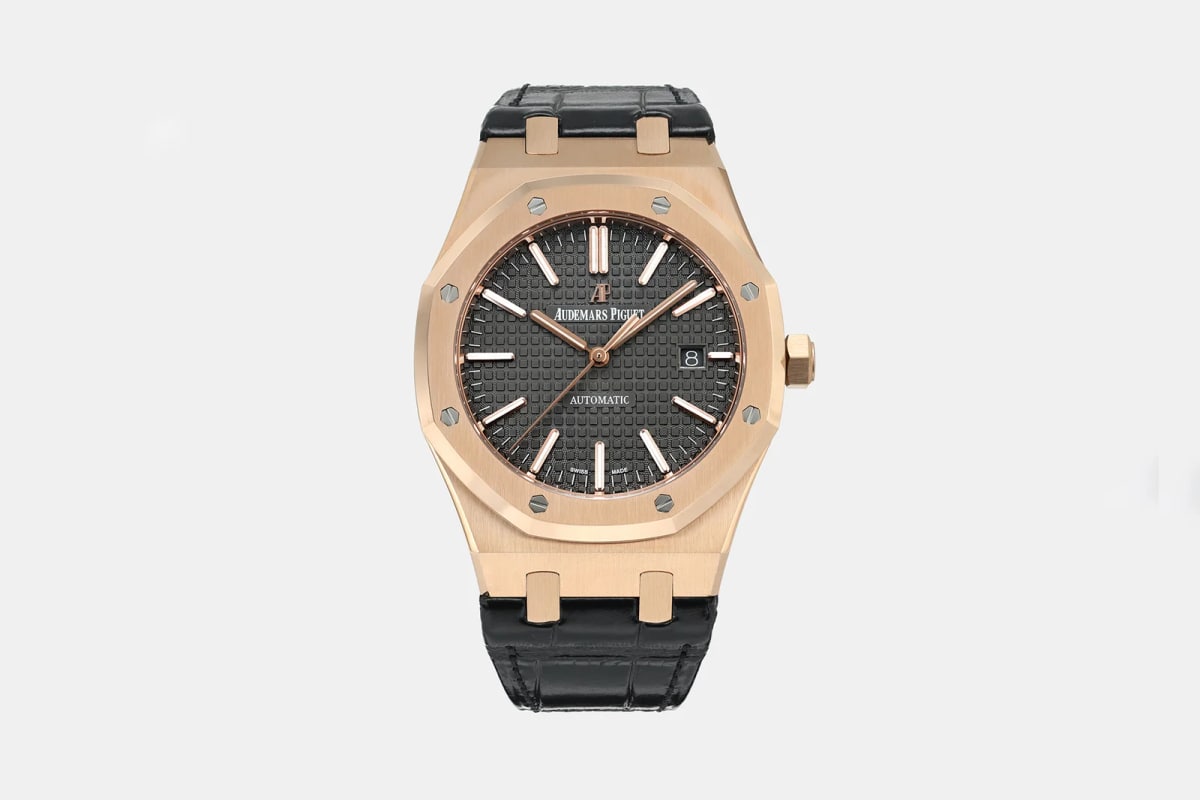
The 15400OR.OO.D002CR.01 is the 41 mm Royal Oak Selfwinding in 18-carat rose gold, and the photographs show its octagonal bezel with the screw heads set in its top face, the black Grande Tapisserie dial with applied rose-gold hour markers and hands, the date aperture at three o’clock and the black leather strap. The 15400 generation followed the 15300 and is discontinued, so any example now comes from what already exists rather than from a current production line.
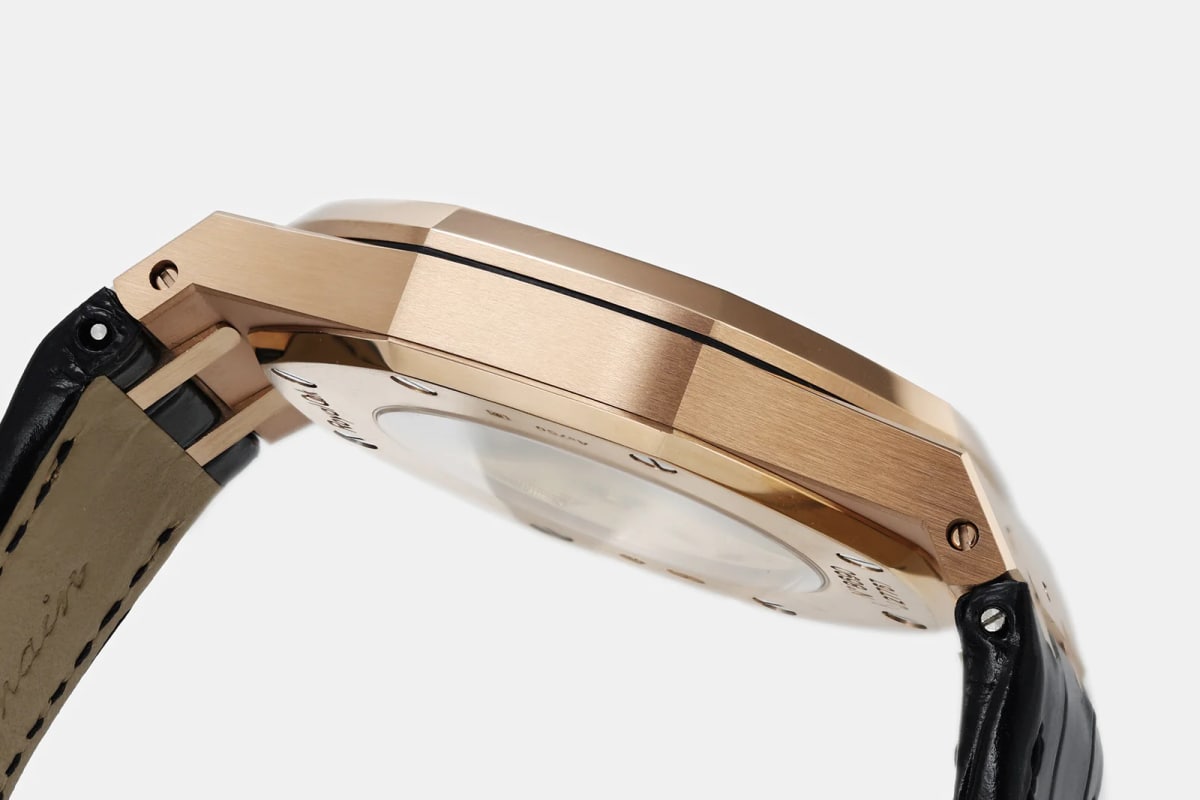
The four frames answer four different questions. The front frame settles how the black dial and the rose-gold case sit together in colour; the angled frame shows the case and bezel in profile with the crown at the right; the close-up frame is where the print, the squared relief of the dial and the shape of the hands can actually be read; the last frame turns the watch over to the back of the case and the strap. What none of them settles — which movement is fitted to the offered piece, what its case and bezel were really made from, which strap and clasp come with it, and what is known about its water resistance — belongs in the questions you ask before agreeing anything.
How is the leather-strap 15400OR different from the bracelet version?
The case and the dial are the same 41 mm rose-gold Royal Oak Selfwinding with the black Grande Tapisserie dial; what changes is the way the watch is held to the wrist. A bracelet continues the case into a band of metal, whereas a strap leaves the case from two fittings and lets the black leather carry the lower half of the watch, so the visible rose gold stops at the case and the case reads as one solid shape against the black.
Two practical consequences follow from that. A bracelet has to fit the wrist by removing links, which makes link count and removable links part of the deal, while a leather strap cannot be adjusted at all and is replaced instead, which makes the length of the strap supplied as important as the size of the case. Ask which strap length and which clasp come with the watch being offered, and whether a bracelet for this case can be supplied separately.
How does a 41 mm rose-gold Royal Oak wear on the wrist?
The case is 41 mm across, and it is a wide, flat case: the bezel lies on top of a mid-case with long straight flanks, so more of the watch rests on the top of the wrist than the diameter by itself would suggest. In gold the head of the watch is the heavy part, and on a strap that weight collects at the top of the wrist rather than being balanced by a bracelet running underneath it.
Fit therefore comes down to numbers the frames cannot give you. Ask for the case thickness and the lug-to-lug measurement, measure your own wrist where you would wear the watch, and compare both with a watch you already wear of similar diameter and thickness. A photograph of the actual watch on a wrist, taken from a step back, tells you more about the fit than any figure copied from a reference table.
Case back and strap detail from below: the rose-gold case flank, the glass at the rear reflecting light, engraving around it, and the black leather strap with its pale lining and stitching
What can be read on the black Grande Tapisserie dial?
The dial is black and covered in the squared relief that gives the Grande Tapisserie its name: rows of small raised blocks standing on a matte ground. Because each facet of each block catches the light at its own angle, the whole surface shifts between dark and grainy as the watch moves, and in the close-up frame the pattern reads as a fine grid behind everything else printed on the dial.
The print sits in three places: the AP monogram with AUDEMARS PIGUET beneath it under twelve, AUTOMATIC above six, and SWISS MADE along the lower edge. The hour markers and the baton hands are applied in rose-gold tone with light inserts, and the thin centre seconds hand is the only element that crosses the pattern freely. Whether the offered watch has the same evenness of texture and the same placement of print is something to judge from a straight-on photograph taken in daylight, since raking light flattens the relief.
Where does the 15400 sit among Royal Oak references?
The 15400 is the 41 mm chapter of the Royal Oak Selfwinding line. It arrived after the 15300, sat alongside the smaller Royal Oak references of its period, and was itself replaced, so it is no longer in production. A discontinued reference is neither a fault nor a merit, but it does change the nature of the purchase: you are buying the particular watch in front of you rather than a model that can be ordered new.
That has two consequences for a buyer. The first is size: 41 mm is a different case from the 39 mm Royal Oaks of the same era, with its own proportions and its own way of sitting on the wrist, so treat the two as separate watches rather than one watch in two diameters. The second is spares: ask whether a strap, a clasp or a bracelet can still be sourced for this case before you commit to a leather-strap example.
What should I inspect on the leather strap and the rose-gold bezel?
On the strap, start at the two points where leather always fails first: where it bends against the case, and where it folds at the clasp. Then look at the underside, because the lining and the stitching there record how hard the strap has been worn, and check the keeper for stretching and the leather for cracking along the creases. Confirm the length of the strap as supplied against your own wrist, since a strap that is too short cannot be lengthened later.
On the bezel, the top face is polished and the flanks of the case are brushed, so scratches behave differently on the two surfaces. Look along the polished top with the light raking across it rather than straight at it, inspect the screw heads and their slots, and then work around the case edges where marks appear first. Any of these areas can be reworked, so what you want is a photograph of the watch as it stands now rather than a studio image of the model.
What do the photographs leave open about this individual watch?
Four things cannot be settled from the frames: which movement is inside the watch being offered, what its case and bezel were actually built from, which strap and clasp are included, and what is known about its state of water resistance. The reference is documented with a self-winding calibre and sapphire glass front and back, but a photograph of a closed case back proves nothing about what sits behind it.
The way to close those gaps is to ask for something specific rather than for reassurance: the calibre number together with a photograph of the movement through the back glass, the metal stated plainly for the case and bezel, the strap and clasp described with their condition, and whatever information exists about water resistance. Add the measured weight in grams, the case thickness and the lug-to-lug distance if you want the numbers, and get all of it in writing before any money moves.
Specification
Specifications and configuration
Model details and design
Detail
Description
Model reference
15400OR.OO.D002CR.01
Model size
41 mm
Dial
Black, Grande Tapisserie
Dial print
AP monogram and AUDEMARS PIGUET below twelve; AUTOMATIC above six; SWISS MADE at the lower edge
Hour-marker layout
Applied rose-gold batons at each hour position
Hand arrangement
Rose-gold baton hour and minute hands with light inserts, thin centre seconds
Date display
Aperture at three o’clock, single white numeral on a dark disc
Bezel design
Octagonal, with visible screw heads in the top face
Colour combination
Black dial and black strap with a rose-gold case and bezel
Strap shown
Black leather with a large square scale pattern, fitted between metal end pieces at twelve and six
Clasp
Folding clasp, as documented for the reference
Case back
Sapphire window, with engraving around the glass
Movement (reference design)
Self-winding calibre 3120, 21,600 vibrations per hour, 60-hour power reserve
Case and bezel (reference design)
18-carat rose gold, octagonal bezel with visible screw heads
Water resistance (reference design)
Published rating of 50 m
Questions
Frequently asked about this reference
How is the leather-strap 15400OR different from the same watch on a bracelet?
The case and dial are the same; the difference is what holds the watch on. The leather version ends in a black strap with a folding clasp, so the rose gold stops at the case and the strap takes all the wear, while the bracelet version continues the metal around the wrist and brings its own fit questions — how many links can come out and how much the clasp adjusts. The two are not interchangeable without buying the missing part, so decide which you want before you compare offers.
How will a 41 mm rose-gold Royal Oak wear on my wrist?
It is a wide, flat case in a dense metal, so it tends to feel broader and higher on the wrist than a round 41 mm watch. The two figures that predict this are case thickness and lug-to-lug distance, and neither can be read off a product photograph, so ask for both and hold them against a watch you already wear and like.
What should I look at on the strap and around the bezel screws before I buy?
On the strap, the leather where it meets the case, the fold at the clasp, the stitching and the lining underneath, and the length as supplied. On the bezel, the polished top face seen under raking light, the screw heads and their slots, and the case edges, since a polished surface shows contact marks long before a brushed one does.
What can these photographs not prove about the watch?
Which movement is inside it, what its case and bezel are actually made of, which strap and clasp are included, and anything about its water resistance. Those belong to the individual watch rather than to the reference, so they have to be answered for the piece you are being offered, not for the model in general.
What should I confirm before paying?
The calibre fitted, with a photograph of it through the back glass; the case and bezel material; the strap and clasp supplied and their condition; the measured weight, case thickness and lug-to-lug; the total cost including shipping to your country; and what the seller will do if the watch arrives different from what was described.
What makes the black Grande Tapisserie dial different from a plain black dial?
A plain black dial returns light evenly, so it looks much the same from any angle. The Grande Tapisserie ground is a field of small raised blocks, and each block catches the light differently, so the dial moves between dark and textured as the watch turns, with the print and the applied markers standing on top of that relief rather than on a flat surface.
Inquiry message
The message below is pre-written with the model, the reference and this page. The button opens a WhatsApp draft for you to review before sending.
Which movement is fitted in the 15400OR.OO.D002CR.01 you are offering, and whether the glass in the case back is sapphire.
What the case and bezel of the offered watch are made of, and which strap and clasp are supplied with it.
How the water resistance of the offered watch was arrived at, and what description of it you can give me.
Measured weight in grams, case thickness and lug-to-lug distance, plus present-condition photographs of the strap and the bezel screws.
Current price for one watch, the shipping cost to my country, the countries you ship to and the lead time.