Price by inquiryconfirmed in the chat, with shipping and lead time
Model size40 mm
DialBlue
Seconds handRed-toned (visible in the gallery)
Date display3 o’clock, with magnifier
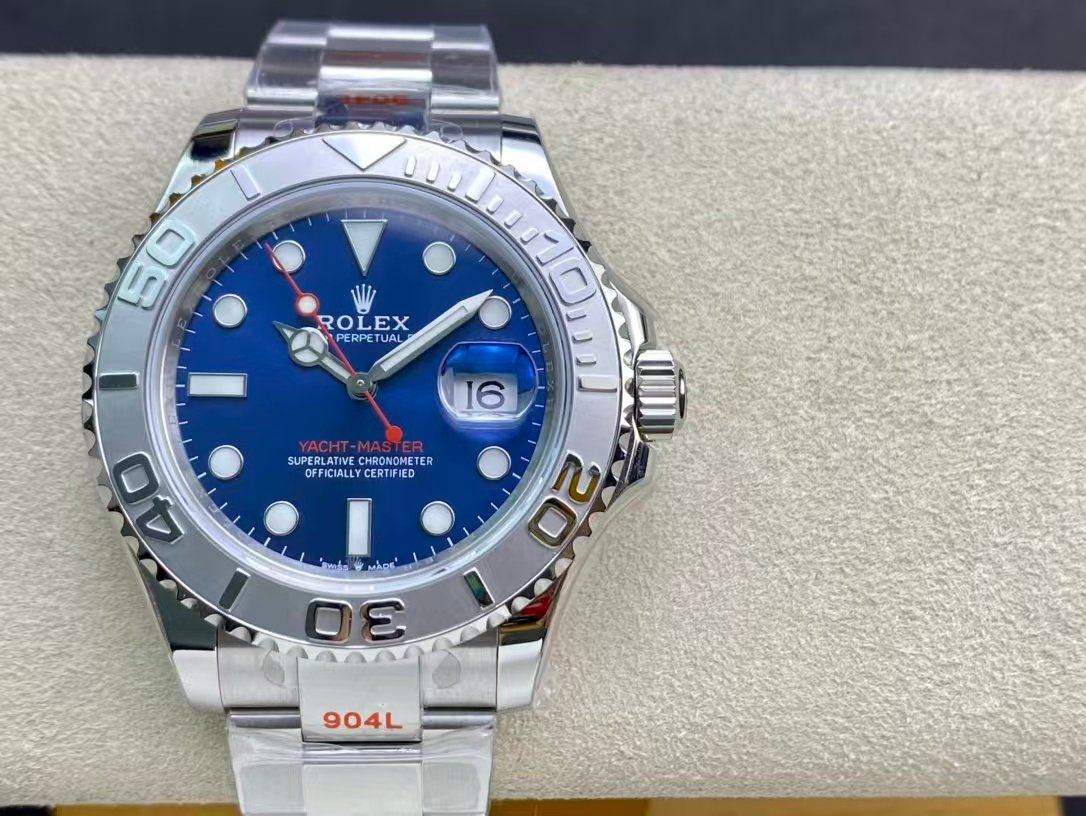
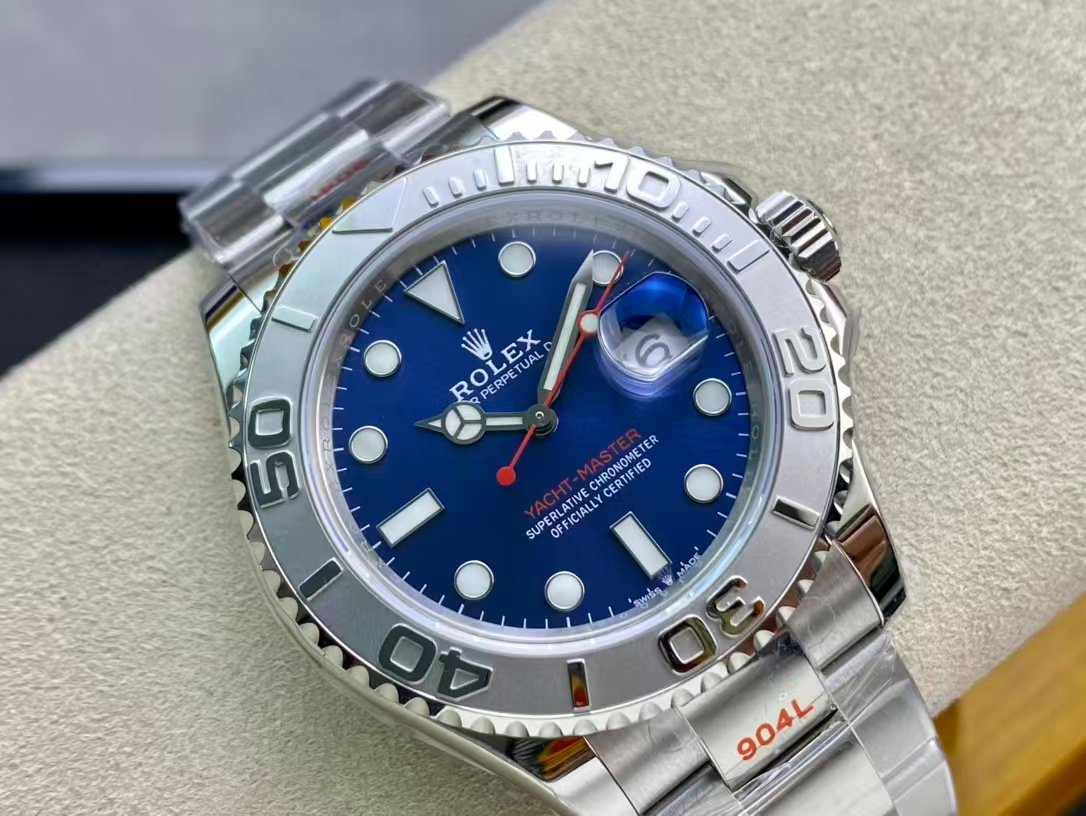
A blue dial with a red-toned seconds hand and the date under a magnifying lens, inside a bidirectional bezel whose sixty-minute scale is formed by raised polished numerals.
Opens a WhatsApp chat with the model, the reference and this page already written into the message.
Nothing is sent until you press send. Prefer to write it yourself? Use the inquiry box further down.
About this watch
Design and details
The Yacht-Master 40 is the design in this collection that treats the bezel as a surface rather than a chart. There is no printed scale and no insert: the sixty-minute graduations are raised numerals standing up from a matte-look ring, each one polished so it separates from its background, and the bezel turns in both directions. The case is 40 mm, the dial is blue with a red-toned seconds hand, and the date sits at three o’clock under a magnifying lens on a three-link bracelet.
What follows describes the named reference and what the gallery photographs show. The material and finish of the bezel on an individual watch is a separate question from the look of the design, and it is one of the items in the inquiry — raised numerals in a photograph do not tell you what the ring they stand on is made from.
A bezel with raised numerals instead of a printed scale
Every other scale in this collection is printed. Here the numbers are three-dimensional: each numeral stands up from the ring in a polished finish, set on a surface that has been left matte so the figures separate from their background under almost any light. From directly in front the effect reads as a band of even grey interrupted by bright shapes; from an angle the numerals change character as their edges catch the light, and the chapter marks cut between them become visible as short grooves. It is the same sixty-minute information as a dive scale, presented so that it can be read by shape rather than by print.
That presentation is what distinguishes this design, and it is also the part of it that is hardest to judge from a single photograph. A straight-on frame shows where the numerals sit relative to the case and how evenly the ring is divided; an angled frame shows whether the raised figures cast edges the way they should, and whether the matte surface around them is consistent. Two frames answer both questions. Neither tells you what the ring is made from, because a raised numeral in a photograph looks the same over any base material.
Reading a bidirectional sixty-minute ring
The scale on this bezel counts elapsed minutes in the same way as the dive references here: the starting marker is placed against the minute hand, and the distance the hand travels past it is the interval that has passed. What differs is how the ring is set and held. A dive bezel turns one way only, so a knock cannot make an interval look shorter than it was; this one turns in both directions and stops at defined minute steps, which makes it a practical marker for a position you want to remember — a departure time, a mooring, a start — as well as for timing an interval. The design is aimed at the same kind of reading as a dive scale without the one-way constraint.
Because the scale is engraved into the ring rather than printed on a flat insert, it can also be read at a glance from a distance, which is the point of raising the numerals at all. What the bezel does not do is tell you anything about a watch: how the ring turns, how much resistance it offers and how precisely it lands on each step are properties of the individual piece, so they are demonstrated on the watch being offered rather than described from the model.
Yacht-Master 40 three-quarter view showing the blue dial, the red-toned seconds hand, the raised numerals on the bezel and the three-link bracelet
The blue dial and the red-toned seconds hand
The dial carries one colour and one accent. The ground is blue, the markers are round with light-filled centres and metal-tone surrounds, a triangle sits at twelve and batons at six and nine, and the date occupies three o’clock under a magnifying lens. Against that the seconds hand is finished in a red tone, so the one element that is always moving is also the one element that is a different colour. The practical effect is that a glance tells you the watch is running, which is the usual reason a seconds hand is coloured at all. The dial print stays minimal: the model name and two lines of specification text, placed low under the centre so the upper half of the dial is left to the markers.
Colour is the part of this design that photographs least predictably. A blue dial photographs differently under direct sun, under an overcast sky and under a lamp, and the same frame can show a lighter or deeper blue depending on how the picture was taken. If the tone matters to you, the frame to ask for is the dial straight on in daylight with no colour enhancement, plus an angled frame so the surface finish is visible. The frames on this page show the combination, not the light in your own room.
The 40 mm case between the dive and dress designs
At 40 mm this sits on the same band as the travel reference here and below the 41 mm dive references, but case diameter is a poor way to describe it. What makes the watch look the way it does is the relationship between three depths: the bezel ring, which is wide and shallow with raised numerals rather than a deep graduated insert; the dial opening, which is correspondingly larger than on a dive design of similar diameter; and the case flank, which stays relatively flat because there is nothing on it apart from a crown. The result is a watch that reads larger than its dimension suggests when seen from the front, and flatter in profile.
For fit, the numbers worth comparing are the ones a photograph cannot supply: lug-to-lug length across the wrist, case thickness, and how the first bracelet links articulate away from the case. The bracelet here is a three-link design with broad centre links, so the transition from the rigid watch head to the flexible strap happens over a shorter span than on a five-link bracelet. Ask for those measurements together with the measured weight rather than selecting by case size alone.
The three-link bracelet and the clasp that sizes it
A three-link bracelet puts one broad centre link between two outer links, which gives relatively large flat surfaces running from the case to the clasp. On this watch that is deliberate: the dial is plain apart from its accent colour and the bezel already supplies the pattern, so a finely divided bracelet would compete with it. In the gallery frames the bracelet is visible lying on the case cushion and folded at an angle, which shows the width of the centre link against the outer ones.
Where a bracelet is concerned, the details that decide whether it works for you are not visible in a product frame. How many links can be removed, whether spare links come with the watch, what fine adjustment the clasp offers and whether the closure sits flush when shut: those are answers about the individual watch. Ask for a frame of the bracelet closed and flat and a close frame of the clasp, and include your wrist measurement and destination country in the same message so sizing and shipping come back together.
What the bezel surface is, and what a photograph cannot establish
The raised numerals create an obvious question, because a three-dimensional bezel surface has to be made from something. The manufacturer describes this reference’s bezel as platinum on a case that combines Oystersteel with platinum, and that description belongs to the reference; it is not a statement about any particular watch. In the photograph, what can honestly be reported is what is visible: a matte-looking ring with polished raised numerals and cut chapter marks between them, carried on a case whose flanks and bracelet read as silver-tone.
Whether the ring on the offered watch is made from a precious metal, from a coated surface or from something else entirely cannot be established from a picture, and colour is no guide — two bezels of completely different construction photograph identically. That is why the material and finish of the bezel on the actual watch is asked about directly, alongside the standard items: which version is available, the measured weight and dimensions, the bracelet supplied, and photographs and a short video of the watch itself. Within this collection the design offers the dressier alternative to the dive references: the same sport-watch shape with a bezel that is meant to be read by eye rather than by print.
Specification
Specifications and configuration
Model details and design
Detail
Description
Model reference
126622-0002
Model size
40 mm
Dial
Blue
Seconds hand
Red-toned (visible in the gallery)
Date display
3 o’clock, with magnifier
Bezel design
Bidirectional sixty-minute ring with raised polished numerals and cut chapter marks
Bezel surface
Matte-looking ring around polished numerals (visible in the gallery)
Bezel material (reference design)
The manufacturer describes this reference’s bezel as platinum on a case combining Oystersteel and platinum; the bezel of an offered watch is confirmed in the inquiry
Hour-marker layout
Round markers with a triangle at 12; batons at 6 and 9
Hand arrangement
Central hour, minute and seconds hands
Outer dial scale
Minute track
Bracelet design
Three-link, silver-tone
Colour combination
Blue and silver-tone with a red accent on the seconds hand
Questions
Frequently asked about this reference
How is a bezel with raised numerals read?
The same way as a printed sixty-minute scale: the starting marker goes against the minute hand and the gap that opens between them is the elapsed time. The difference is presentation — the numerals stand up from the ring and separate from their surface by reflection rather than by print.
Does the bezel turn both ways?
The reference design describes it as bidirectional, which is a deliberate contrast with the one-way dive bezels elsewhere in this collection: it can be used to mark a position as well as to time an interval. How the ring on the offered watch turns is shown on that watch.
Is the bezel platinum?
The manufacturer describes this reference’s bezel as platinum on a case combining Oystersteel and platinum. That is a statement about the named reference. What the bezel of the watch you are offered is made from — and whether it is solid, coated or something else — cannot be read from a photograph and is one of the first questions in the inquiry.
Why is the seconds hand a different colour?
It is the one element on the dial that is always in motion, so a distinct colour makes it obvious at a glance that the watch is running. It also gives a blue and silver-tone dial a single warm accent.
How does this compare with the dive references in the collection?
The case shape and the idea of a sixty-minute scale are shared. The differences are the bezel, which is raised and polished rather than printed, the direction it turns, the larger dial opening and the red accent on the seconds hand. Which you prefer is largely a question of whether you want a timing scale you read against a hand or one you read by reflection.
What should I include in an inquiry?
The reference, your wrist measurement and your destination country — plus the questions only the individual watch can answer: what the bezel is actually made from, which movement is fitted, the measured weight and dimensions, and any test evidence.
Inquiry message
The message below is pre-written with the model, the reference and this page. The button opens a WhatsApp draft for you to review before sending.
Which version is available to you, and what it is fitted with.
The material and finish actually used on the bezel of the offered watch, and how the raised numerals are formed.
Current price for one watch, the shipping cost to my country, the countries you ship to and the lead time.
Bracelet and clasp variant supplied, how many links can be removed, what the clasp adjustment offers and whether spare links are included.
Measured weight in grams, plus the case thickness and the lug-to-lug length.
Photographs of the actual watch: the dial straight on in daylight, the bezel straight on and at an angle, the bracelet closed and the case back.