Opens a WhatsApp chat with the model, the reference and this page already written into the message.
Nothing is sent until you press send. Prefer to write it yourself? Use the inquiry box further down.
About this watch
Design and details
The GMT-Master II is the travel design: a fourth hand that completes one circuit of the dial every twenty-four hours, and a bezel graduated in twenty-four hours that the hand is read against. Reference 126710BLNR pairs that display with a black dial and a two-colour insert whose blue and black halves divide the scale rather than decorate it.
This page describes the model and what the gallery photographs show. Which version of the watch is offered, and which bracelet it arrives on, are settled in the conversation, and the bracelet is the first thing worth asking about.
The fourth hand and why its tip is an arrow
Most watches show hours on a twelve-hour scale, so a hand that took twelve hours to circle the dial would be enough. This design adds a hand that takes twenty-four, which means it cannot be read against the dial’s hour markers: its position carries information that only a twenty-four-hour scale can express. That is the reason the tip is a distinctly shaped arrow rather than a matching baton, and the reason it is finished as a separate element on the dial.
In use the pointer gives a second time reading that never has to be recalculated at midday or midnight. The dial’s own markings stay conventional — a triangle at twelve, applied markers around the ring, a date at three — so the extra hand reads as an addition rather than as a different way of telling the time.
Reading the twenty-four-hour bezel
The insert carries numerals at every even hour from two to twenty-two, with individual marks between them, and the scale is read against the arrow-tipped hand rather than the minute hand. Find the graduation the pointer is passing: that is the hour on a twenty-four-hour scale. Twenty-two is late evening, two is the small hours, and the position of the pointer tells you which half of the day you are in without converting anything.
Because the scale is graduated around the bezel rather than printed on the dial, it can also be used from a fixed position — the whole ring is legible regardless of where the watch is held. The reading method in full, including what the scale deliberately does not tell you, is set out in the guide linked with this page.
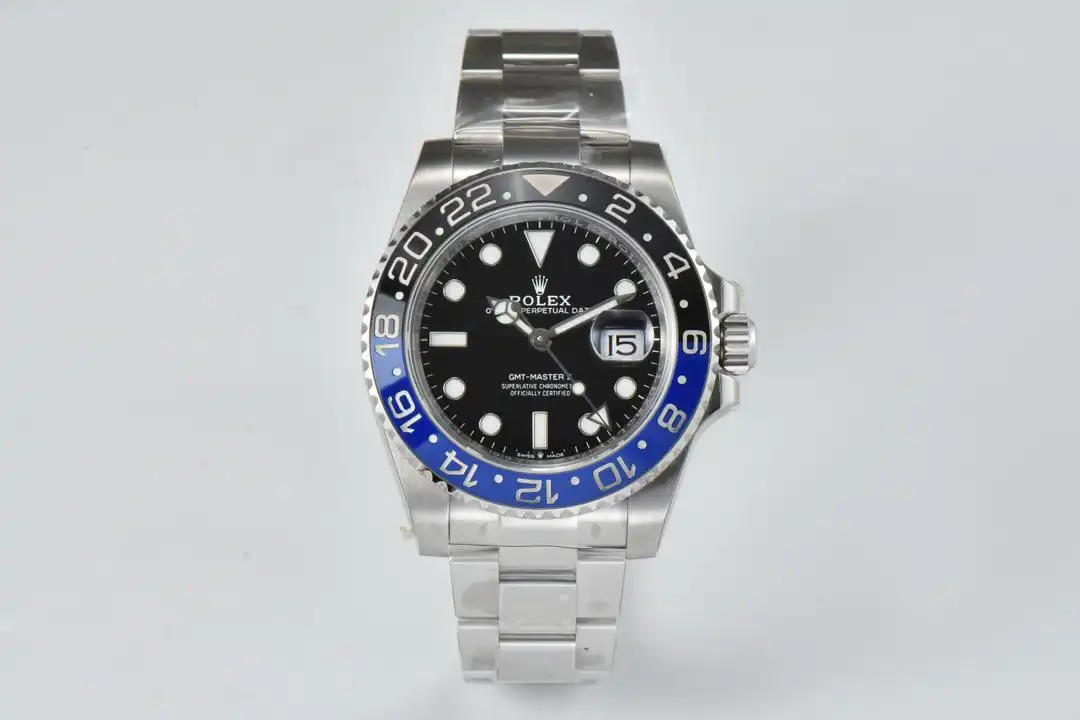
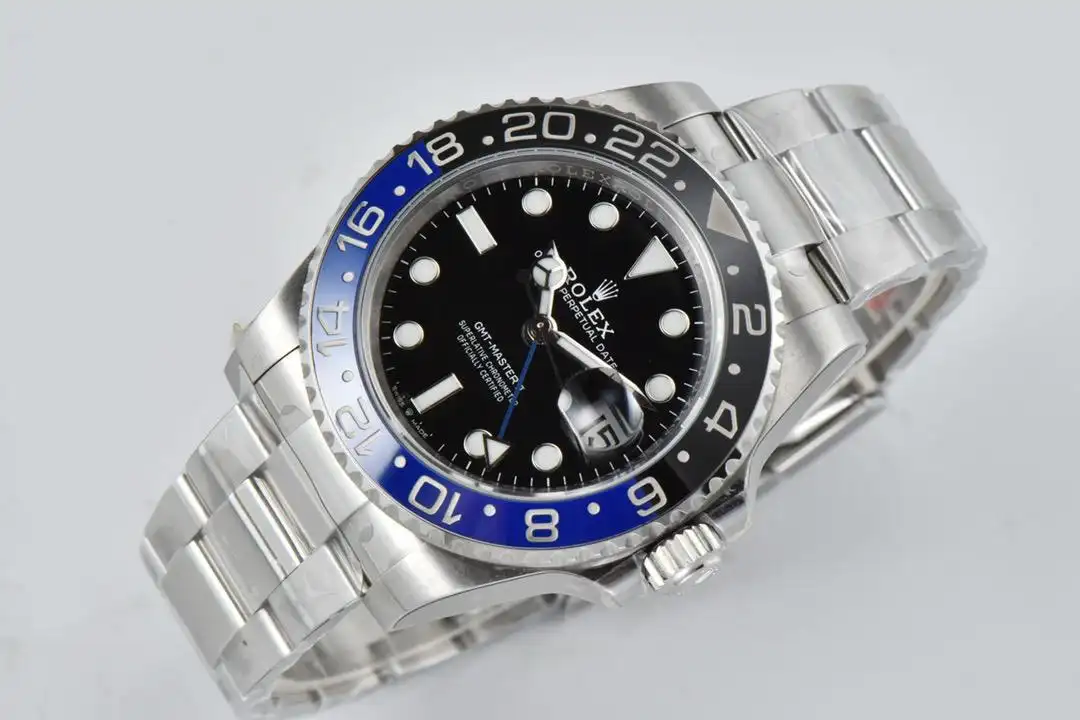
GMT-Master II two-colour bezel, graduations and case profile
Why the insert is split into two colours
The blue and black halves of the insert divide the scale into two blocks rather than two decorations. One colour covers the hours usually spent awake and the other the hours usually spent asleep, so a glance at where the pointer sits inside the ring answers a question that a single-colour scale leaves you to calculate. That boundary is the reason the two-colour insert was introduced on the original design and the reason it has stayed the reference’s most recognisable feature.
In the gallery frames, the transition between the halves appears clean and the boundary can be seen running across the scale. Those photographs show where the changeover sits and how evenly the numerals are spaced either side of it; they do not establish the insert’s construction or material.
The black dial, its markers and the date
A black dial with a light-filled marker set is the simplest way to make a scale-heavy watch readable, and this reference uses it. Applied markers sit around the ring with a triangle at twelve, the hands are broad enough to be told apart when they overlap, and the printed text stays in the upper half of the dial so the lower half is left to the pointer and the date. The date occupies three o’clock under a magnifying lens, which is the one place on the dial where an extra display interrupts the marker ring.
Reading the dial in a photograph is mostly a question of contrast: whether the marker surrounds sit level on the track, whether the print is crisp at this size, and whether the magnifier sits squarely over the aperture. A frame taken straight on answers those three; an angled frame shows how the lens sits proud of the crystal but hides the alignment.
A 40 mm case with one control
The model’s case diameter is 40 mm and there is a single winding crown on the right-hand side: no chronograph pushers, no second crown, so the silhouette stays symmetrical and the case flank reads as one continuous line. Compared with the Submariner in this collection, the bezel is thinner, the dial opening proportionally larger and the whole composition flatter on the wrist — the difference you notice first when the two are placed side by side.
As always, diameter is not a fit measurement on its own. Lug-to-lug length, case thickness and the articulation of the first bracelet links decide how the watch sits, and they describe an individual watch rather than the model, so they are asked for rather than assumed. The same applies to how the bezel behaves in the hand: how it turns, and how it sounds, are demonstrated on the actual watch.
Bracelet and clasp: the detail to settle first
The bracelet is the part of a watch that photographs settle least well, and it changes how the watch reads more than any other single element: a finely divided link pattern sits like jewellery on the wrist, while a broader one reads as a tool. What the frames on this page show is a three-link bracelet, with bright outer links around a broader brushed centre, and that describes the watch in the photographs rather than the next one out of the box.
So the bracelet is the first item in the inquiry. Ask which bracelet is on the watch being offered, ask for a frame of the bracelet closed and flat, a close frame of the clasp, and how many links can be removed. Those four answers describe the individual watch. Until they arrive, the design of the rest of the watch — case, dial, bezel, hands — is what the photographs can honestly show.
Specification
Specifications and configuration
Model details and design
Detail
Description
Model reference
126710BLNR
Model size
40 mm
Dial
Black
Second time zone display
Arrow-tipped 24-hour hand read against the bezel scale
Date display
3 o’clock, with magnifier
Bezel design
Two-colour insert, blue and black, 24-hour graduation
Bezel numerals
Even-hour numerals from 2 to 22, with marks between
Bezel rotation
Bidirectional 24-hour bezel design
Bracelet shown in the gallery
Three-link, silver-tone (visible in the gallery photographs)
Bracelet on the watch offered
Confirmed per watch in the inquiry
Colour combination
Black, blue and silver-tone
Crown position
3 o’clock, with no pushers
Outer dial scale
Minute track
Questions
Frequently asked about this reference
What is the arrow-tipped hand for?
It completes one circuit every twenty-four hours, so it cannot be read against the dial’s twelve-hour markers. Its position is read against the twenty-four-hour graduations on the bezel, which is how a second time zone is shown.
How do I read the bezel?
Find the graduation the arrow hand is passing and read that number as the hour on a twenty-four-hour scale. Even numbers are printed; the marks between them are the odd hours.
Why is the bezel in two colours?
The colour boundary separates the hours generally spent awake from those generally spent asleep, so the position of the pointer tells you which part of the day the second time zone is in at a glance.
Is this watch called the Batman or the Batgirl?
Both names are buyer-side nicknames for the blue-and-black bezel colourway. Neither is a manufacturer name and neither is a reference number, and the nicknames are used loosely and inconsistently — so quote the reference, and the bracelet you want, when you inquire.
Which bracelet will the watch I am offered have?
The frames on this page show a three-link bracelet, but that describes the pictured watch rather than the one you would be sent. Ask for a photograph of the bracelet closed with the clasp shut, and for the clasp adjustment range, before agreeing anything.
Can the bezel be used without turning it?
Yes. The scale is fully readable from a fixed position, because it is graduated around the bezel rather than printed on the dial, so the pointer can be read against it without any adjustment.
Inquiry message
The message below is pre-written with the model, the reference and this page. The button opens a WhatsApp draft for you to review before sending.
Which version is available to you, and which bracelet it comes on.
Current price for one watch, and the shipping cost to my country.
Which countries you ship to, and the lead time.
Whether the second time zone and the date set and advance correctly on that watch, in a short video.
Measured weight in grams, plus the case thickness and the lug-to-lug length.
Photographs of the actual watch: the bracelet closed, the clasp, the dial straight on and the case back.