Opens a WhatsApp chat with the model, the reference and this page already written into the message.
Nothing is sent until you press send. Prefer to write it yourself? Use the inquiry box further down.
About this watch
Design and details
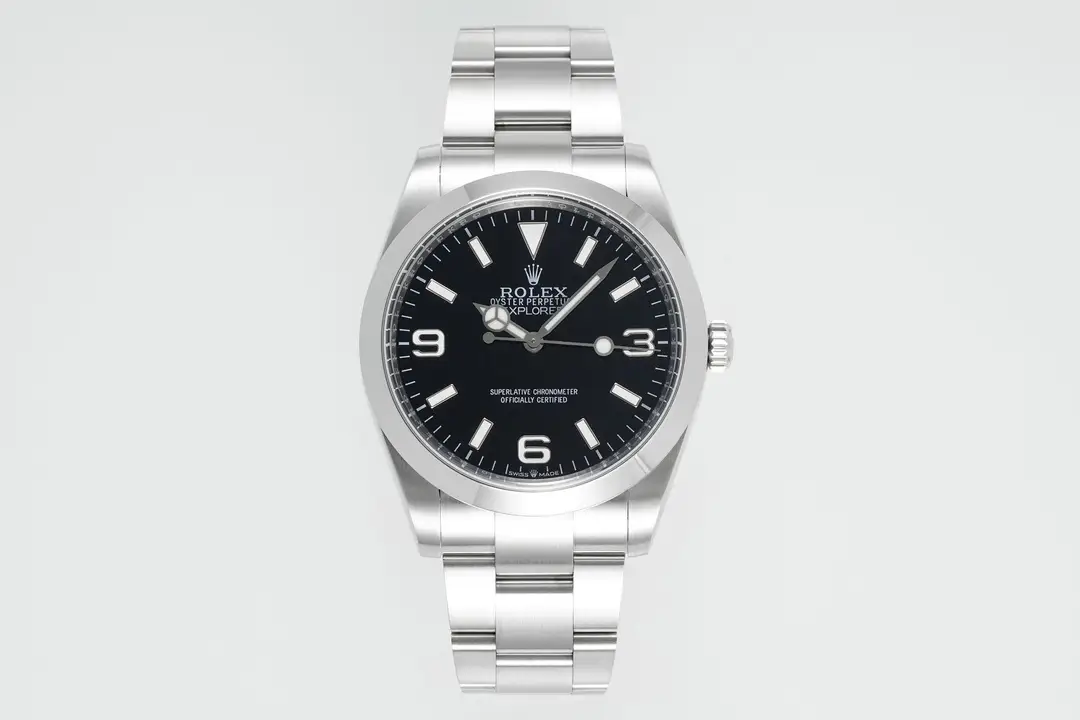
The Explorer is the plainest design in the collection: one dial, one set of hands, no date, no rotating bezel and nothing on the case except a crown. This reference is the 40 mm silver-tone version, with a black dial carrying large numerals at three, six and nine and baton markers everywhere else, under a smooth bezel that adds no scale of its own.
The description below covers the named reference and what the gallery photographs show. Measurements of an individual watch, the fitted movement and its rating are confirmed with the inquiry, because none of them can be read from a photograph.
The 3, 6, 9 dial and its marker hierarchy
Three hour positions carry numerals and the other nine carry batons, which makes the dial readable in two ways at once. The numerals break the ring into quarters, so the dial can be read at a glance by quadrant alone; the batons fill the gaps and give the same edge-to-centre alignment as the markers on the sports references. A triangle sits at twelve, and the numeral and baton shapes share one tone and one finish so the hierarchy stays consistent all the way round.
Because the numerals are large and angular, they take up more of the dial than printed numbers would, and the space between them is correspondingly wider. That is the visual signature of the design: a quiet dial with three loud landmarks on it. It also makes the dial easy to check in a photograph — square, level numerals are obvious, and so is a numeral that sits off the track.
Black dial, white print: what makes it legible
The contrast here is the simplest possible: a black ground with light-filled markers, numerals and hands. Nothing is printed in colour, there is no second scale competing for the outer edge, and no aperture interrupts the ring, so the only information on the dial is the time. The minute track runs just inside the markers, and the printed text stays above the centre so the lower half of the dial is left open.
The hands are the other half of the legibility story. The hour hand carries the same broad segmented tip used across this collection, the minute hand is longer and narrower, and the seconds hand is a slender pointer with a counterweight on the opposite side of its pivot. Every shape is distinguishable from the others at arm’s length, which is exactly what a dial with only one display has to get right.
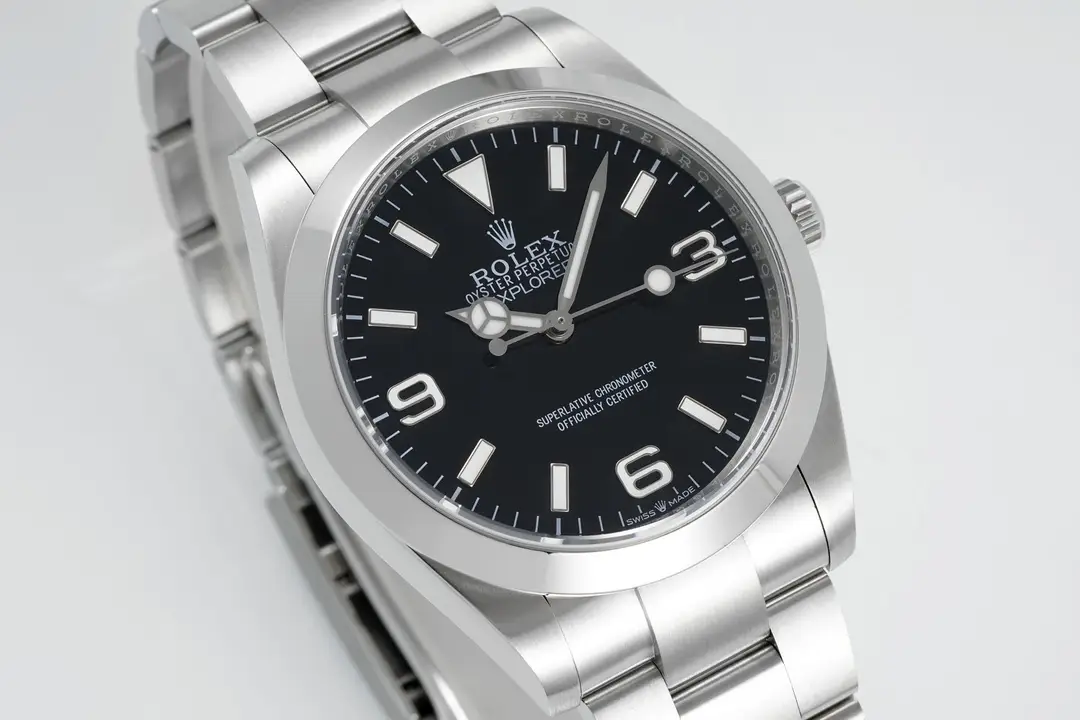
Explorer 40 dial close-up showing the marker layout, the minute track and the hands
A smooth bezel and the light it returns
The bezel is a plain silver-tone ring with no ridges, no scale and no insert. Where the fluted bezel on a Datejust breaks a highlight into many small pieces and a dark dive-watch insert shows fewer bright reflections, this one throws a single continuous band of light back at the viewer and keeps the case outline clean. The effect on the dial is a wider apparent opening: with nothing printed or ridged between crystal and case, the dial reads larger than its diameter suggests.
The photographs show the trade-off clearly. From straight on, the smooth bezel almost disappears behind its own reflection; from a three-quarter angle it reads as a definite proportion between the dial edge and the case flank. That second frame is the one to ask for if you want to judge how much of the case is bezel and how much is dial.
No date, no rotating bezel: one scale only
Two decisions define this design: the marker ring runs unbroken because there is no date aperture, and the bezel does not turn because there is no scale to set. The consequence is a watch with one piece of information on it and one thing to operate — the crown. There is no magnifier over the crystal, no lower half of the bezel to read, and nothing to knock out of position, which is the whole argument for the design and the reason it has been made in essentially this form for decades.
It also means there are fewer places for something to go wrong, and fewer things to ask about. The questions that remain are the ones a photograph cannot answer: the fitted movement against its marking, how the crown winds and sets, and any rating or test evidence for the individual watch.
40 mm, and the diameter question
The model’s case diameter is 40 mm. This is a watch that is often compared against a smaller version of the same design, and the honest way to make that comparison is dimension by dimension rather than by feel. Diameter sets the width of the case body; lug-to-lug length sets how much wrist the watch occupies; thickness sets how it sits under a cuff; the dial opening sets how large the watch looks to the person reading it. A smaller watch with a wide dial opening can look bigger from the front than a larger one with a narrow opening.
If you have a strong preference between the two diameters, say which you want in the inquiry and let the answer come back with the dimensions of the actual watch. Nobody can judge fit from a model name, and this is the one design in this collection where the size question is the first thing buyers ask about.
Bracelet, clasp and describing the fit you want
A three-link bracelet with broad centre links meets the case through fitted end links, keeping the visible line from case to clasp unbroken. There is no second pattern here, and that is deliberate: the design depends on the dial being the only busy element.
Because the bracelet is what decides how the watch actually feels, that is where the practical questions live. Ask how many links can be removed, what fine adjustment the clasp offers, whether spare links come with the watch and whether the end links sit flush against the case on the watch being offered. Then include your wrist measurement and your destination country in the same message, so the sizing and shipping answers arrive together instead of one at a time.
Specification
Specifications and configuration
Model details and design
Detail
Description
Model reference
224270-0001
Model size
40 mm
Dial
Black
Date display
No date
Hour-marker layout
Numerals at 3, 6 and 9; triangle at 12; batons elsewhere
Bezel design
Smooth, no scale or insert
Bezel rotation
None (fixed)
Crystal feature
No magnifying lens (visible in the gallery)
Hand arrangement
Central hour, minute and seconds hands
Minute scale
Fine track around the dial perimeter
Bracelet design
Three-link, silver-tone
Crown position
3 o’clock, between protective shoulders
Colour combination
Black and silver-tone
Questions
Frequently asked about this reference
Why do only three hour positions carry numerals?
The numerals divide the dial into quarters, which makes it readable by quadrant at a glance, while the batons fill the intervals without adding three more shapes to identify. It is a legibility decision, not a decorative one.
Is there a date on this reference?
No. Three o’clock carries a baton marker, so the ring runs unbroken and there is no magnifying lens over the crystal.
Does the bezel turn?
No. It is a smooth fixed ring with nothing printed on it, which is why this design has no second scale to read or to misread.
How does it compare in size with the smaller version of the Explorer?
The two differ in diameter, and fit also depends on lug-to-lug length, thickness, dial opening and bracelet articulation. State the diameter you want and ask for the measured dimensions of the watch being offered rather than choosing from the model name.
What does the smooth bezel change compared with a fluted or ceramic one?
Reflection. A fluted bezel splits light across many ridges, a dark insert shows fewer bright reflections, and a smooth bezel returns one continuous band. That changes how large the dial appears and how the watch looks in a photograph.
What should I include in an inquiry about this watch?
The reference, the diameter you want, your wrist measurement if you want sizing advice, and your destination country — then the questions that only the individual watch can answer: movement and its marking, measured weight and dimensions, and any rating or test evidence.
Inquiry message
The message below is pre-written with the model, the reference and this page. The button opens a WhatsApp draft for you to review before sending.
Which version is available to you, and what it is fitted with.
Which of the two Explorer diameters you can supply.
Current price for one watch, and the shipping cost to my country.
Which countries you ship to, and the lead time.
Measured weight in grams, plus the case thickness and the lug-to-lug length.
Photographs of the actual watch: dial straight on, the case profile, the bracelet closed and the case back.