Opens a WhatsApp chat with the model, the reference and this page already written into the message.
Nothing is sent until you press send. Prefer to write it yourself? Use the inquiry box further down.
About this watch
Design and details
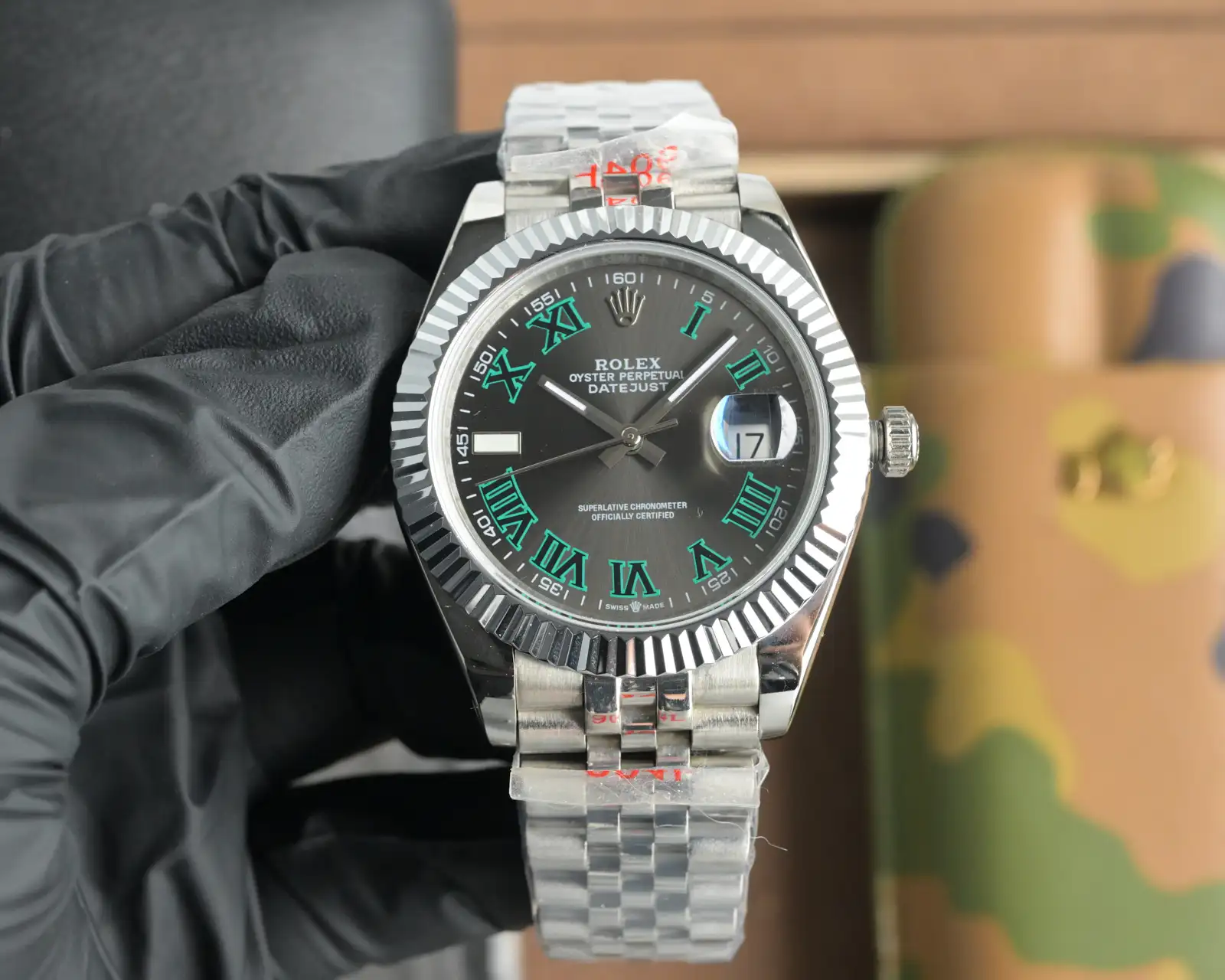
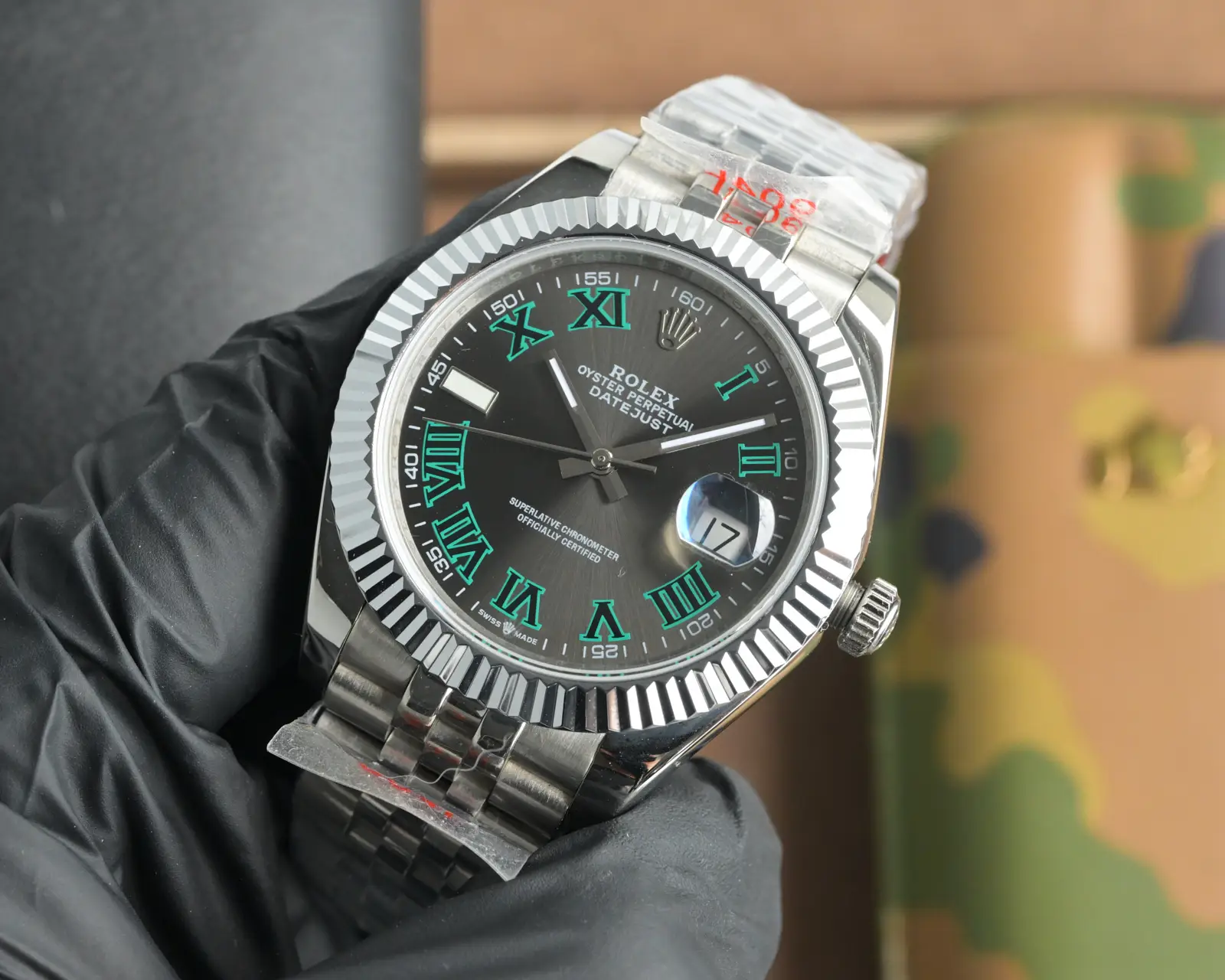
A Datejust is a combination of three choices: dial, bezel and bracelet. This 41 mm reference puts a slate dial carrying Roman numerals with green outlines between a fluted bezel and a five-link bracelet, so the watch reads silver-tone with one deliberate accent colour rather than an overall colour scheme. It is also the Datejust dial most often looked up by nickname instead of by reference number, which makes it worth describing in physical terms first.
Everything below describes the named reference and what the gallery photographs show. The parts actually fitted to an individual watch, and the material behind any coloured surface, are confirmed in the conversation.
What the “Wimbledon” name actually refers to
The nickname is buyer-side shorthand. It is not a name the manufacturer gives the dial, and it is not a reference number; it is the label that has attached itself to the slate-grey Datejust dial with green-outlined Roman numerals, on account of the accent colour. Two practical points follow. If you ask for a “Wimbledon” dial you are describing a colour and marker treatment, so adding the reference number removes any doubt about which one you mean. And because the nickname travels separately from the catalogue, it does not identify a case size either — the same dial treatment has existed on more than one Datejust diameter, which is why the size on this page is given as a model figure rather than inferred from the name.
Green-edged Roman numerals on a slate background
Each Roman numeral is an applied element rather than a printed shape: a green outline around a lighter centre, standing slightly off the dial, with a reflective edge that catches light as the wrist turns. The slate background is finished with a radial brushing that runs outwards from the centre, so the same dial looks darker straight on and lighter at an angle. Eleven positions carry numerals; the twelfth is the date.
Under the numerals sits a fine minute track with small printed indices. That gives the outer dial two rhythms to look at — the wide, angular Roman forms above and the fine track beneath them — and it is why a photograph taken close to straight on is more informative than a wide shot: you can check that each numeral sits level on the track rather than floating above or clipping into it. Against the dark ground, the green outline is the strongest colour event on the watch.
Datejust 41 dial close-up showing the green-edged Roman numerals, the minute track and the date window
The fluted bezel and the light it returns
A ring of repeating ridges surrounds the dial. Every ridge presents a slightly different face to the light, so the bezel alternates between bright and dark as the wrist moves — the visible signature of the design, and the reason one photograph rarely tells the whole story about it. Soft daylight and a small indoor lamp produce quite different results on the same bezel, so two frames taken at different angles are more useful than one perfectly lit frame.
This bezel carries no printed scale at all: no minute graduations, no rate scale. The model’s published specification describes the case and bezel combination as steel with white gold, and the bezel is the warmest-looking surface on the watch even though the overall impression is silver-tone. Colour alone cannot tell you what a supplied example is made from or whether a white-metal surface is solid, capped or plated; that question is one of the items in the inquiry.
The date window and the magnifier
The date sits at three o’clock under a raised magnifying lens, which makes the calendar a visual feature of the design rather than a small cut-out in the dial. The lens also changes how the date looks from different angles: the numeral inside the aperture is easiest to judge from close to straight on, and least reliable from a steep diagonal.
In a clear dial photograph three things are worth checking together — where the lens sits relative to the crystal edge, how the aperture is shaped, and whether the numeral is centred inside it. What no photograph of the outside can establish is how the date changes: the movement’s design decides that, and it belongs to the supplied watch, so it is asked about rather than assumed.
41 mm on the wrist, and what the number leaves out
The model’s case diameter is 41 mm. Two watches of the same diameter do not wear alike: the dial opening, the width of the bezel, the case thickness and the way the first links angle away from the case all change the impression on the wrist. A white-metal fluted bezel and a lightened dial also make this watch read warmer and busier than a black-dial sports watch of the same size in this collection.
If you already own a 41 mm watch, compare the dimensions you can measure rather than assuming the fit carries over. Diameter tells you the width of the case body; lug-to-lug length tells you how much wrist the watch occupies; thickness tells you whether it will sit under a cuff. Those are the numbers to ask for, and a wrist photograph is only useful alongside the wrist size it was taken on.
The five-link bracelet and how to name a combination
The bracelet is divided into five links across its width: three narrower centre links between two broader outer links, which produces a finer visual rhythm than the broad centre section of a three-link bracelet. Linked side by side with the fluted bezel, the two repeating patterns carry the same colour idea round the whole watch instead of concentrating it in one piece.
When you ask about a Datejust, name the three parts together — dial, bezel and bracelet — plus the case size and the reference. Stating them separately invites answers about different watches. If you want a different dial treatment or a bracelet in the other link pattern, say so in the same message; the collection shows a small number of configurations and the message is where a specific one is pinned down.
Specification
Specifications and configuration
Model details and design
Detail
Description
Model reference
126334-0022
Model size
41 mm
Dial
Slate, with Roman numerals
Marker outline
Green-edged applied numerals (visible in the gallery)
Date display
3 o’clock, with magnifier
Bezel design
Fluted, repeating ridges
Bezel scale
None printed
Bracelet design
Five-link, silver-tone
Dial finish
Radial brushed appearance in the gallery photographs
Colour combination
Silver-tone with green marker accents
12 o’clock marker
Coronet
Outer dial scale
Minute track
Hands
Central hour, minute and seconds hands
Questions
Frequently asked about this reference
Is “Wimbledon” a model name?
No. It is a buyer-side nickname for the slate dial with green-outlined Roman numerals, not a name the manufacturer uses and not a reference number. Quote the reference when you inquire, so the dial cannot be confused with another slate or grey Datejust dial.
Does the green appear anywhere else on the watch?
Only on the marker outlines as far as the photographs show. The scale, the bezel and the bracelet stay silver-tone, which is what makes the outline colour read as a deliberate accent.
Why does the dial look lighter in one photograph than another?
The radial finish diffuses light differently depending on the angle and the source, so the same dial moves between deeper and lighter greys. It is a property of the finish, not a difference between two watches.
Is the fluted bezel solid gold?
That cannot be answered from a photograph or from the colour of a surface. The model’s published specification describes the combination as steel with white gold; what a supplied example is made from, and whether any white-metal surface is solid, capped or plated, is a question for the conversation — and it is one of the items in the inquiry.
Will a 41 mm Datejust wear like a 41 mm Submariner?
No. Diameter is shared, but dial opening, bezel width, case thickness, lugs and bracelet structure differ, and those decide how a watch looks and sits. Compare measured dimensions rather than the single case figure.
Can I discuss a different dial or bracelet?
Yes — send the reference, the dial you want, the bracelet pattern and your destination country together. Naming the combination in one message is what makes the answer about the watch you actually have in mind.
Inquiry message
The message below is pre-written with the model, the reference and this page. The button opens a WhatsApp draft for you to review before sending.
Which version is available to you, and what it is fitted with.
What the fluted bezel and any white-metal parts are actually made from, and the plating or wrap thickness if they are not solid.
Current price for one watch, and the shipping cost to my country.
Which countries you ship to, and the lead time.
Case thickness, measured weight in grams and the lug-to-lug length.
Photographs of the actual watch: dial straight on, the fluted bezel from two angles, the bracelet closed and the clasp.