Opens a WhatsApp chat with the model, the reference and this page already written into the message.
Nothing is sent until you press send. Prefer to write it yourself? Use the inquiry box further down.
About this watch
Design and details
The Datejust 36 is the smaller end of the calendar design in this collection, and the whole point of it is proportion. A 36 mm case carries a fluted bezel, a blue dial and a five-link bracelet, with the date at three o’clock under a magnifying lens — the same three-part combination as the 41 mm references here, scaled down, which changes how much of the dial each part occupies.
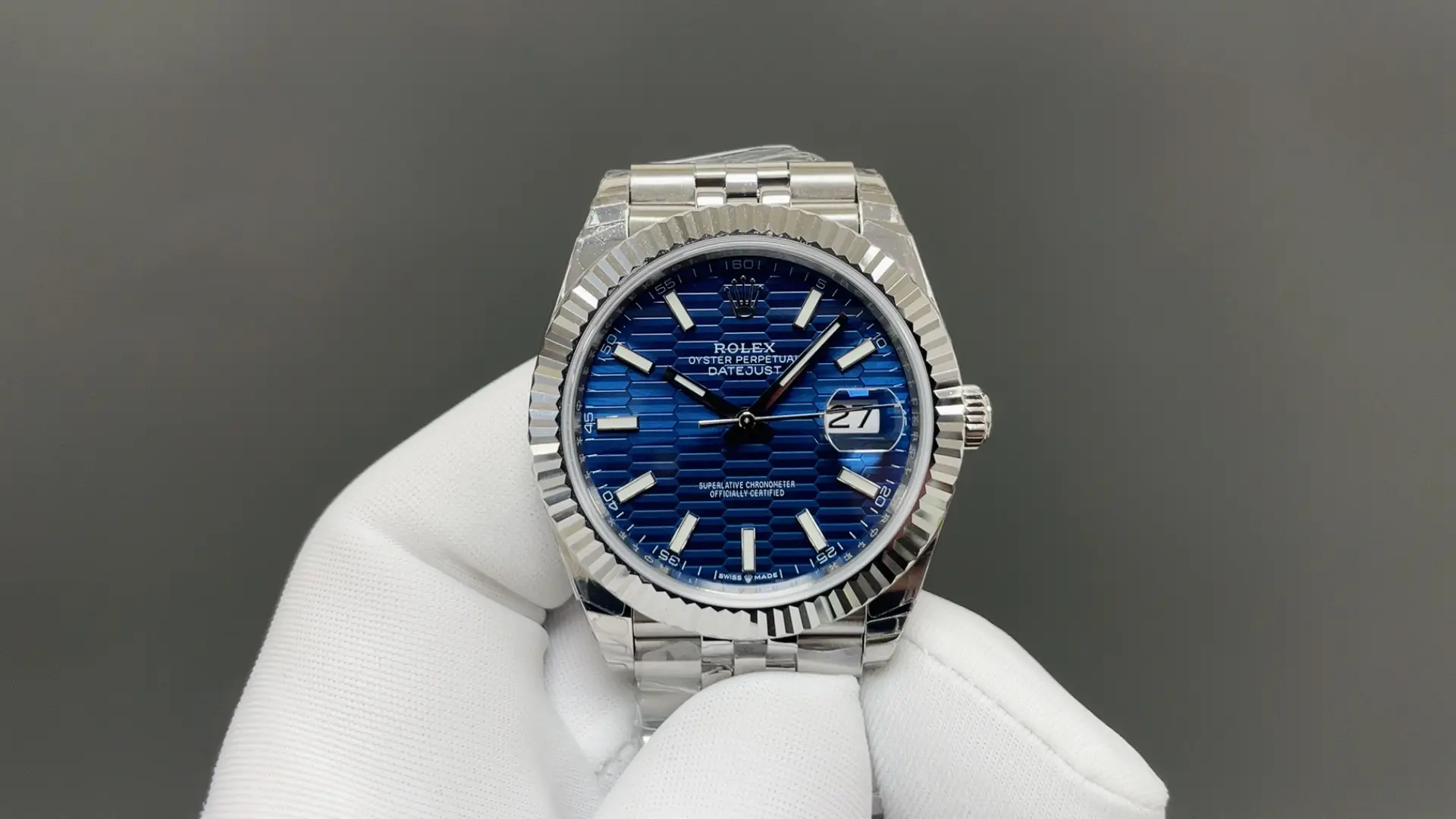
The gallery shows a repeating fluted texture across the blue dial and printed numerals around its outer track. Those visible details identify the pictured configuration within the wider 126234 reference family. When asking about it, include the words “blue fluted-texture dial” with the reference family so the answer concerns the finish shown here.
The 36 mm case and what the smaller diameter changes
Case diameter is the first number buyers compare, and on a Datejust it changes more than the width of the wrist the watch occupies. A fluted bezel takes a fixed ring of depth around the crystal, and a five-link bracelet takes a fixed number of links to span the same width. Put those on a 36 mm case and each one occupies a larger share of the whole than it does on a 41 mm reference, so the bezel reads as a more prominent ring and the link pattern reads as finer detail. The dial opening shrinks with the case, which is why the number of printed elements the dial has to carry matters at this size.
None of that tells you which size suits your wrist, because a case measurement is not a fit measurement. If you already wear a 36 mm watch, compare the dimensions you can measure on it: lug-to-lug length across the wrist, case thickness under a cuff, and how the first links angle away from the case. Ask for the same numbers for the watch on offer, and treat a wrist photograph as useful only when the wrist size it was taken on is known. The two diameters have existed side by side for decades precisely because they suit different wrists and different preferences.
The blue dial: surface texture and the outer numeral track
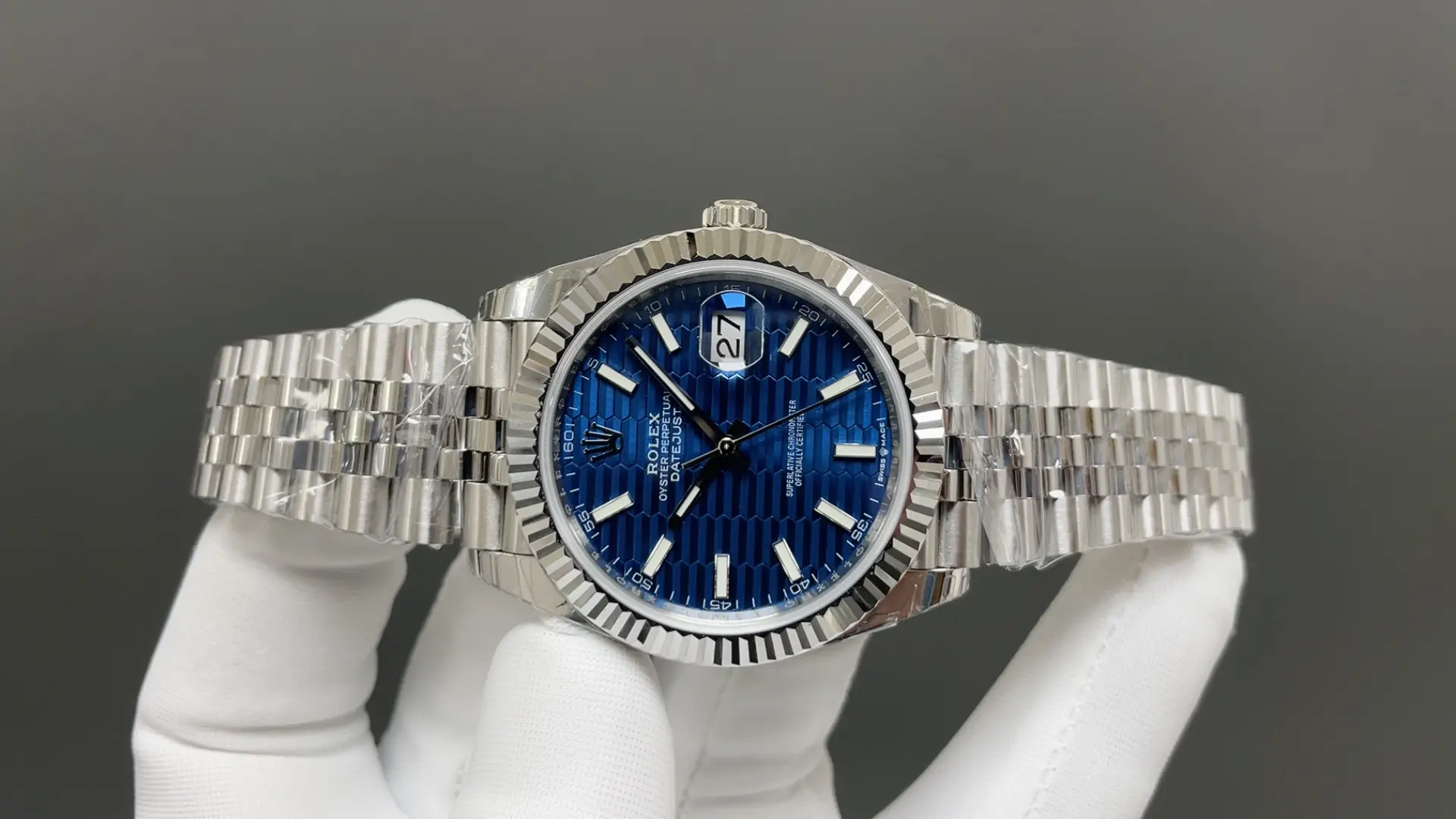
The photographs show two things layered on the same dial. The first is the surface itself: a repeating pattern of narrow flutes running across the whole face, each one catching light at a slightly different angle from its neighbour, so the blue moves between deep and lighter tones as the dial tilts. The second is a ring of small printed numerals sitting outside the markers, at five-minute intervals, which gives the dial a second, much finer rhythm around its edge. Together they make a dial whose colour and texture change more with the light than a plain brushed finish would.
That behaviour is worth understanding before judging the colour from one frame. In the gallery there is a straight-on view in which the flutes read as an even pattern and the blue looks consistent, and there is an angled view in which the same surface breaks into alternating light and dark bands. If the finish matters to you, ask for the dial photographed straight on and at an angle in daylight, and remember that neither frame tells you how the dial of a different watch is finished — that is a question about the watch being offered, not about the design.
Datejust 36 dial close-up showing the fluted dial surface, the applied baton markers, the printed outer numerals and the date under a magnifying lens
The fluted bezel and the light it splits
A fluted bezel is a ring of repeating ridges, and its whole visual effect comes from dividing a highlight into many small pieces instead of letting it run around the case in one continuous band. From straight on, the ridges alternate between bright and dark, which makes the bezel look like a fine-toothed ring around a small dial. The effect changes with the light source: a small lamp produces hard alternating facets, while soft daylight blends them. This is why the bezel is the feature that most rewards being photographed twice — once straight on and once from a three-quarter angle.
The bezel carries no scale of any kind. Nothing on it is printed, and nothing on it turns, so it adds reflection and texture rather than information. The manufacturer describes the case and bezel combination of this reference as Oystersteel and white gold; that is a statement about the reference, and it is not a statement about what any particular watch is made from. Whether the fluted ring on the watch being offered is solid, capped or plated, and how thick any coating is, cannot be read from colour in a photograph, so it is asked about directly in the inquiry.
Five links across the bracelet, and how the pattern reads
The bracelet is divided into five links across its width — three narrow centre links between two broader outer links — which is the finest link pattern in this collection. On a 36 mm case that pattern is proportionally more noticeable than the same bracelet would be on a larger watch, and it suits the dial it is paired with: a ridged bezel, a textured dial and a finely divided bracelet are three versions of the same repeating idea, so the watch reads as a single design rather than as a case with an accessory attached. In the photographs the links are shown wrapped across a gloved hand, which is the best available way to see how the rows of links sit next to one another.
How a bracelet feels is a different question from how it looks, and it depends on things no photograph can show: how many links can be removed, whether spare links come with the watch, what fine adjustment the clasp offers, and how the end links meet the case. Ask for a frame of the bracelet closed and flat, a close frame of the clasp, and those sizing answers together. Those describe the individual watch, and they are the reason bracelet questions belong in the first message rather than after a price has been quoted.
The date window, the magnifier and the balance at three o’clock
The date sits at three o’clock under a raised magnifying lens, so the calendar is a visible feature of the dial rather than a small cut-out in it. On a 36 mm dial the lens occupies a larger proportion of the frame than it would at 41 mm, and because it draws the eye it shifts the visual weight of the dial towards the right-hand side. What answers that shift is the rest of the ring: applied baton markers with reflective surrounds sit at the other positions, and the printed outer numerals keep a continuous rhythm going around the dial, so the aperture reads as one deliberate break in a pattern rather than as a gap.
Two questions are worth separating here. The first is what the lens looks like, and a straight-on photograph settles it — whether the numeral sits centred inside the window and how the lens edges line up with the crystal. The second is how the calendar behaves, and no photograph can settle that: the moment the date changes, how far the crown travels to set it and whether it advances cleanly are properties of the movement in the specific watch, so they are asked about in writing and demonstrated on the watch being offered.
Naming the combination: dial, bezel and bracelet together
A Datejust is not one decision but three, and they are visible at the same time: which dial, which bezel and which bracelet. That is why the same reference family contains several blue finishes — the suffix on a reference number is what distinguishes one combination from another. If you ask about “the blue Datejust” you are describing at least two different watches, and the reply may be about the one you did not mean. Name the finish as you can see it, quote the reference, and the answer comes back about the right configuration.
There is one more thing worth knowing about searching for this model by name. Datejust dials collect buyer-side nicknames — the slate Roman numeral dial elsewhere in this collection is the best-known example — and those names travel separately from the catalogue. They are not manufacturer names and they are not reference numbers, so they are useful for finding a dial and useless for ordering one. Within this collection the design gives you a smaller alternative to the 41 mm references, a date with a magnifier and two repeating patterns in the bezel and the bracelet. If the dial texture is what you are after, say so in the same message as the reference, your wrist measurement and your destination country.
Specification
Specifications and configuration
Model details and design
Detail
Description
Model reference
126234
Model size
36 mm
Dial
Blue, with the fluted texture shown in the gallery
Dial surface in the gallery
Repeating fluted texture across the dial
Outer dial track in the gallery
Small printed numerals at five-minute intervals outside the markers
Hour markers
Applied baton markers
Date display
3 o’clock, with magnifier
Bezel design
Fluted, repeating ridges
Bezel scale
None printed
Bracelet design
Five-link, silver-tone
12 o’clock marker
Coronet
Bracelet colour layout
Single-tone in the gallery photographs
Colour combination
Blue dial with a silver-tone case and bracelet
Questions
Frequently asked about this reference
Is the blue dial plain or textured?
The dial in the gallery carries a repeating fluted texture rather than a plain surface. The 126234 family includes several dial combinations, so name the blue fluted-texture finish and confirm it against photographs of the actual watch.
What are the small numbers around the outside of the dial?
They are printed numerals at five-minute intervals, sitting outside the markers and forming an outer track. They add a finer reading rhythm to the dial; they are not a second scale for a different hand.
Is the fluted bezel solid gold?
That cannot be answered from a photograph or from the colour of a surface. The manufacturer describes this reference as Oystersteel and white gold; what an offered watch is made from, and whether any white-metal surface is solid, capped or plated, is one of the items in the inquiry.
Will 36 mm fit me?
Diameter is not a fit measurement. Lug-to-lug length, case thickness, the dial opening and the way the first links articulate all change how a watch sits. Ask for those numbers for the watch on offer rather than choosing from the model name.
Is this the same dial as the 41 mm reference in the collection?
No. That reference uses a slate dial with Roman numerals; this one is blue with baton markers and a textured surface. Sharing a model line does not mean sharing a dial.
What should I include in an inquiry?
The reference, the dial finish you want, the bracelet pattern, your wrist measurement if you want sizing advice and your destination country — then the questions only the individual watch can answer: which movement is fitted, the measured weight and dimensions, and any test evidence.
Inquiry message
The message below is pre-written with the model, the reference and this page. The button opens a WhatsApp draft for you to review before sending.
Which version is available to you, and what it is fitted with.
Which blue dial finish the offered watch has, and a daylight photograph of the dial straight on and at an angle.
What the fluted bezel and any white-metal parts are actually made from, and the plating or wrap thickness if they are not solid.
Current price for one watch, the shipping cost to my country, the countries you ship to and the lead time.
Case thickness, measured weight in grams and the lug-to-lug length.
Photographs of the actual watch: the bracelet closed, the clasp, how many links can be removed, and whether spare links are included.