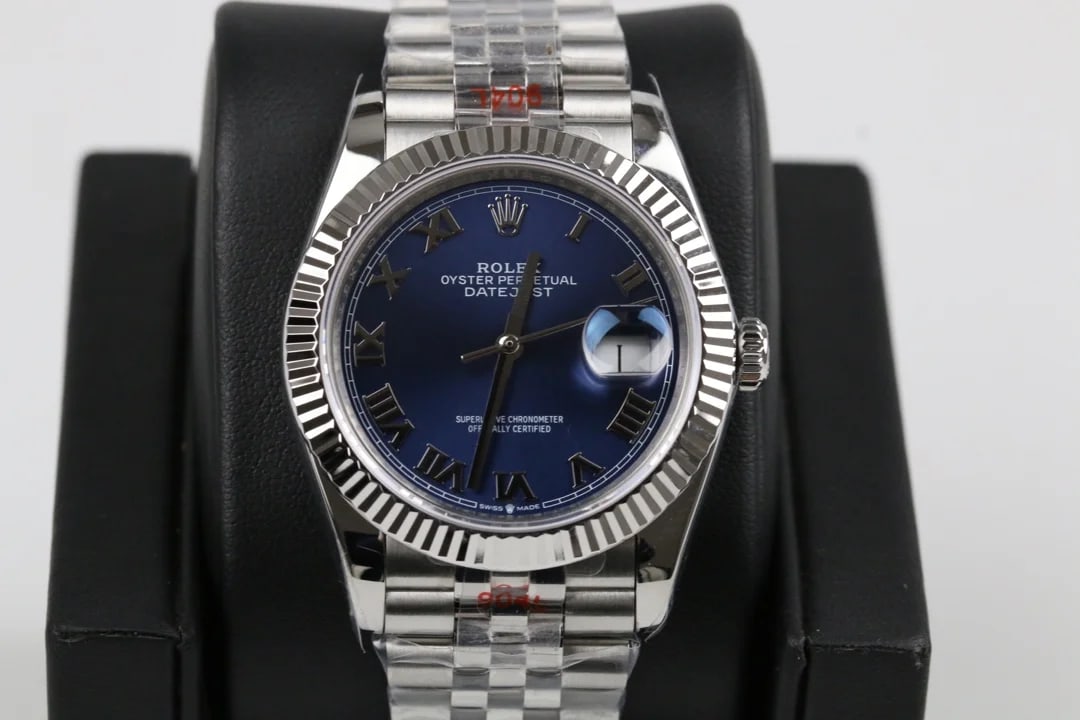
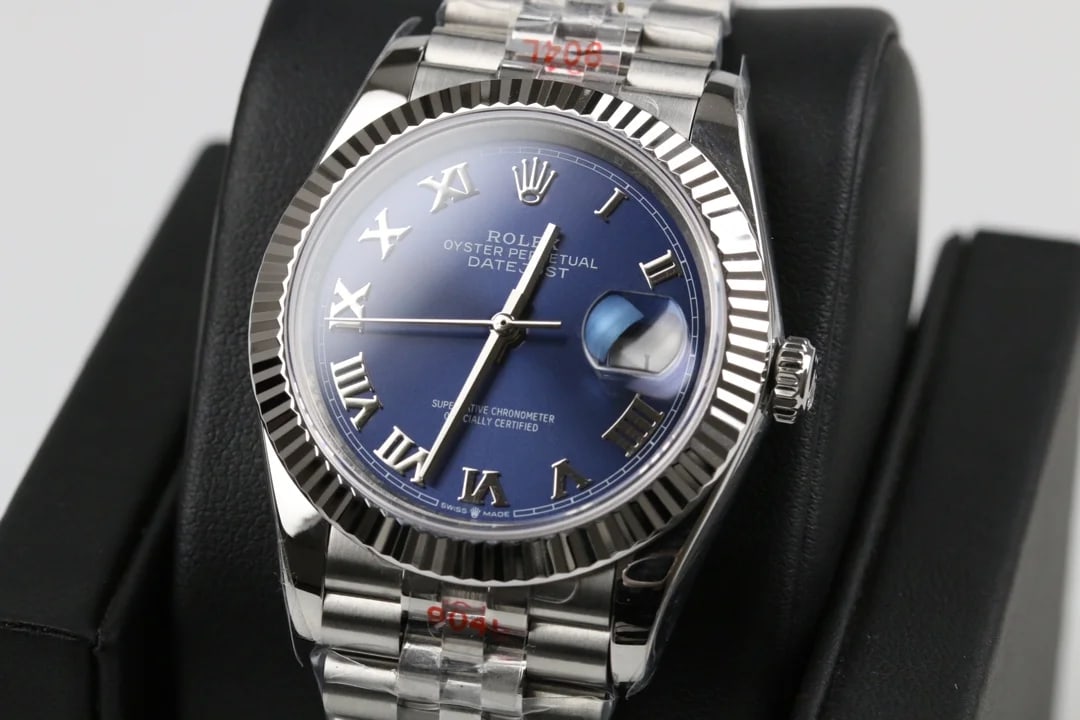
Rolex Datejust 36, blue Roman-numeral dial with a fluted bezel
Model reference: 116234-0141
Price by inquiryconfirmed in the chat, with shipping and lead time
Model size36 mm
DialBlue, with an outward-brushed finish
Hour-marker layoutApplied Roman numerals, with the coronet at 12 and the date at 3
Date display3 o’clock, under a magnifying lens
A 36 mm Datejust with a blue Roman-numeral dial, a fluted white-gold bezel, the date under its magnifier and a five-link bracelet with a concealed clasp.
Opens a WhatsApp chat with the model, the reference and this page already written into the message.
Nothing is sent until you press send. Prefer to write it yourself? Use the inquiry box further down.
About this watch
Design and details
Roman numerals change a dial before any colour does. Instead of a ring of separate points, the hour positions become applied shapes with individual widths, so the eye reads a continuous sequence around the face rather than a set of marks. On a 36 mm dial each numeral occupies a larger share of the ring, which is why the effect is stronger here than on a 41 mm reference.
The gallery moves from that straight-on view to the angled one, where the fluted bezel breaks the light into alternating ridges, and then to a close-up of the bezel and crown. This reference is the earlier generation of the 36 mm Datejust in this collection; the later one is a separate model, so the two pages are kept apart deliberately.
How do Roman numerals change the way the dial reads?
Each numeral is an applied piece with its own width: I is a narrow stroke while VIII is broad, so the ring alternates between tight and open in a fixed rhythm. That is the opposite of baton markers, which divide the dial evenly and leave the space between them consistent.
The sequence is also interrupted twice on this dial. The coronet sits where XII would be, and the date aperture takes the place of III, so the reading runs from the top mark clockwise to the window and then continues. That interruption is part of the design rather than a missing element, and it is the detail most worth checking straight on.
What is the fluted bezel made of, and how does it read?
On this reference the fluted bezel is in white gold while the case and the bracelet are steel. Visually the two metals sit in the same silver-tone family, so the bezel does not announce itself through colour; it announces itself through shape, because the fluting turns the case outline into a ring of alternating bright and dark ridges.
That is visible in the close-up frame, where the flutes occupy most of the image. When inspecting an individual watch, this is also where unevenness or polishing marks show up first, so it is worth asking for that view of the offered piece.
Fluted bezel three-quarter view with the Roman numerals reading around the blue dial and the five-link bracelet below the case
What does the blue dial do in different light?
The blue is a brushed surface that runs outward from the centre, so it lightens as the viewing angle moves away from the middle and darkens when the watch is held flat on. In the straight-on frame the colour is even; in the angled frame the outer part of the dial is noticeably lighter than the inner part.
Colour comparisons are safest between frames of the same watch, which is why this page shows two views of the same dial rather than one. Where an exact tone matters, ask for a daylight photograph of the dial on the specific watch.
How does the five-link bracelet hide its clasp?
Five narrow links run across the width, and the clasp folds into the bracelet so that no buckle is visible from the outside; the link pattern continues unbroken. That construction is why the bracelet in these frames looks like a continuous band rather than a strap with a fastening.
The practical consequence is that fit is adjusted by removing links instead of by a visible buckle, and that the clasp area is where wear shows first. Ask how many links are fitted, whether spares come with the watch, and how much adjustment remains.
How should 36 mm be judged next to the other Datejust sizes here?
Thirty-six millimetres sits between the 28 mm and 31 mm cases at the small end of this collection and the 41 mm case at the large end. On the wrist the difference is not only width: a smaller case makes the bezel and the dial ring proportionally larger relative to the whole watch.
Use the diameter together with the lug-to-lug length and the thickness, then compare with a watch you already wear. A five-link bracelet follows the curve of the wrist closely, so the case sits differently from the same size on a three-link bracelet.
What should be confirmed before choosing this generation?
The 36 mm Datejust exists in more than one generation, and this page covers the earlier 116234 reference. If the generation matters to you, compare the reference numbers directly: the later 36 mm model in this collection is a different reference with its own page, and the two should be discussed separately.
Beyond that, the checks are the usual ones for a steel watch with a gold bezel: what the bezel is made from and whether it is plated, the bracelet length as supplied, the condition of the crystal and the magnifier, and the measured weight and dimensions of the actual watch.
Specification
Specifications and configuration
Model details and design
Detail
Description
Model reference
116234-0141
Model size
36 mm
Dial
Blue, with an outward-brushed finish
Hour-marker layout
Applied Roman numerals, with the coronet at 12 and the date at 3
Date display
3 o’clock, under a magnifying lens
Bezel design
Fluted, warm-white metal tone in the photographs
Bracelet design
Five-link, silver-tone throughout in the photographs
Clasp
Concealed inside the bracelet, leaving the link pattern unbroken
Colour combination
Blue dial and silver-tone case and bracelet with a fluted bezel
Questions
Frequently asked about this reference
Does this dial show all twelve Roman numerals?
No. The coronet takes the place of XII and the date window takes the place of III, so the sequence is interrupted at the top and at three o’clock. Those two positions are what to check first in a straight-on photograph.
Is the whole watch white gold?
The fluted bezel is white gold on this reference while the case and bracelet are steel, and the two look close in colour. Ask the seller what the bezel on the offered watch is made from and whether anything is plated over the base metal.
How does this differ from the later 36 mm Datejust in the collection?
They are different references from different generations of the same 36 mm design, listed as separate models with their own pages. Compare them by reference number and by the frames on each page rather than treating one as an option on the other.
What should I look for in the bracelet photographs?
Ask for the bracelet held horizontally so the links hang free, which shows stretching and wear at the folds, and for a frame of the open clasp. On this type of bracelet the clasp is hidden when closed, so the open view is the only one that shows its condition.
How big is 36 mm compared with the 41 mm reference here?
It is five millimetres smaller in diameter and proportionally shorter lug to lug, so it covers less of the wrist and the bezel occupies more of the visible face. Compare the diameter, the lug-to-lug length and the thickness together.
What should the inquiry include?
The reference 116234-0141, your wrist measurement and destination country, what the bezel and case are made from, which movement is fitted, the bracelet length as supplied, and the measured weight and case thickness.
Inquiry message
The message below is pre-written with the model, the reference and this page. The button opens a WhatsApp draft for you to review before sending.
What the fluted bezel and any white-metal parts are actually made from, and the plating or wrap thickness if they are not solid.
Which movement is fitted, and whether the calibre marking is visible in a photograph.
Current price for one watch, the shipping cost to my country, the countries you ship to and the lead time.
Bracelet length as supplied for my wrist measurement, how many links are fitted, whether spares are included and how much adjustment remains.
Photographs of the actual watch: the dial straight on in daylight, the bezel and crown across the case, the bracelet held horizontally and the open clasp.