Opens a WhatsApp chat with the model, the reference and this page already written into the message.
Nothing is sent until you press send. Prefer to write it yourself? Use the inquiry box further down.
About this watch
Design and details
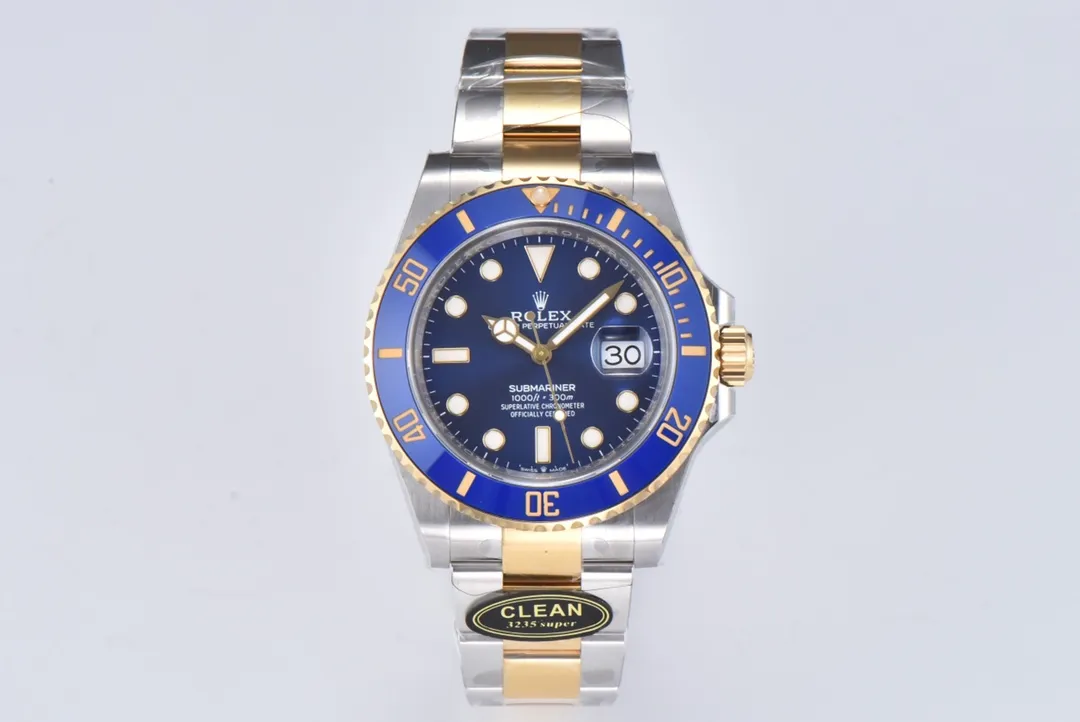
This is the two-tone Submariner Date in this collection: a dive design in which the colour does not stop at the bezel but continues down the bracelet. Reference 126613LB pairs a blue dial and a blue sixty-minute insert with a three-link bracelet whose centre links are gold-toned while the outer links and the case flanks stay silver-toned, and the date sits at three o’clock under a magnifying lens.
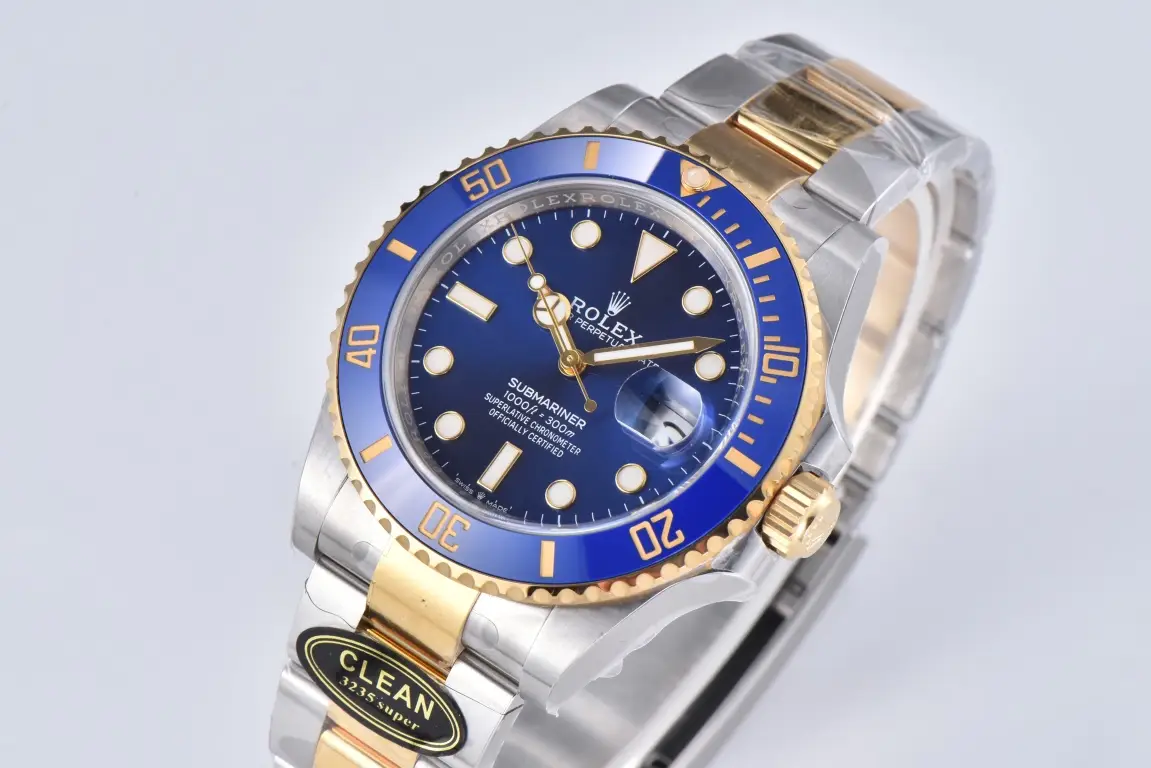
The gallery shows the whole watch from the front and from an angle, followed by a close view of the bracelet and clasp. Those frames establish the visible colour arrangement and scale layout. What the gold-toned surfaces are made from, how thick any plating or wrap is, and how the offered watch operates remain questions for the inquiry.
What two-tone changes on a bracelet
A three-link bracelet divides its width into three parts, and on a two-tone watch those parts stop being one surface. The two outer links stay silver-toned while the broad centre link carries the warmer colour, so a continuous strip of gold tone runs from the case down to the clasp, framed on both sides. That does two things at once. It repeats the colour arrangement of the watch head along the wrist instead of concentrating all of it above the dial, and it turns the centre of the bracelet into the brightest, most reflective band on the watch. In the gallery frames you can see the alternation directly: two narrow silver-toned edges, one wide gold-toned middle, repeated link after link.
What that arrangement does not tell you is what the colour is made of. A gold-toned surface in a photograph can be a solid coloured metal, a layer bonded over another metal, or a plated finish, and the three look identical in a still frame. The published configuration for this reference describes the case as a combination of Oystersteel and yellow gold; that describes the reference, not the watch being offered. On a two-tone watch the finish and thickness of the coloured layer is what decides how the piece ages, so it belongs at the top of the inquiry rather than at the end of it.
The blue insert and the sixty-minute scale
The bezel carries the same dive scale as the other references in this series: a triangle at the starting point, individual minute divisions through the first quarter and larger numerals at ten-minute steps around the rest of the ring. A blue insert over a blue dial gives the watch one continuous colour field from the centre outwards, interrupted only by the printed and applied elements — light graduations on the bezel, light markers on the dial — which is a very different visual arrangement from a coloured bezel sitting over a black dial. The colour boundary in this configuration is not between the dial and the bezel but between the watch head and the case flanks, where the warmer tone stops.
Two things are worth separating about the insert. The first is what the scale does: it counts elapsed minutes against the minute hand, and the bezel turns one way only, so an interval cannot be shortened by a knock. The second is how the colour behaves: blue reads differently in daylight and under a lamp, and the same insert can look brighter or deeper from one angle to the next. The photographs that settle it are the dial and the insert straight on in daylight, which is why those two frames are the first items requested for the offered watch rather than something to be judged from a product shot.
Two-tone bracelet close-up showing the gold-toned centre links running between the silver-toned outer links
The blue dial, its print and the date
The blue dial puts the strongest colour on the largest surface of the watch and leaves the markers and hands to sit light against it. The dial keeps the same vocabulary as every other dive reference in this collection: a triangle at twelve, rectangles at three, six and nine, round markers elsewhere, each with a light-filled centre inside a metal-tone surround, and a fine minute track running inside the ring. The date occupies three o’clock under a magnifying lens, the single break in the pattern.
The front and angled gallery frames show the layout and how the blue changes under the source lighting. They do not establish the colour or surface finish of another watch. Ask for a straight-on daylight photograph and an angled frame of the actual watch being offered, then compare the marker alignment, date position and insert colour against the same features shown here.
The clasp, the end links and how the bracelet is sized
The end links are where the colour story meets the case, and they are worth looking at closely because an imperfect fit shows up there first: a gap between the end link and the case flank, or a step where the centre link meets the case, is visible from the outside and cannot be corrected. In the gallery frames the centre section can be seen running into the clasp without the colour stopping at the edge of the bracelet. The clasp itself is the part of a bracelet that gets handled most, so its finish and the way the closure sits flush are the details to compare against a photograph of the same area on the offered watch.
Sizing questions are separate from appearance questions, and they are the ones that decide whether the bracelet is wearable for you. How many links can be removed, how much fine adjustment the clasp offers, whether spare links come with the watch and whether the clasp closes without play are all answers about an individual watch. Ask for a frame of the bracelet closed and flat, a close frame of the clasp shut, and those answers in the same message as your wrist measurement and destination country.
41 mm, the dive scale, and the decisive question about the gold tone
The model’s case diameter is 41 mm, and on this reference the case is where the two colours meet: the warmer tone runs around the bezel edge and down the centre of the bracelet while the case flanks and the outer links stay silver-toned. That interleaving is what the design is about, and it is also where the practical risk of a two-tone watch lives, because surfaces that are coloured rather than solid age differently from the metal around them. The colour can fade, wear through at the points of contact, or rub against a desk edge long before the silver-toned parts show anything at all.
So the questions that matter are not about colour but about construction: whether the gold-toned surfaces are solid, capped or plated, and if they are plated, how thick the plating or wrap is. A photograph cannot answer any of it — two watches built in completely different ways look the same in a still frame. That is why the material and thickness question sits first in the inquiry on this page, alongside the usual items: which version is available, the measured weight and dimensions, the bracelet supplied, and photographs of the actual watch in daylight.
Choosing between the all-silver-tone reference and this one
Three references in this collection are built on the same 41 mm dive design, and this is the one that changes the metal story rather than the display. Against the plain reference, the difference is colour and warmth along the whole bracelet. Against the green-insert reference, the difference is that the two-tone treatment carries past the bezel and onto the wrist. The case size, the sixty-minute scale, the marker layout, the hand shapes and the link pattern are shared, so the decision is entirely about how much colour you want on the watch and how you feel about a coloured surface that will be touched, knocked and polished over years of wear.
That combination has its own buyer-side nickname — “Bluesy” is the shorthand for a two-tone blue dial and blue insert — and it is worth remembering that the name is not a manufacturer term and not a reference number. Nicknames travel between generations and between configurations, so they are useful for finding the watch and unreliable for ordering it. Quote the reference, say “two-tone with the blue dial and insert”, and include the plating or wrap question in the same message so the answer arrives with the price rather than after it.
Specification
Specifications and configuration
Model details and design
Detail
Description
Model reference
126613LB-0002
Model size
41 mm
Dial
Blue (the published configuration for this reference is royal blue)
Date display
3 o’clock, with magnifier
Bezel design
Blue insert, sixty-minute scale
Bezel markings (reference design)
The manufacturer describes this reference’s numerals and graduations as coated in gold; the insert on an offered watch is confirmed in the inquiry
Two-tone arrangement in the gallery
Gold-toned centre links between silver-toned outer links; warmer tone around the bezel edge
Coloured-surface question
What the gold-toned surfaces are made from, and the plating or wrap thickness if they are not solid, is confirmed in the inquiry
Bezel graduations
Individual marks in the first 15 minutes; ten-minute numerals for the rest
Hour-marker layout
Triangle at 12; batons at 3, 6 and 9; round markers elsewhere
Bracelet design
Three-link, two-tone
Crown position
3 o’clock, between protective shoulders
Colour combination
Blue dial and insert with silver-toned and gold-toned surfaces
Questions
Frequently asked about this reference
Is the gold tone solid gold?
That cannot be seen in a photograph. The colour of a surface does not describe what is underneath it, and solid, capped and plated surfaces look the same in a still frame. The manufacturer describes this reference as a combination of Oystersteel and yellow gold; what the offered watch is made from, and the plating or wrap thickness if it is plated, is asked about directly.
What should I check in the gallery photographs?
Use the front and angled frames to compare the blue dial, bezel scale, marker layout and two-tone colour arrangement. Then request the same views of the actual watch being offered, taken straight on and in daylight.
Is “Bluesy” a model name?
No. It is buyer-side shorthand for a two-tone watch with a blue dial and a blue insert, not a manufacturer term and not a reference number. The nickname does not identify a generation or a bracelet, so quote the reference as well.
How is the blue insert read, and does it turn both ways?
The scale counts elapsed minutes against the minute hand, with the triangle set at the starting point. The reference design describes the bezel as unidirectional like the other dive references, so a knock cannot shorten an interval. How the bezel of the offered watch turns is demonstrated rather than assumed.
Will a two-tone bracelet wear differently from an all-silver-tone one?
Surfaces that are coloured rather than solid can behave differently at the points that rub and rest on a desk, which is why the finish and thickness questions come first here. How any particular watch ages depends on how it was made and how it is worn, and neither can be established from a photograph.
What should I include in an inquiry?
The reference, the words “two-tone, blue dial and blue insert”, the material and plating or wrap question, your wrist measurement, your destination country, and a request for photographs of the actual watch — dial straight on in daylight, insert straight on, bracelet closed, clasp and case back.
Inquiry message
The message below is pre-written with the model, the reference and this page. The button opens a WhatsApp draft for you to review before sending.
Which version is available to you, and what it is fitted with.
What the gold-toned surfaces of the offered watch are made from — solid, capped or plated — and, if they are plated, the plating or wrap thickness.
Current price for one watch, the shipping cost to my country, the countries you ship to and the lead time.
Bracelet and clasp variant supplied, how many links can be removed, what adjustment the clasp offers and whether spare links are included.
Measured weight in grams, plus the lug-to-lug length and case thickness.
Photographs of the actual watch: the dial straight on in daylight, the insert straight on, the bracelet closed, the clasp and the case back.