Opens a WhatsApp chat with the model, the reference and this page already written into the message.
Nothing is sent until you press send. Prefer to write it yourself? Use the inquiry box further down.
About this watch
Design and details
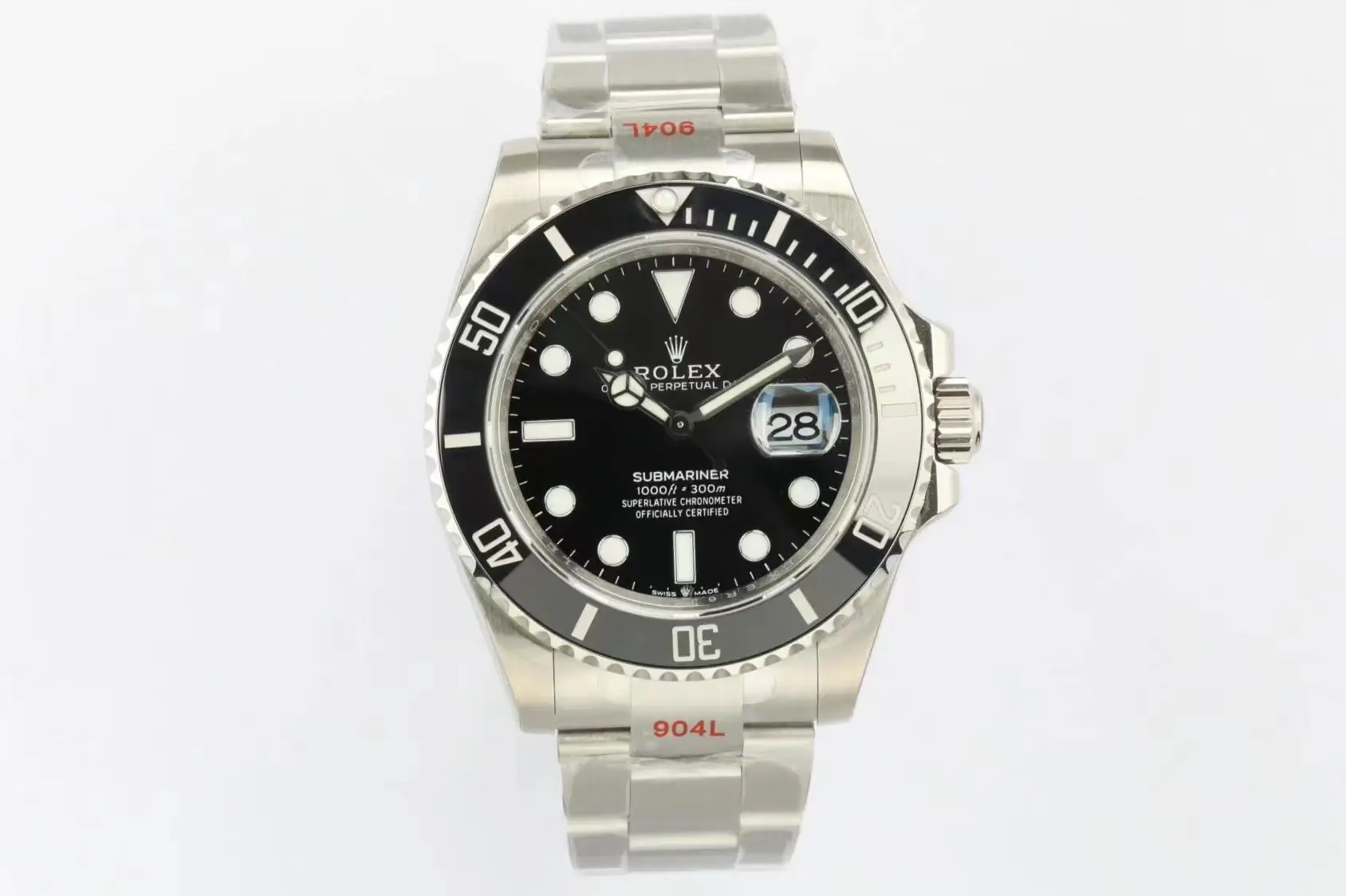
The Submariner Date is the dive-watch design with one addition to the dial: a date aperture at three o’clock, magnified by a lens set into the crystal. Reference 126610LN pairs that display with a black dial, a black sixty-minute bezel and a three-link bracelet, so the whole watch reads black and silver-tone and nothing else competes for attention.
Everything on this page describes the named model reference and what the photographs in the gallery show. Which version of the watch is offered — what is fitted inside it, which bracelet it arrives on, how it has been tested — is confirmed in the conversation, and the questions worth asking are listed with the inquiry further down the page.
The date aperture, and what it changes at three o’clock
On the no-date Submariner the hour markers run around the dial without interruption, and three o’clock carries a rectangular marker of its own. This reference replaces that marker with a date aperture, so the right-hand side of the dial becomes a window rather than a fixed shape. The rest of the marker ring is unchanged: a triangle at twelve, rectangles at six and nine, round markers in the remaining positions.
One position is enough to change how the dial is read. A date window is a second piece of information, and it sits where the eye arrives when it checks the right-hand side of the watch. Buyers who want one continuous ring of markers stay with the no-date version; buyers who want the calendar on the dial choose this one. The case, the bezel scale and the bracelet design are common to both, which is why this single detail usually decides the question — the guide linked below works through it in full.
The magnifier, and the balance it shifts
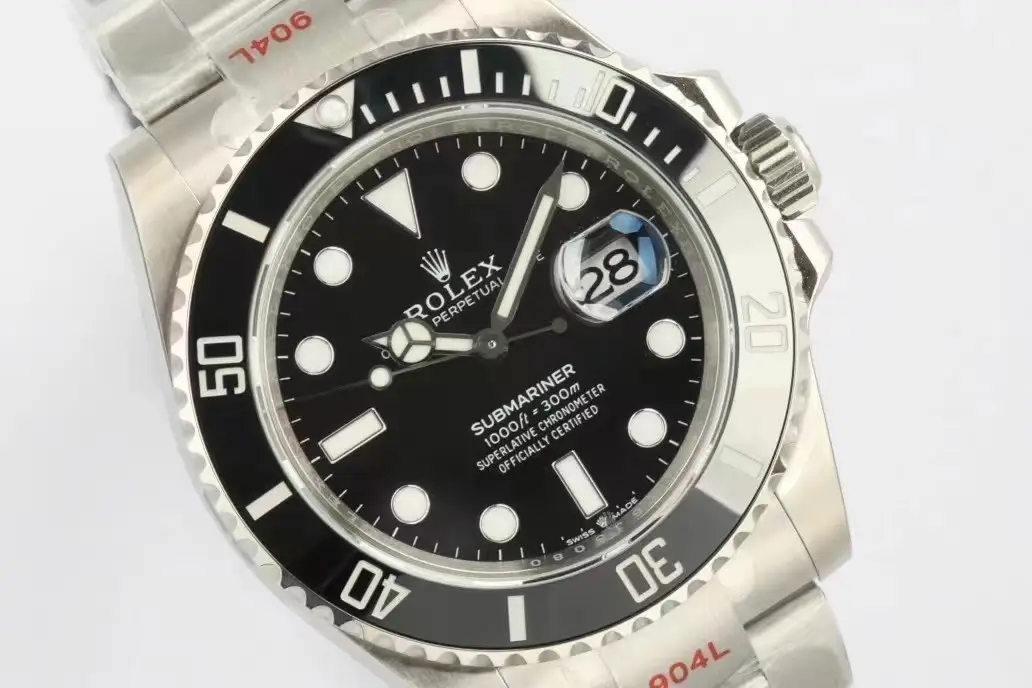
The crystal on this reference carries a raised magnifying lens over the date window. It is a three-dimensional element rather than a printed detail: seen straight on it enlarges the numeral inside the aperture, and seen from an angle it stands proud of the crystal surface and throws an extra bright edge onto the right-hand side of the dial. A straight-on photograph is the only frame in which the numeral’s position inside the aperture can honestly be judged; an oblique frame exaggerates the lens instead.
Because the lens draws the eye, the dial’s visual weight tilts slightly towards three o’clock. The applied marker surrounds and the polished hands answer that with reflections of their own, but the result is a different balance from the no-date dial, where the marker ring reads evenly the whole way round.
Submariner Date dial, bezel and date magnifier close-up
Marker geometry and the shape of the hands
The hour hand carries a broad, segmented tip; the minute hand is longer and narrower; a slim central seconds hand sweeps over both. The shapes are not decoration. When the hour and minute hands sit close together, a segmented tip and a plain baton stay distinguishable, which is what you need at reading distance. The same logic runs through the markers, where the triangle, the rectangles and the circles are three separate forms rather than one repeated shape.
A fine minute track runs around the dial’s edge, inside the printed ring, and each marker sits in a metal-tone surround around a light-filled centre. On a black dial that combination is the whole contrast strategy: light areas on a dark ground, each one edged with a thin reflective outline so the marker reads as a raised element rather than a flat dot.
Reading the sixty-minute bezel
The bezel carries a triangle at its starting point and a scale that runs through a full sixty minutes. The first fifteen minutes are divided individually, because short intervals are the ones worth reading precisely, and the rest of the scale thins out to large numerals at ten-minute steps. The outer edge is scalloped, which gives the fingers a surface intended for grip when the bezel is turned.
Read as an elapsed-time scale, the triangle is lined up with the minute hand and the gap that opens between hand and triangle is the interval that has passed: a quarter turn past the marker is a quarter of an hour. It counts minutes; it does not convert them into a rate. The bezel turns one way only, so a knock against a door frame cannot make an interval look shorter than it was — which is the reason the design is built that way.
The 41 mm case and the proportions that go with it
The model’s case diameter is 41 mm. On a dive-watch design that figure describes the case body, and the visible size also comes from the broad bezel around it, which narrows the dial opening relative to the case. The crown sits on the right-hand side between shaped shoulders, and the pictured bracelet meets the case through fitted end links without a visible gap.
For fit, diameter is only the first number. Lug-to-lug length decides how far the case reaches across the wrist, case thickness decides how high it sits under a cuff, and the articulation of the first links decides how the bracelet falls away from the case. Those are the measurements to ask for if you want to compare two watches seriously, and they describe an individual watch rather than the model.
Choosing inside the Submariner series
There are two obvious directions inside this series. The reference on this page adds a calendar and a magnifier; the no-date reference already in the collection keeps an unbroken marker ring. Same case, same bezel scale, same bracelet design, one visible difference — which is why the choice is usually settled by how you want the dial to read rather than by any other specification.
If what you want is a different bezel colour or a two-tone case, that is a different reference number, and it is worth naming the combination you have in mind in a single message alongside the reference, so the reply covers the configuration you actually want instead of a general answer. The collection currently shows a small number of configurations, and the message is where a specific one is pinned down.
Specification
Specifications and configuration
Model details and design
Detail
Description
Model reference
126610LN-0001
Model size
41 mm
Dial
Black
Date display
3 o’clock, with magnifier
Bezel design
Black, 60-minute scale
Bezel graduations
Individual marks in the first 15 minutes; ten-minute numerals for the rest
Bezel starting marker
Triangle at zero
Hour-marker layout
Triangle at 12; batons at 3, 6 and 9; round markers elsewhere
Hand arrangement
Central hour, minute and seconds hands
Minute scale
Fine track around the dial perimeter
Bracelet design
Three-link, silver-tone
Crown position
3 o’clock, between protective shoulders
Colour combination
Black and silver-tone
Questions
Frequently asked about this reference
What does the date version change compared with the no-date Submariner?
One position on the dial. Three o’clock carries a date aperture under a magnifying lens instead of a rectangular hour marker. The case, the bezel scale and the bracelet design are the same on both references.
How are the numbers on the bezel read?
They are minute graduations. Line the triangle up with the minute hand before timing starts; the distance the hand has travelled away from the triangle is the number of minutes that have passed.
Why are the first fifteen minutes divided more finely?
Because an individual-minute division is what you want at the start of an interval, when a small error matters most. Further round the scale the marks thin out so the bezel can still be read at a glance.
Is 41 mm enough to know whether it will fit?
No. Diameter says nothing about lug-to-lug length, case thickness or how the first links articulate, and those decide how a watch sits on a wrist. Ask for the measured dimensions you want to compare.
Does the writing on the dial tell me what the watch I would receive is rated for?
No. The dial describes the model. The rating and the condition of an individual watch are separate facts; if they matter to you they belong in the inquiry, together with whether any test has been carried out on that watch.
How is the bracelet sized, and can I ask about it?
Ask for photographs of the bracelet closed, a close frame of the clasp, how many links can be removed and what adjustment the clasp offers. Those answers describe the individual watch rather than the model.
Inquiry message
The message below is pre-written with the model, the reference and this page. The button opens a WhatsApp draft for you to review before sending.
Which version is available to you, and what it is fitted with.
Current price for one watch, and the shipping cost to my country.
Which countries you ship to, and the lead time.
Bracelet and clasp variant supplied, how many links can be removed, and what adjustment the clasp offers.
Measured weight in grams, plus the lug-to-lug length and case thickness.
Photographs of the actual watch being offered: dial straight on, bracelet closed, the clasp and the case back.