Opens a WhatsApp chat with the model, the reference and this page already written into the message.
Nothing is sent until you press send. Prefer to write it yourself? Use the inquiry box further down.
About this watch
Design and details
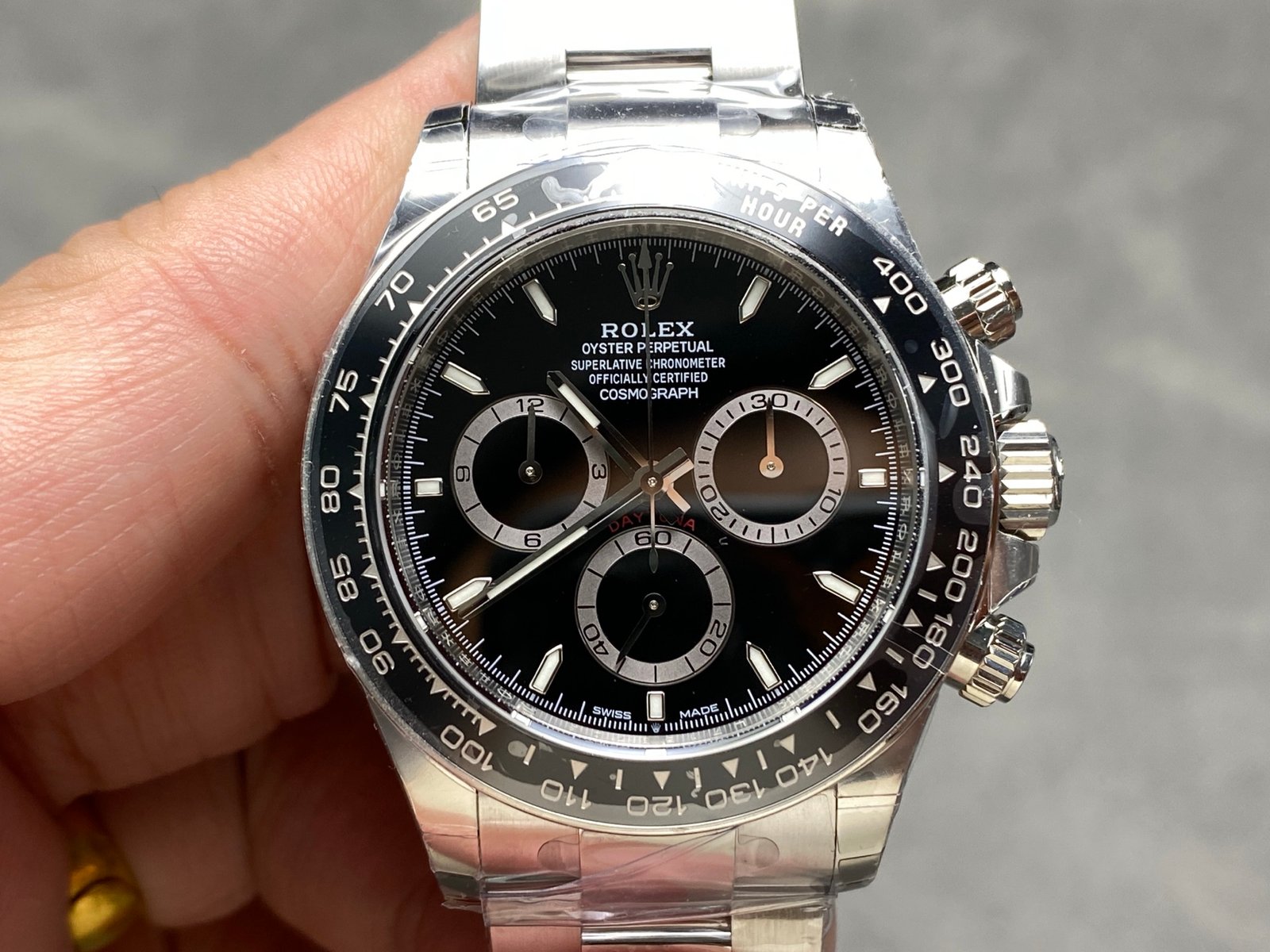
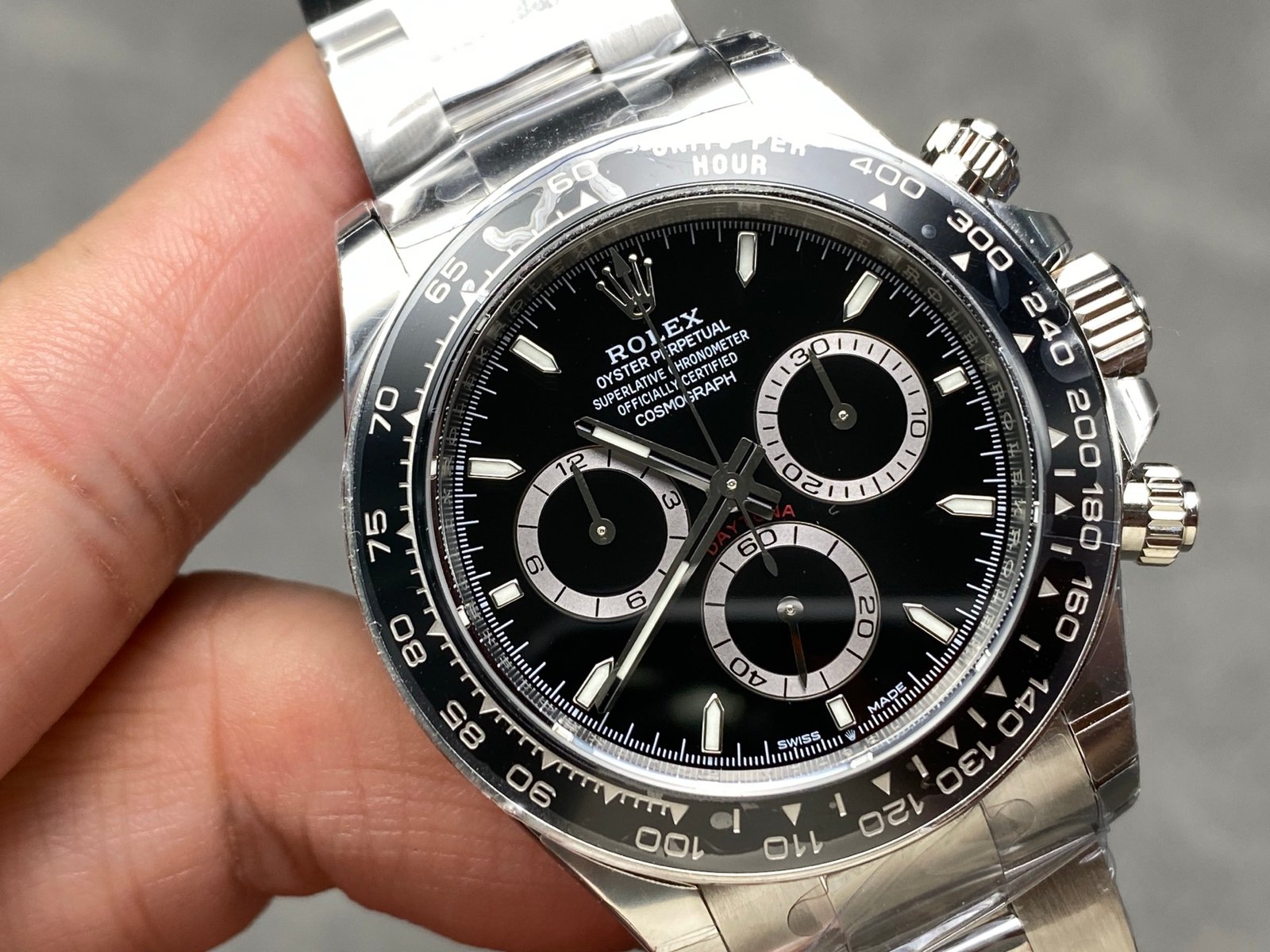
The Cosmograph Daytona is the chronograph design: three smaller dials set into the main dial, two pushers beside the crown, and a scale printed around a fixed bezel. This reference is the dark-dial silver-tone version, with counters ringed in a light tone against a black ground and a black ceramic-style bezel carrying the tachymeter scale.
What follows describes the named reference and the design it uses. How a supplied watch’s chronograph actually behaves — starting, stopping, returning to zero — is shown on the specific watch, and a video of it belongs with the answers before anything is agreed.
A black dial read through three light rings
The order of contrast on this dial is unusual. The ground is the darkest element, the three counter rings are the lightest, and the printed scales sit between the two. That means the eye is guided by three bright circles rather than by a bright field, so at arm’s length the counters are the first thing you can locate and the last thing you lose when the light drops. On the white-dial version of this reference the arrangement is inverted: there the dial is the light area and the counters are outlined in a darker tone, which is why the two versions read as different watches rather than as two colours of the same one.
Around the counters, applied markers and broad hands carry the everyday reading, and a fine minute track runs the outer edge. The dial carries no date, so nothing interrupts the three-register layout on the right-hand side.
Where the counters sit and what each one counts
Three counters, in three positions: one at three o’clock, one at nine and one at six. They do not carry the same scale. The counter at three is graduated to thirty, the one at nine to twelve, and the one at six to sixty, which correspond to elapsed minutes, elapsed hours and running seconds. The long central hand belongs to the chronograph rather than to everyday timekeeping.
That division of labour is the point of the layout: two of the three counters accumulate an interval, and the third simply runs. Reading them means knowing which is which before you start, because the numbers themselves do not announce it. Counting the counters, or assuming they all measure the same thing, is the most common misreading of this dial; the scales printed inside each ring are what identify them.
Cosmograph Daytona black dial close-up showing the three counters and the printed tachymeter scale
The tachymeter scale as printed
The bezel is fixed and its scale converts elapsed time into a rate. The arithmetic is a division: 3,600 divided by the elapsed seconds gives the units per hour, so an interval of thirty seconds corresponds to 120, forty-five seconds to 80 and sixty seconds to 60. Because that is a division rather than a fixed step, the values crowd together at the head of the scale and spread out further round — the printed spacing is the calculation, visible.
The scale works for any unit you choose, provided the interval measured is one of that unit: one kilometre gives kilometres per hour, one mile gives miles per hour. Reading a rate from the bezel is a separate matter from the accuracy of the timing that produced it, and accuracy on a particular watch is established by the watch, not by the bezel print.
Crown, pushers and the case silhouette
Two pushers stand above and below the crown on the right-hand side, so this is the only design in the collection whose case flank is not symmetrical. That grouping is the first thing the eye registers in a side-on photograph: three elements in a vertical line, each with a different diameter and finish, breaking the line of the case. The model’s case diameter is 40 mm, and because the pushers are part of the visible width but not of that figure, the watch looks wider than its case size suggests.
For fit, the useful dimensions remain the ones a photograph cannot fake: lug-to-lug length across the wrist, case thickness under a cuff, and how the first links angle away from the case. A straight-on frame is the right one for judging the case and dial alignment; a three-quarter frame is the right one for seeing how the pushers sit against the flank.
Colour discipline: black, silver tone and one accent
The bezel is black, the dial is black, the bracelet is silver-tone, and the counter rings and marker surrounds provide the only light areas that are not print. The result is a watch with a busy dial and a restrained palette — the opposite of a design that uses colour to separate its functions. Where the existing white-dial page in this collection explains the register layout and the rate scale, this page is about what changes when the dial is dark: the counters move to the front, the bezel edge blends with the dial, and the whole watch reads smaller and flatter in a photograph than it does on the wrist.
The colour strategy is worth checking in two kinds of frame. A straight-on daylight frame shows how the counter rings separate from the ground; an oblique frame shows how the bezel meets the case and how much of the dial a reflection can obscure at that angle. Neither frame tells you how the watch will look under your own kitchen light — ask for daylight frames rather than studio ones for that reason.
What the design states, and what the supplied watch has to demonstrate
The design tells you the layout: which counter sits where, what each scale counts, how the bezel’s rate scale is arranged, and where the controls are on the case. It cannot tell you anything about the individual watch — whether the pushers feel the way they should, whether the central chronograph hand returns cleanly to zero, or whether the counters advance as marked.
Those are questions for the watch being offered, answered by a short handheld video showing the chronograph starting, stopping and resetting, plus the counters returning to their start positions. It is a small request to make and the most useful single piece of evidence about a chronograph before payment. The dial photographs establish what the watch is meant to be; the video establishes what that particular one does.
Specification
Specifications and configuration
Model details and design
Detail
Description
Model reference
126500LN-0002
Model size
40 mm
Dial
Black, with light-toned counter rings
Date display
No date
Subdial layout
3, 6 and 9 o’clock
Subdial markings
30-unit scale at 3; 60-unit scale at 6; 12-unit scale at 9
Bezel design
Black ceramic-style bezel, printed tachymeter scale
Bezel inscription
Units per hour
Control layout
Crown between two chronograph pushers
Bracelet design
Three-link, silver-tone
Outer dial scale
Minute track
Hour markers
Applied baton markers
Colour accents
Black, silver-tone and white print; one red lettering accent on the dial
Questions
Frequently asked about this reference
How does the black-dial version differ from the white-dial reference already in the collection?
The dial ground and the counter treatment are inverted. Here the ground is dark and the counter rings are light; on the white-dial reference the ground is light and the counter rings read as dark outlines. Case, layout, scales and controls are the same.
Which counter does what?
The counter at three is graduated to thirty and counts elapsed minutes, the one at nine is graduated to twelve and counts elapsed hours, and the one at six is graduated to sixty and runs as small seconds. The long central hand is the chronograph hand.
Is the tachymeter scale limited to kilometres per hour?
No. It gives units per hour from the seconds taken for one known unit, so it works for miles as readily as kilometres, provided the distance measured is one of those units.
Does the 40 mm figure include the pushers?
No. Case diameter describes the case body, so the crown and the two pushers add visible width beyond it. That is part of why a chronograph looks larger than a time-only watch of the same diameter.
Why is the bezel fixed rather than rotating?
Because the scale it carries is a printed rate table rather than an adjustable timing scale. The rate is read from the position of a hand against the print, so nothing needs to move.
Can I see the chronograph working before I decide?
Ask for a short video of the chronograph starting, stopping and resetting, with the counters returning to their starting positions. It is the one piece of evidence a still photograph cannot provide.
Inquiry message
The message below is pre-written with the model, the reference and this page. The button opens a WhatsApp draft for you to review before sending.
Which version is available to you, and what it is fitted with.
Current price for one watch, and the shipping cost to my country.
Which countries you ship to, and the lead time.
Whether the chronograph starts, stops and resets correctly, and whether the counters return to zero, in a short video.
Measured weight in grams, plus the case thickness and the lug-to-lug length.
Photographs of the actual watch: dial straight on in daylight, the pushers, the bracelet closed and the case back.