Opens a WhatsApp chat with the model, the reference and this page already written into the message.
Nothing is sent until you press send. Prefer to write it yourself? Use the inquiry box further down.
About this watch
Design and details
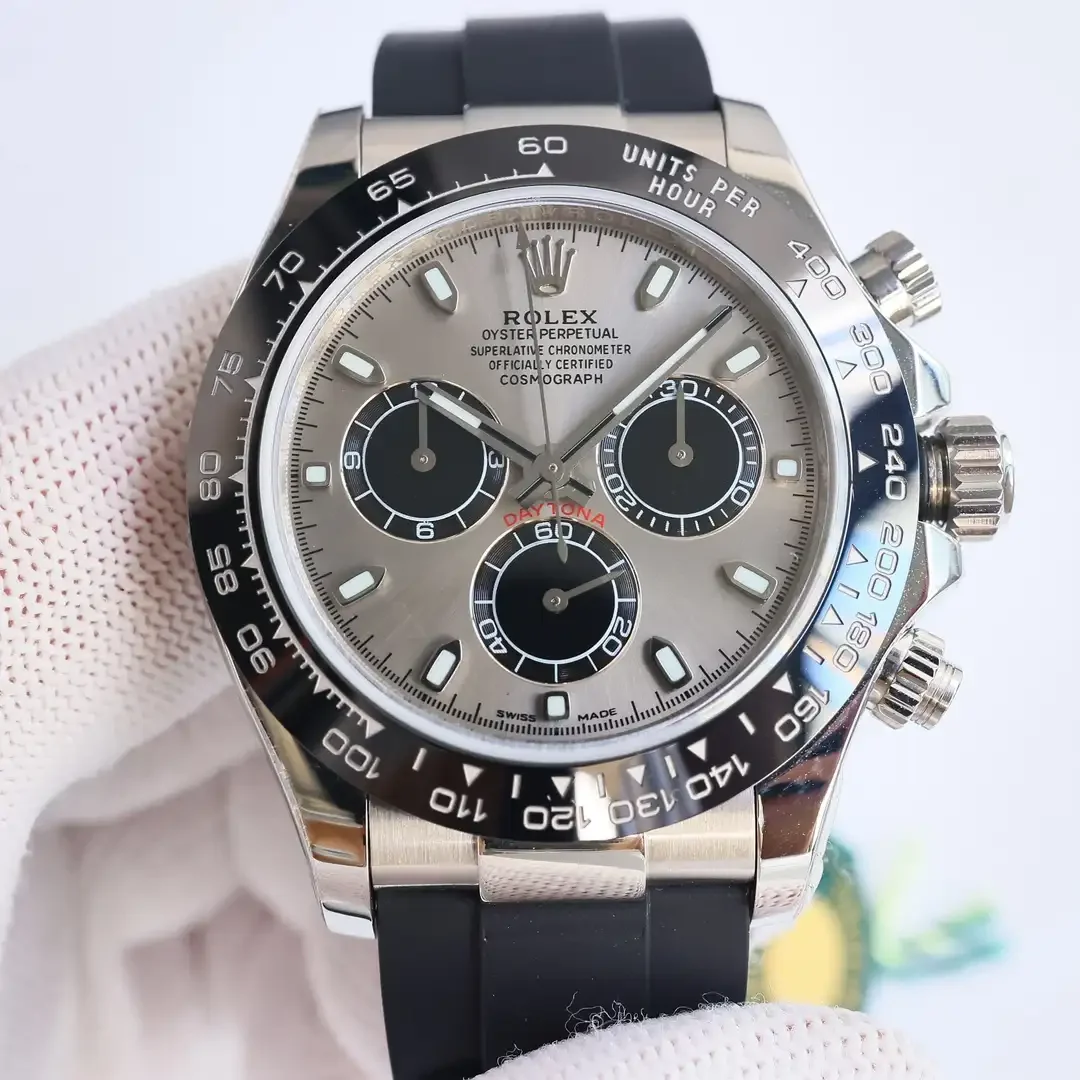
The dial is the reason this configuration exists: a meteorite surface whose pattern is the crystal structure of the material, crossed by three counters with dark rings and a set of applied markers with dark surrounds.
Around it sit the parts that make a Daytona recognisable — a fixed black bezel carrying a tachymeter scale, a crown between two pushers, and a strap that is rubber on the outside and metal underneath. The photographs in the gallery move from the dial straight on, to the case flank with its pushers, to the clasp folded under the strap, so each structural part can be seen in the order it would be checked.
What exactly is a meteorite dial, and what does it look like here?
A meteorite dial is cut from meteoritic material, so the pattern comes from the metal’s internal crystal structure rather than from a print or a brushing pattern. That is why no two of them look alike: the surface is a texture, not a colour.
In these frames the surface reads silver-grey with darker, irregular areas, and the three counters stand out because their rings are dark against it. Because the texture is fine and low-contrast, it photographs best in even light; a hard reflection can flatten it out, which is worth knowing when you compare photographs of two different watches.
How do the three counters and the tachymeter bezel work together?
The dial carries three counters, arranged at three, six and nine o’clock, plus a long central chronograph hand. One counter accumulates elapsed minutes, one accumulates elapsed hours, and the lower one runs continuously as the seconds display — the marker layout and the printed scales tell you which is which, while the fitted movement determines how they behave.
The black bezel is marked “Units per hour” and carries a tachymeter scale, an uneven rate table. It converts the time taken for one known unit of distance into an average speed: sixty seconds for one unit corresponds to sixty units per hour, thirty seconds to 120, and so on. Reading the table is independent of whether the timing mechanism itself is accurate.
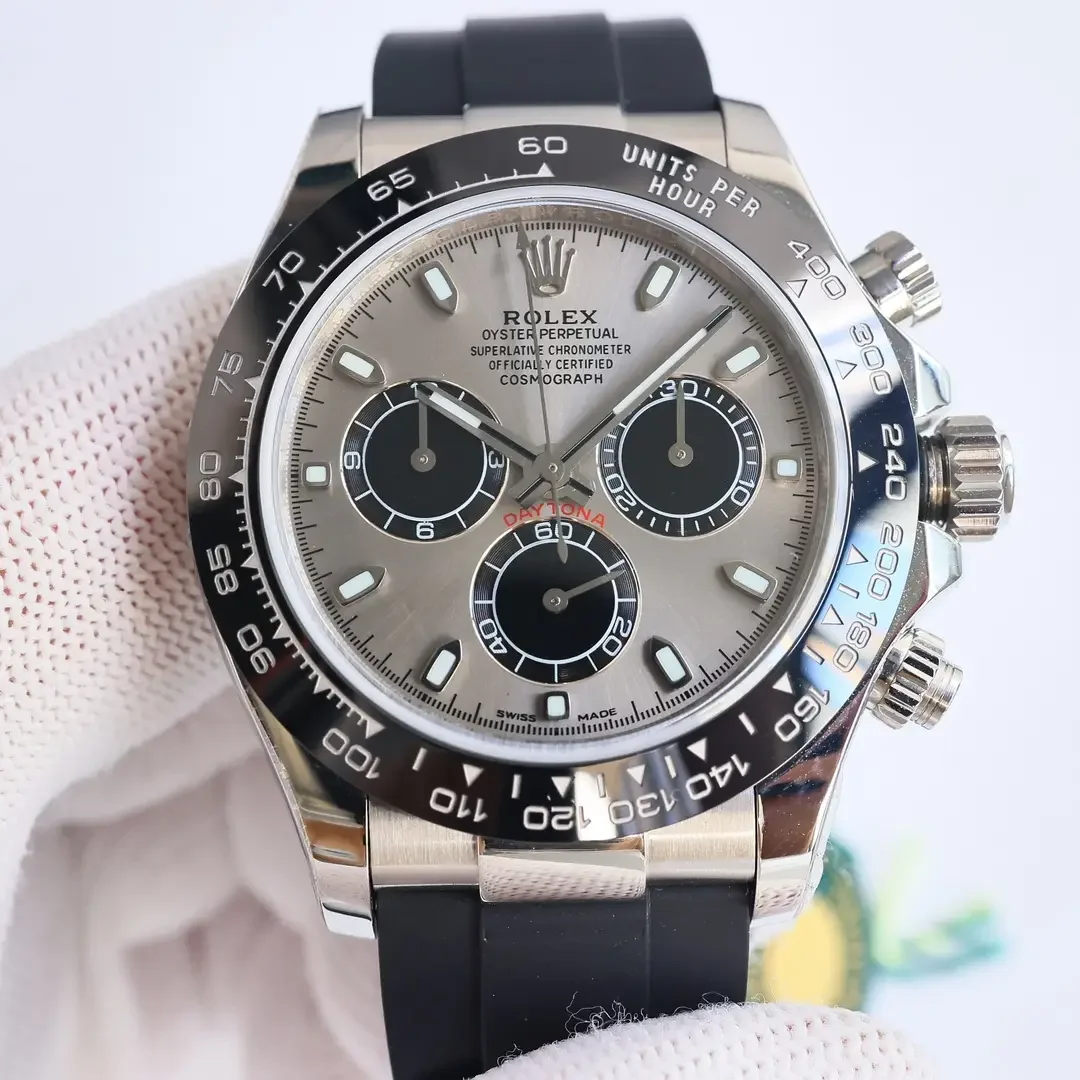
Meteorite dial straight on with the tachymeter scale on the bezel above it, the three dark-ringed counters and the applied markers in view
Why is the strap described as rubber over metal?
This reference is supplied on a strap built from two curved metal blades, one in each section, moulded over with black elastomer. The result looks like a rubber strap but bends and holds its shape like a bracelet, and it is fitted with cushions on the inside to keep it from rolling on the wrist.
In the photographs the outside is matte black while the clasp and its blade are polished metal, which is the quickest way to identify the construction. Strap sizing is a genuine question here: the length is adjusted through the clasp, so ask which sections are fitted and how much adjustment is left.
What does white gold look like in a photograph?
The case and clasp in these frames read as a cool silver-tone rather than a warm yellow or pink. White gold is a gold alloy, so it photographs slightly warmer than steel does in daylight — a difference that shows up most clearly where a polished surface meets the black bezel and the dark strap.
The photographs show the finish of the surfaces, not a material certificate. If the metal composition of the offered watch matters to you, ask what the case is made from and what, if anything, is plated over it, and ask for that answer in writing.
How does the 40 mm case sit with pushers on the right-hand side?
A 40 mm case diameter describes the round case body. On this watch the crown and the two chronograph pushers extend the silhouette on the right, so the case looks wider than its nominal measurement from some angles — most obviously in the three-quarter frame, where all three controls sit in a vertical line.
For wrist fit, add case thickness and lug-to-lug length to the diameter, then consider that the strap leaves the case differently from a link bracelet. Those measurements should be requested for the individual watch rather than assumed from the reference number.
What is worth checking before an inquiry?
Four things decide most of these conversations. First, whether the meteorite pattern visible in the photographs is the one on the watch you would receive. Second, how the counters start, stop and reset. Third, the strap length as fitted and what adjustment remains. Fourth, the case and crystal condition, which a straight-on frame hides.
Ask for a short video of the chronograph running and of the reset, plus a flat-on dial photograph in daylight. That combination answers more than any number of angled shots, and it keeps the discussion anchored to the actual watch rather than to the reference name.
Specification
Specifications and configuration
Model details and design
Detail
Description
Model reference
116519LN-0027
Model size
40 mm
Dial
Meteorite, with dark-ringed counters
Subdial layout
Counters at 3, 6 and 9 o’clock, plus a central chronograph hand
Date display
No date
Hour-marker layout
Applied markers with dark surrounds; small minute divisions between them
Bezel design
Fixed black bezel with a tachymeter scale
Bezel inscription
“Units per hour” above the upper scale
Control layout
Crown between two pushers on the right-hand side
Strap design
Black strap over curved metal blades, with cushions on the inside
Clasp
Folding safety clasp with a length-adjustment extension
Colour combination
Meteorite dial and black bezel in a cool silver-tone case, on a black strap
Questions
Frequently asked about this reference
Is the meteorite pattern different on every watch?
Material cut from meteorite shows a structure that varies across the blank, so the pattern on one dial will not repeat exactly on another. Ask for a straight-on photograph of the dial in even light so you can see the pattern on the watch being offered.
Do all three counters measure the same thing?
No. One counter accumulates elapsed minutes, one accumulates elapsed hours, and the lower counter runs as the seconds display. Their printed scales identify the intended layout; the fitted movement decides how each one behaves.
Is a tachymeter limited to kilometres?
No. It works with any single known unit: one mile in thirty seconds gives 120 units per hour, exactly as one kilometre in thirty seconds does. The scale only needs one confirmed distance or quantity.
How do I understand the strap length before buying?
Length is set through the clasp on this type of strap, so the useful questions are which sections are fitted, what adjustment range remains and your wrist measurement. Those three answers, not a generic strap size, decide the fit.
How is this meteorite Daytona different from the Everose one in the collection?
The case colour and the way the dial contrasts with the bezel are the visible differences: this configuration pairs a cool silver-tone case with a black bezel and black strap, while the Everose version photographs distinctly warm. The counter and bezel layout is the same idea on both.
What should the inquiry include?
The reference 116519LN-0027, your country and wrist measurement, and the questions only the individual watch can answer: which movement is fitted, what the case and clasp are made from, the measured weight and dimensions, and a video of the chronograph starting, stopping and resetting.
Inquiry message
The message below is pre-written with the model, the reference and this page. The button opens a WhatsApp draft for you to review before sending.
Which version is available to you, and which movement is fitted to the movement-dependent functions on this chronograph.
The material used on the case and clasp of the offered watch, and whether any plating or wrap is applied on top.
Current price for one watch, the shipping cost to my country, the countries you ship to and the lead time.
Which strap sections are fitted, what bracelet length that gives on my wrist, and how much adjustment remains in the clasp.
Photographs of the actual watch: the dial straight on in daylight, the bezel straight on, the case flank with the pushers, and the case back.
A short video of the chronograph running and resetting, plus the measured weight and case thickness.